

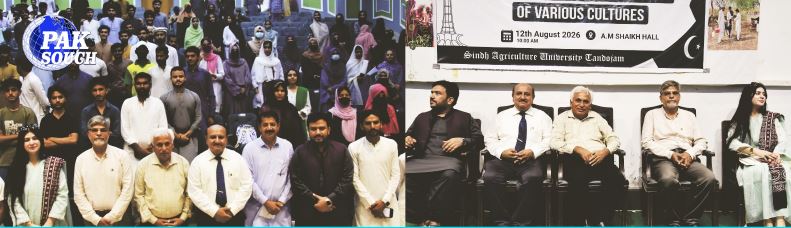
TANDOJAM (Report: Mehboob Hussain Bozdar): A colourful cultural event titled “Cultural Diversity and Exhibition of Different Cultures” was organized at the Sindh Agriculture University Tandojam as part of celebrations marking Pakistan’s 79th Independence Day.
The event was held at the Dr. A.M. Sheikh Auditorium Hall, where the cultures, traditions, traditional attire, languages, music, lifestyles and agricultural heritage of different provinces and regions of Pakistan were showcased.
The chief guest, Dean Faculty of Crop Production Dr. Inayatullah Rajpar, said that the ancient civilization and culture of Sindh associated with the Indus River represented a historical heritage spanning thousands of years.
He said the diverse cultures of Pakistan’s provinces and regions collectively formed a beautiful bouquet representing the country’s national culture.
Dr. Rajpar described Pakistan’s cultural diversity as a symbol of the country’s national strength, tolerance and mutual respect. He noted that there were also deep similarities in the agricultural cultures of different regions because Pakistan’s economy, civilization and rural way of life were closely connected with agriculture.
He said the people of Sindh had a particularly strong attachment to their agricultural culture. This affection, he added, could even be seen in the tradition of naming children after flowers, fruits, trees and beautiful birds.
Dr. Rajpar emphasized the need to preserve the country’s cultural heritage while introducing younger generations to its historical and cultural significance.
Dean Faculty of Crop Protection Dr. Abdul Mubeen Lodhi said Pakistan’s fine arts, literature, poetry, music, dance and traditional clothing reflected the country’s rich history and strong cultural foundations.
He said culture was the identity of every nation, making it essential to connect young people with their cultural heritage.
Speaking on the occasion, STEP Chairman Dr. Muhammad Ismail Kumbhar said Pakistan’s diverse languages, clothing, music, dances, cuisines, customs, traditions and social practices demonstrated that the country was culturally rich and highly diverse.
He highlighted the distinctive cultural identity of Sindh, including the Sindhi cap, ajrak, ralli, lungi and traditional hospitality.
He added that the cultures of Punjab, Balochistan, Khyber Pakhtunkhwa, Kashmir and Gilgit-Baltistan also contributed unique colours and traditions to Pakistan’s national cultural landscape.
Dr. Tahseen Fatima Miano, Dr. Zaheer Khan and other speakers also addressed the gathering. They shed light on the cultural characteristics, historical backgrounds and social traditions of different regions of Pakistan.
The most prominent feature of the event was a cultural programme presented by university students, showcasing the traditions and cultural identities of different provinces and regions.
Students performed cultural dances to various regional and national songs, beautifully depicting the cultural colours of Sindh, Punjab, Balochistan, Khyber Pakhtunkhwa, Kashmir and Gilgit-Baltistan.
The students’ performances received an enthusiastic response and widespread appreciation from the participants attending the ceremony.
The event highlighted Pakistan’s cultural diversity while promoting national unity, tolerance and respect for the traditions of different communities and regions.
Speakers stressed that the country’s diverse cultural heritage should be regarded as a source of strength and unity rather than division, and called for greater efforts to preserve these traditions for future generations.
About The Author