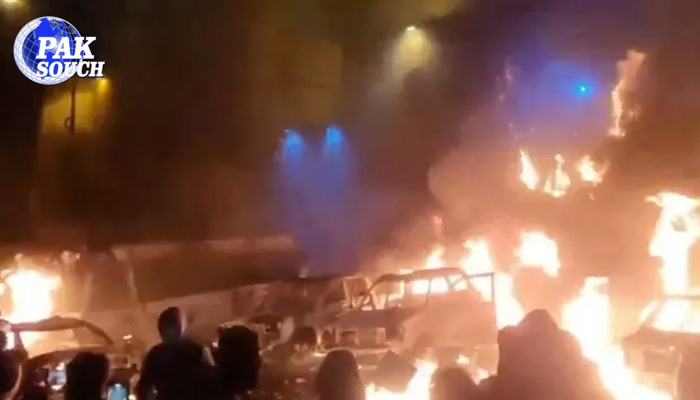
Jeffrey Sachs, a professor at Columbia University, has attributed the recent violent protests in Iran to the actions of the United States and Israel, challenging mainstream narratives about the causes of unrest in the country. According to Sachs, the protests are being misrepresented by biased media outlets to portray the Iranian government as oppressive, while the real instigators are foreign powers.
Sachs described the situation in Iran as an “extraordinary, violent, and ruthless game,” noting that mainstream American media—“bought and biased,” in his words—claims that the Iranian government has lost control of its economy. He emphasized that what is not reported is that the US itself has actively undermined Iran’s economic stability. “As always, lies are fed to the public suggesting that the Iranian government is oppressing its people,” he added.
The professor further stated that the ultimate aim of the US and Israel is to worsen the living conditions of ordinary Iranians and to pursue regime change. “The real goal is to make life as difficult as possible for the Iranian people while trying to replace the current government,” Sachs said, underscoring the foreign policy motivations behind economic and political pressures on Iran.
Echoing these remarks, Iran’s Supreme Leader has blamed the United States for the deaths and damages resulting from the protests, reinforcing the view that external interference is a key factor in the unrest.
The statements have sparked discussion among international affairs experts. Senator Mashahid Hussain Syed, a noted commentator, praised Sachs’ perspective on social media, writing that Western media coverage of Iran is “so weak, fake, and bought that it refuses to tell the truth.”
Sachs’ comments reflect broader concerns about media bias and foreign influence in shaping public narratives about domestic unrest. By highlighting the role of external actors, he challenges widely circulated claims that the protests are purely a result of internal governance failures, and instead frames them within the context of geopolitical strategy and intervention.
The debate underscores a growing divide between international expert assessments and mainstream media portrayals of events in Iran, raising questions about how global audiences understand foreign political developments and the sources they trust for accurate reporting.