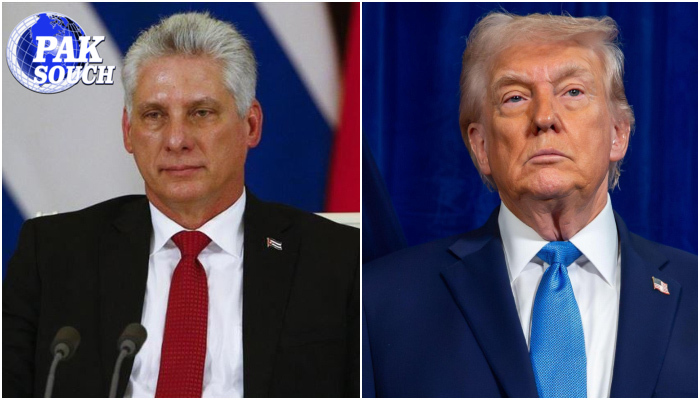
Washington, D.C.: Former US President Donald Trump has issued a stark warning to Cuba, urging the Caribbean nation to reach an agreement with the United States before it is “too late.” Trump’s statements, which criticized Cuba’s longstanding support for Venezuela, have elicited a strong and defiant response from Cuban President Miguel Díaz-Canel.
Trump accused Cuba of sustaining itself for years through Venezuelan oil and financial support while providing security assistance to Venezuelan leaders. “Cuba has survived for years on oil and money received from Venezuela, while supplying security to two Venezuelan rulers. But now Venezuela is under the protection of the world’s most powerful military—the United States,” Trump said. He added a warning that, going forward, Cuba would no longer receive financial or oil assistance unless it comes to terms with the United States immediately. “Cuba must make a deal now, before it’s too late,” Trump said.
In response, Cuban President Miguel Díaz-Canel strongly rejected Trump’s warning, emphasizing Cuba’s sovereignty and independence. “Cuba is a free and sovereign nation. No one has the right to dictate what we should do,” Díaz-Canel said. He described the US approach as “criminal” and a threat to global peace.
The Cuban leader highlighted the country’s history of enduring US hostility over the past 66 years. “Cuba does not issue threats, but we are prepared to defend our homeland,” he said. Díaz-Canel also condemned those who attempt to blame the Cuban Revolution for the nation’s economic challenges, asserting that such accusations are both shameful and unjust. “Those who see human lives only through a commercial lens and point fingers at Cuba’s revolution should feel ashamed,” he added.
Trump’s warning and Cuba’s immediate rebuttal underscore the enduring tension between the two nations, which has persisted since the Cuban Revolution in 1959. The dispute reflects broader geopolitical concerns in Latin America, particularly US-Cuba-Venezuela relations, where ideological differences and economic sanctions continue to shape policy decisions.
Analysts note that Trump’s statements are consistent with his broader approach to Latin America, which emphasizes pressure, economic leverage, and threats of military or diplomatic measures to achieve strategic objectives. In this context, Cuba’s refusal to comply signals its commitment to national sovereignty and resistance to external coercion.
The exchange also highlights the delicate balance between diplomacy and confrontation in the region. While Trump frames his message as an urgent call for negotiation, Cuba portrays itself as defending its rights and independence against what it considers illegal threats. This standoff could further complicate US-Cuba relations and affect regional stability, particularly in the context of ongoing crises in neighboring Venezuela.
Human rights observers have also weighed in, warning that economic and political pressures could exacerbate hardships for ordinary Cuban citizens. The debate over external influence versus national sovereignty remains central to discussions about Cuba’s future and its role in regional geopolitics.
Despite the heightened rhetoric, both sides maintain firm positions. Trump emphasizes immediate compliance and alignment with US interests, while Díaz-Canel reiterates that Cuba will not surrender its autonomy. This clash reflects longstanding tensions and the enduring geopolitical struggle between the US and Cuba, with wider implications for Latin America and international diplomacy.