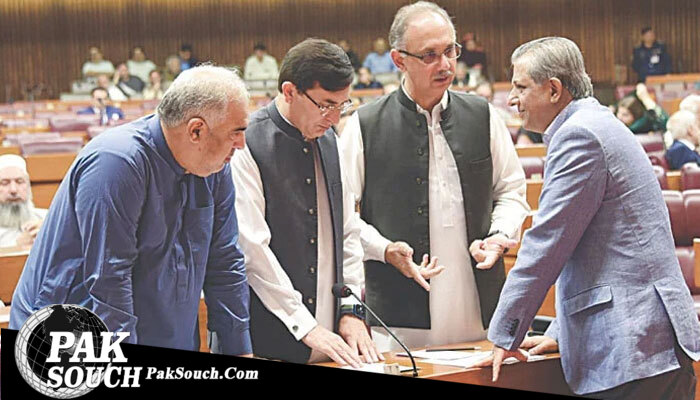
Islamabad: In the wake of signals from opposition parties indicating willingness to engage in dialogue on national issues, the federal government has made its position unequivocally clear to the leadership of Pakistan Tehreek-e-Insaf (PTI): any prospective negotiations will not include discussions on the general elections held on February 8, 2024. Well-informed sources say the government has categorically conveyed that the 2024 elections are a closed chapter and will not be reopened under any circumstances through talks.
According to the sources, the government has adopted a firm stance that it will not entertain demands related to rejecting the 2024 election results, forming commissions to probe last year’s polls, or transferring power to the opposition through negotiations. Officials have emphasized that all objections and grievances concerning the electoral process can only be addressed through constitutionally mandated forums, namely election tribunals and courts of law. The government has reiterated that it will accept the verdicts of these institutions, even if decisions go against the ruling parties.
This message has reportedly been delivered to senior PTI leaders and subsequently relayed by PTI to the opposition alliance Tehreek Tahaffuz-e-Aain Pakistan (TTAP), led by Mahmood Khan Achakzai. Sources add that the government also cautioned PTI that reopening the issue of the 2024 elections would inevitably lead to renewed scrutiny of the 2018 elections and even earlier general elections. Such a process, officials argue, is neither practically feasible nor politically viable.
Despite drawing a clear red line on the elections, the government has signaled openness to dialogue on a broader reform agenda. According to insiders, Islamabad is willing to engage in talks on institutional and constitutional reforms, strengthening parliament, ensuring the rule of law, and undertaking wide-ranging democratic reforms. Discussions on national political matters within the constitutional framework are also on the table. Furthermore, there is room to consider dialogue on the issue of political prisoners and other matters of national concern, provided they remain within constitutional limits.
However, when it comes to sensitive cases related to the violence of May 9 and attacks on military installations, sources say the matter does not lie solely within the civilian government’s authority. Any relief or resolution on these cases would require the involvement of stakeholders beyond the elected government. The stance of the military leadership on the May 9 incidents has already been made public and, according to sources, leaves little room for flexibility.
When contacted by The News, PTI Chairman Barrister Gohar Ali Khan confirmed that messages from the government had been received by the party. However, he refrained from commenting on the details, signaling PTI’s continued cautious approach to the overtures.
Prime Minister Shehbaz Sharif, meanwhile, reiterated his offer of dialogue to PTI on Wednesday, stressing that talks could only take place on what he described as “legitimate demands.” At the same time, he issued a warning that attempts to use negotiations as a means of political blackmail would not be tolerated. His remarks underline the government’s effort to project openness to dialogue while maintaining firm boundaries.
Leaders of the opposition alliance Tehreek Tahaffuz-e-Aain Pakistan have responded with cautious optimism. They have announced readiness to engage in talks on national issues and the restoration and protection of the Constitution. PTI, however, has maintained its position of refusing direct negotiations with the government, keeping the political impasse largely intact.
Political analysts note that while both sides appear interested in reducing political tensions, deep-rooted disagreements over the legitimacy of the 2024 elections and accountability for the events of May 9 remain the principal obstacles. These issues are likely to determine whether the current contacts evolve beyond preliminary exchanges or stall once again.
Although PTI is not presently inclined toward negotiations, observers argue that extraordinary political circumstances often require unconventional steps. Some analysts believe that PTI, more than any other stakeholder, may have an urgent need for dialogue to facilitate a return to political normalcy and regain space within the mainstream political process.
There is also growing concern that additional PTI members of parliament could face indictments in the Sangjani rally case by January 7, as proceedings in the Islamabad Anti-Terrorism Court are expected to move swiftly. Such legal pressures could further complicate the party’s strategic calculations. It is a known fact that on November 4, former prime minister عمران خان authorized Mahmood Khan Achakzai and Allama Raja Nasir to explore avenues for dialogue, but no tangible progress has been made so far.
The future course of PTI’s protest movement—whether on the streets or in another form—also remains uncertain. According to one source, any meaningful breakthrough will ultimately require direct, good-faith engagement between the two sides. Without such sincerity and clarity of intent, the prospects of resolving Pakistan’s ongoing political deadlock appear limited.