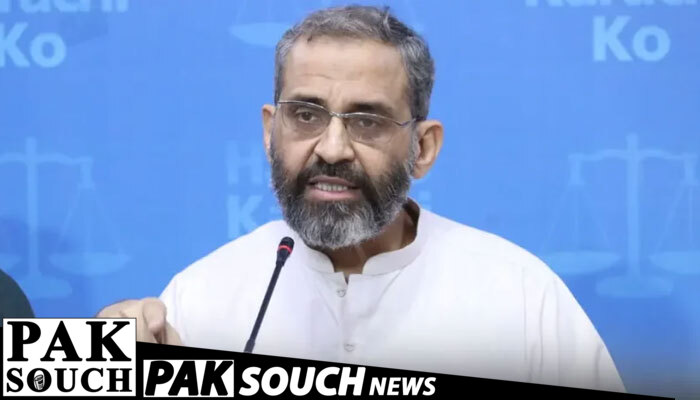
Karachi, Pakistan’s largest and most economically significant metropolis, continues to grapple with severe infrastructural decay, administrative negligence, and growing public frustration. Speaking at a detailed press conference held at Idara Noor-e-Haq, Ameer Jamaat-e-Islami Karachi, Munim Zafar, delivered a strong critique of the ruling Pakistan Peoples Party (PPP), accusing it of “17 years of corruption and mismanagement that have brought the city to the brink of collapse.”
According to Zafar, Karachi today stands as a glaring example of municipal failure. “The city has no guardian,” he said, adding that entire neighborhoods increasingly resemble “open sewers.” The Ameer argued that despite Karachi’s enormous contribution to the national economy, it has consistently been deprived of the attention, investment, and administrative seriousness it deserves.
“Every project is delayed—nothing is ever completed on time”
Zafar highlighted that major development and maintenance projects across the city suffer from chronic delays. The Karimabad underpass, announced months ago, is still incomplete. Roads connecting Malir Chowk to Tank Chowk lie in a state of severe disrepair, creating hardships for thousands of daily commuters. Similarly, residents of Gulistan-e-Jauhar continue to face disruptions due to the so-called underpass project that has been dragging on without visible progress.
He further criticized the provincial government’s approach, stating that instead of solving problems, ongoing projects have become sources of suffering for residents. Even key roads such as Jahangir Road remain in neglected condition. “The rulers do not listen to citizens at all,” Zafar said, adding that the provincial government is more focused on making claims and announcements rather than delivering results.
Local bodies kept powerless despite the 18th Amendment
One of the central themes of Zafar’s address was the lack of authority granted to local government institutions. He pointed out that despite the passage of the 18th Amendment—intended to devolve power—Karachi’s elected representatives and municipal bodies remain deprived of essential administrative and financial powers.
“You do not empower the people of Karachi, nor do you empower local bodies,” he stated. “Even after the 18th Amendment, the provincial government is unwilling to share resources.” While the provincial budget has increased nearly eightfold since devolution, conditions in Karachi have not improved. Zafar noted that the allocations Karachi received in 2018 are no different from what it receives today, raising serious questions about transparency and governance.
Slow progress by the Karachi Mayor questioned
Responding to promises made by the city’s mayor, Zafar asked, “When will the 60 days of development work actually begin?” He pointed out that Karachi Metropolitan Corporation (KMC) has thus far collected over four billion rupees through taxes added to K-Electric bills, yet the city has little to show in terms of improvement.
He also highlighted the worsening situation within the Karachi Water Corporation, which falls under the administrative oversight of the provincial government. According to Zafar, inefficiency within the corporation has exacerbated water shortages, contributed to sanitation problems, and led to tragic incidents. He revealed that 24 people have lost their lives this year after falling into open manholes, a situation he described as “deeply shameful for any government claiming to care about its citizens.”
Transport promises exist only on paper
Karachi’s transport crisis, long known to residents, was another major aspect of Zafar’s criticism. Despite repeated announcements by the provincial transport minister, Zafar noted that the city has seen no actual improvement.
He pointed out that Karachi has only 300 standard buses in operation. Even if the 100 Bus Rapid Transit (BRT) vehicles are included, the total number comes to only 400—grossly insufficient for a city with a population exceeding 35 million. “There are only announcements, not actual buses,” he remarked. Referring to frequent press statements made by provincial authorities, he said that neither the commitments of the mayor nor the claims made by the transport minister ever materialize.
Heavy traffic accidents continue to claim lives
A particularly alarming issue raised by Zafar was the increasing number of fatal incidents involving heavy traffic across the city. With millions of residents commuting on motorcycles daily, the lack of proper traffic management has proven deadly. Zafar said that more than 250 people have been crushed in such incidents, yet no systematic action or safety reforms have been initiated by authorities.
“People are losing their lives every week, but there is no one to ask why,” he said.
A call for accountability and genuine governance
Towards the end of his address, Munim Zafar stressed that Karachi’s crisis cannot be resolved through mere statements or symbolic projects. He demanded that real authority be delegated to local bodies, transparent audits be conducted on development funds, and elected officials deliver measurable results rather than political rhetoric.
He reiterated that Karachi’s residents have endured enough, warning that if the city continues to be neglected, public frustration will increase. Zafar called for immediate reforms, including improved road infrastructure, a functional sanitation system, timely completion of development projects, and an efficient public transport network.
The Jamaat-e-Islami leader concluded by emphasizing that Karachi—Pakistan’s financial heartbeat—deserves governance that matches its importance. Until then, he said, the city will remain trapped in a cycle of decay, delays, and administrative apathy.