


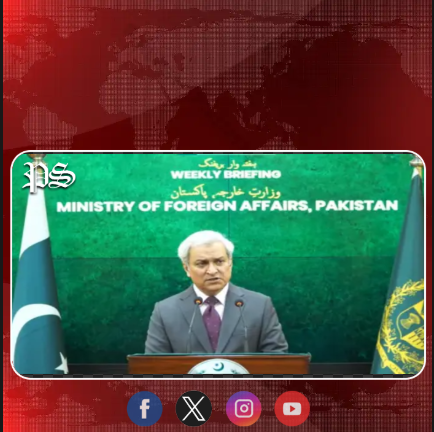
Pakistan on Thursday expressed “disappointment” with the European Union’s (EU) recent report that pointed out issues in Pakistan’s compliance with its commitments under the Generalised Scheme of Preferences Plus (GSP+).
The report was issued last week as part of the European Commission’s global assessment of the GSP during the 2023-2025 period. It said Pakistan had “regressed in a number of areas while positive change was limited”.
Responding to a query during a weekly press briefing on Thursday, Foreign Office (FO) spokesperson Tahir Andrabi appreciated the report’s “acknowledgement of Pakistan’s legislative progress” and its continued compliance with 27 international conventions under the GSP+.
“Nevertheless, I would be remiss if I do not express disappointment with the assessment, with the report’s overall narrative which does not present sufficiently balanced pictures of Pakistan’s performance,” Andrabi added.
He said the EU report “understates the breadth of reforms undertaken since Pakistan joined GSP+ in 2014” and “places disproportionate emphasis on the lower-than-desired progress in a few areas”.
At the same time, the FO spokesman affirmed that GSP+ remained “central to Pakistan’s economic relationship with the EU, supporting exports, employment, women’s economic participation, poverty reduction and broader economic development”.
He observed that GSP+ was a “mutually beneficial arrangement in that aspect”.
“We will remain constructively engaged with the European Commission and other EU institutions and remain committed to the effective implementation of international conventions underpinning the GSP framework,” Andrabi affirmed.
He highlighted that beyond GSP+, Pakistan’s EU cooperation extended to development, migration, counterterrorism, regional stability, climate resilience, connectivity and many other areas.
About The Author