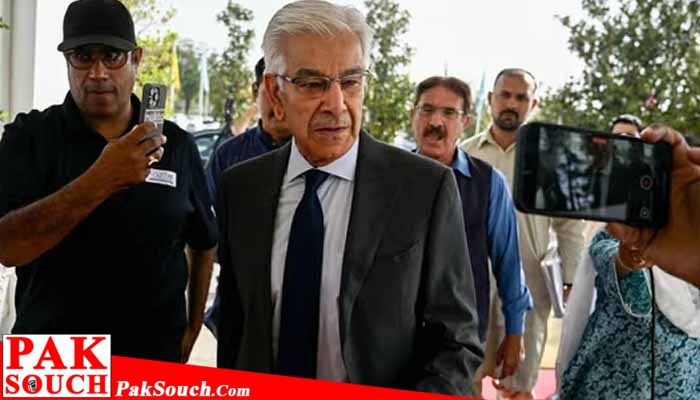
ISLAMABAD — Pakistan’s Defence Minister Khawaja Asif has said that after a new round of dialogue, Pakistan and Afghanistan have reached a mutual understanding that the immediate elimination of terrorism is essential for regional stability.
In an interview with Arab News, the defence minister stated that the central purpose of the recent bilateral agreement between Islamabad and Kabul is to address and eradicate the long-standing issue of terrorism, which has plagued border regions of both countries for decades.
“As both nations have suffered the devastating consequences of terrorism for years, we have now realized that urgent and coordinated action is necessary,” Asif emphasized. He revealed that discussions over the past week were tense and that the issue had even escalated to direct cross-border clashes. However, the two sides have now agreed that resolving this threat must be a top priority.
The defence minister underscored that both Pakistan and Afghanistan are committed to serious, result-oriented efforts to combat militant groups operating along their shared frontier. “If we fail to act decisively, the peace and stability of the entire region will face severe risks,” he warned.
Khawaja Asif also disclosed that the agreement was made possible through mediation by Qatar and Türkiye, thanking both nations for their diplomatic support. “We are grateful to the Emir of Qatar, Sheikh Tamim bin Hamad Al Thani, Turkish President Recep Tayyip Erdoğan, and Turkish delegation head Ibrahim for facilitating this important understanding,” he said.
The new consensus between the neighboring countries comes amid heightened tensions following a surge in cross-border attacks blamed on militant networks operating from Afghan soil. Pakistani officials have long accused elements within Afghanistan of providing sanctuary to the Tehreek-e-Taliban Pakistan (TTP), while Kabul has insisted that it does not allow its territory to be used against any state.
Regional analysts view the latest talks as a cautious but promising step toward de-escalation. They note that sustained cooperation and mutual trust will be key if both sides are to implement security mechanisms that can effectively dismantle terrorist networks.