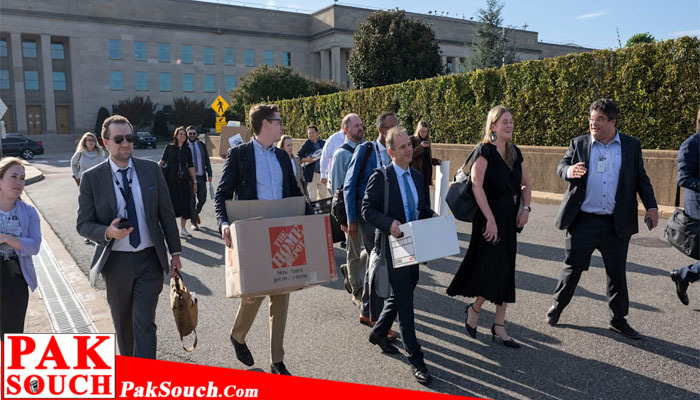
WASHINGTON: A major standoff has erupted between the U.S. Department of Defense and the national press corps after more than thirty leading news organizations rejected the Pentagon’s newly proposed media policy. In a rare act of protest, dozens of journalists have vacated their offices within the Pentagon, leaving the once-bustling press area eerily deserted.
According to reports, the dispute centers on new restrictions the Pentagon attempted to impose on accredited journalists covering defense affairs. The policy reportedly requires reporters to seek prior clearance for interviews with military officials, limits spontaneous questioning during press briefings, and introduces expanded clauses allowing the Department of Defense to revoke press credentials for “security or procedural violations.”
Media organizations — including prominent outlets such as The Washington Post, The New York Times, Reuters, Associated Press, and several television networks — have described the move as an unprecedented attempt to curb press freedom and restrict transparency in military reporting.
A joint statement from the Pentagon Press Association (PPA), representing correspondents stationed within the Department of Defense, declared that the proposed policy “threatens the core principles of an independent press” and undermines journalists’ ability to report freely on matters of national security. The statement added that the new policy “creates a chilling effect, limiting accountability and the public’s right to know.”
The walkout has left the Pentagon’s once-crowded press briefing area virtually empty. Reporters who had long maintained desks inside the Department of Defense began clearing their equipment and files after refusing to sign the mandatory compliance document introduced by Pentagon officials last week.
Unnamed sources within the Pentagon confirmed that the new policy had been approved by senior defense officials after “months of internal review,” aimed, they claim, at “modernizing security protocols and ensuring responsible reporting on defense matters.” However, media watchdogs argue that the rules are deliberately vague and could be used to censor unfavorable coverage or delay the release of sensitive information.
Several prominent journalists took to social media to denounce the policy. Veteran defense correspondent Laura Seligman wrote that “press access to the Pentagon is not a privilege but a democratic right — this policy turns it into a controlled privilege.” Others warned that the restrictions mirror those seen in countries with limited media freedom, setting a dangerous precedent for the United States.
The White House Correspondents’ Association (WHCA) also expressed concern, urging the Department of Defense to reconsider the policy and engage in dialogue with media representatives. “Transparency and accountability are essential in a democracy,” the WHCA said in a statement. “Restricting access to the press undermines the very institutions the Pentagon is sworn to defend.”
In response, a Pentagon spokesperson defended the policy, stating that it aims to “enhance coordination, protect operational security, and prevent the spread of misinformation related to ongoing defense activities.” The spokesperson emphasized that “responsible journalism remains welcome,” but insisted that “national security considerations must come first.”
Despite this, legal experts argue that the Pentagon’s stance could face challenges in federal court for violating First Amendment protections. Media advocacy groups are already consulting constitutional lawyers to assess possible legal action against what they describe as “an overreach of executive authority.”
The situation marks one of the most serious confrontations between the U.S. military establishment and the press in recent decades. Comparisons are being drawn to the Pentagon Papers era of the 1970s, when government secrecy and press freedom clashed over issues of national importance.