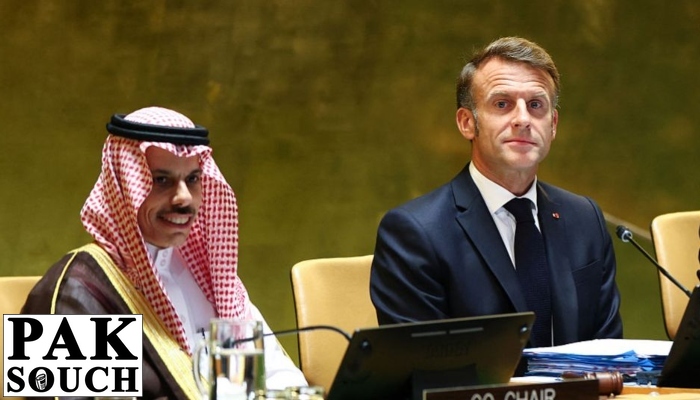
New York: Saudi Arabia has once again underscored its unwavering support for the two-state solution as the only viable pathway to achieving lasting peace between Israel and Palestine. Speaking at the United Nations conference in New York, Saudi Foreign Minister Prince Faisal bin Farhan emphasized that regional stability and security cannot be realized without addressing the Palestinian question through the creation of an independent Palestinian state.
Call for Recognition of Palestine
During his address, Prince Faisal expressed gratitude to French President Emmanuel Macron for France’s decision to officially recognize Palestine as a state. The announcement by France follows similar moves in recent months by Britain, Canada, Australia, and Portugal, signaling a growing international consensus in favor of Palestinian recognition.
“France’s courageous step is a historic contribution to justice and peace,” Prince Faisal said, adding that Saudi Arabia views this development as a vital boost to international efforts aimed at reviving negotiations on the basis of the two-state framework.
The Two-State Vision
Saudi Arabia has consistently promoted the idea of two states living side by side — Israel and Palestine — with East Jerusalem as the capital of a sovereign Palestinian state. According to Prince Faisal, this vision is not only aligned with the aspirations of the Palestinian people but also with international resolutions, including numerous UN Security Council decisions.
He stressed that piecemeal measures or temporary truces will not resolve the conflict. Instead, only a comprehensive settlement guaranteeing Palestinian rights and sovereignty can pave the way for durable peace in the Middle East.
“The two-state solution is not an option among many,” he declared firmly. “It is the only option that can deliver justice to Palestinians, security to Israelis, and stability to the wider region.”
Context of France’s Recognition
French President Macron’s announcement at the UN General Assembly that France now officially recognizes Palestine as a state was met with widespread reactions globally. France is one of the most influential European powers to take this step, and its decision is likely to place additional pressure on other Western countries that have long hesitated to recognize Palestinian statehood.
Macron argued that the world cannot stand idle as the conflict drags on indefinitely. “Recognition of Palestine is not an act against Israel but a step toward peace,” he said, stressing that the move aligns with France’s commitment to justice and diplomacy.
Broader International Momentum
With Britain, Canada, Australia, Portugal, and now France adding their voices, the international momentum for Palestinian recognition appears stronger than in recent years. Analysts suggest this growing consensus reflects frustration with the lack of progress in negotiations, ongoing Israeli settlement activity, and recurring cycles of violence in Gaza and the West Bank.
Saudi Arabia views these recognitions as a turning point. Prince Faisal highlighted that international acknowledgment of Palestinian statehood strengthens the legitimacy of the Palestinian cause and sends a clear message to Israel that the status quo cannot continue indefinitely.
Regional Implications
The Saudi foreign minister warned that without a credible path toward Palestinian sovereignty, the Middle East will remain trapped in instability. Conflicts in Gaza, tensions in Jerusalem, and humanitarian crises in refugee camps will continue to fuel extremism, undermine economic development, and obstruct cooperation between states.
He noted that Saudi Arabia’s broader vision for the region — including initiatives like Vision 2030 — depends on peace and security. “Our region cannot prosper while millions of Palestinians remain dispossessed, stateless, and deprived of their fundamental rights,” he said.
Saudi Arabia’s Diplomatic Role
Saudi Arabia has long played a central role in advocating for Palestinian rights. From the Arab Peace Initiative of 2002, which Riyadh spearheaded, to recent mediation efforts with Arab and Western partners, the kingdom has consistently placed the Palestinian issue at the top of its foreign policy agenda.
Prince Faisal reiterated that Saudi Arabia will continue to work with the UN, regional partners, and international powers to facilitate dialogue. He also stressed that Saudi diplomacy is rooted in the principle that peace cannot be imposed unilaterally but must be based on mutual recognition and justice.
A Message to Israel
While careful not to escalate rhetoric, the Saudi minister indirectly urged Israel to reconsider its policies. He noted that continued settlement expansion, military operations, and refusal to engage in genuine negotiations erode trust and make peace increasingly difficult.
“Peace with the Arab world is within reach for Israel,” he said, “but it will not come at the expense of Palestinian rights. The two-state solution remains the foundation of any normalization or broader regional integration.”
Global Reactions
The speech by Prince Faisal drew significant attention among UN delegates. Many countries in the Global South applauded Saudi Arabia’s stance, pointing out that the kingdom’s leadership carries moral and political weight across the Muslim world. Western diplomats also acknowledged that the momentum generated by France’s recognition, backed by Saudi Arabia’s strong endorsement, could reignite dormant peace initiatives.
However, Israel remains strongly opposed to unilateral recognitions of Palestinian statehood, arguing that such steps bypass direct negotiations. Israeli officials maintain that peace can only be achieved through bilateral agreements, not international declarations.
Conclusion
The Saudi foreign minister’s statement at the UN reaffirms Riyadh’s central role in shaping the global conversation on the Israeli-Palestinian conflict. By declaring the two-state solution as the only path to peace, Saudi Arabia has aligned itself with a growing wave of international support for Palestinian recognition.
As more countries move to formally recognize Palestine, pressure will continue to mount on Israel and its allies to reconsider their positions. The coming months could prove decisive in determining whether this renewed international momentum translates into concrete negotiations — or whether the conflict remains locked in stalemate.