

US President Donald Trump claimed major progress in talks with Tehran while reviving grievances against European allies over the recent US war against Iran.
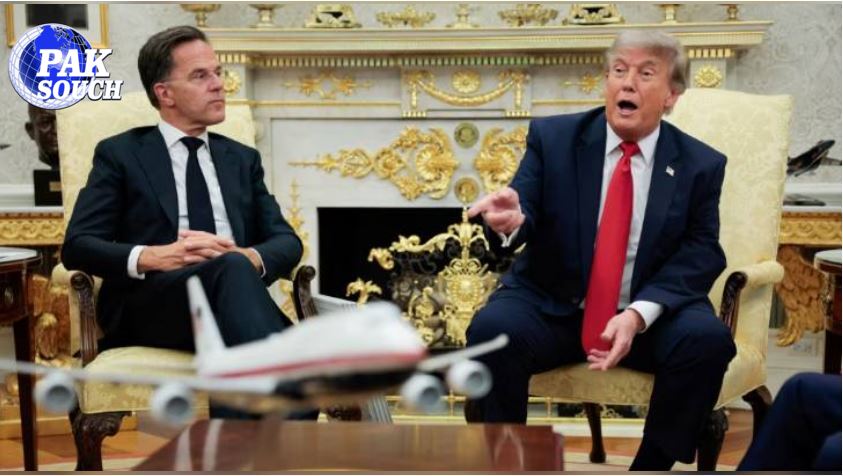
Hosting NATO Secretary-General Mark Rutte at the White House on Wednesday, Trump told reporters that negotiations with Iran are advancing rapidly, asserting, that “Iran is making a lot of concessions and we are winning by a large margin.”
Trump also reiterated that any attempts by Iran to introduce fees or tolls for ships passing through the Strait of Hormuz would be unacceptable.
With Iranian officials denying immediate access to their damaged nuclear sites, Trump insisted Tehran has capitulated to oversight, including joint US and International Nuclear Energy Agency (IAEA) inspections. “They are agreeing to everything I want, and they have to; otherwise we will come back and do whatever is necessary,” Trump warned speaking to journalists on a separate occasion on June 24 in Washington, D.C.
Trump used the meeting with Rutte to express resentment toward NATO members who opposed or distanced themselves from the conflict, telling the secretary-general that many allies “disappointed me” regarding Iran. Although Rutte defended European cooperation by highlighting vital logistical support and airspace access, Trump added that he wouldn’t have gone to a NATO in Ankara on July 7-8, if it wasn’t for Turkish President Recep Tayyip Erdogan who hosts it.
‘Let down’ by NATO
President Trump told NATO chief Mark Rutte he was “let down” by members of the transatlantic alliance who did not back his war against Iran.
“We were let down. We didn’t need help on this at all. We demolished (Iran) literally in the first week but it would have been nice if they would have said, ‘We’d like to help,’” Trump said.
For his part, Rutte defended the conduct of NATO countries, saying there were 4-5,000 “US planes taking off from bases in Europe” during the war.
The NATO chief then told journalists after the meeting that Trump is “completely committed to the NATO alliance,” and said Washington would “absolutely” protect Europe in case of attack.
Trump’s criticism of NATO comes just two weeks before leaders from the 32 member nations are set to meet for a July 7-8 summit in the Turkish capital of Ankara.
The United States and Israel jointly attacked Iran on February 28. Trump did not consult NATO ahead of time and key European allies have voiced skepticism over the need for war.
Trump’s second term has been marked by tensions with NATO allies, including over Greenland, which the US president threatened to annex before backing down in January after weeks of threats.
Washington has also been clear with Europe that it wants NATO allies on the continent to take over primary responsibility for their own conventional defence as Washington’s focus shifts towards China.
As part of that process, the Pentagon has already told allies it is reducing the number of assets worldwide that it makes available for NATO operations.
The US move has sparked fear it could leave Europe vulnerable in the face of an aggressive Russia as allies still rely on Washington for some key weaponry.
Doubt on US school strike
President Trump cast doubt on US involvement in the missile strike on an Iranian school “because missiles were flying all over the place” on the first day of the Middle East war.
The attack killed 73 boys, 47 girls, 26 teachers, seven parents, a school bus driver, and another adult in the southern city of Minab on February 28, according to Iranian state media.
“It’s horrible what happened, but there were missiles flying all over the place, and somebody said it was our missile, well, maybe it wasn’t our missile. But I’ve seen nothing to lead me to believe it was,” Trump told reporters at the White House.
Trump then called on Defence Secretary Pete Hegseth, seated on a couch in the Oval Office, to back up his assertion. “Well Mr President, we’ve taken the investigation very seriously, and when, when the appropriate time is right, whatever that outcome is, that’ll be the time to divulge,” Hegseth said.
The United States has avoided assuming responsibility for the tragedy, with Trump initially claiming Iran may have struck the school itself because “they have no accuracy whatsoever” with their munitions.
In May, the commander of US Central Command (CENTCOM) Admiral Brad Cooper, told Congress the military will share the results of any investigation when complete and that a “complex” probe was underway.
The New York Times has previously reported that the school was hit by a US Tomahawk cruise missile, a weapon which Iran does not possess. CNN has also reported that the US was responsible for the attack.
Despite being in the minority, House Democrats filed impeachment proceedings against Hegseth in the wake of the attack.
Last week Senate Democrats threatened to block his travel funds until he submits “unredacted civilian harm investigations,” including for the Minab school.
$88b in extra war funding
President Trump asked Congress for nearly $88 billion in extra spending, most of it to cover the cost of the Iran war, at a moment of growing unease in both parties over the conflict and its political price.
The White House request for $87.6 billion in supplemental funding includes tens of billions of dollars for the Pentagon, as well as money for US farmers, Ebola response efforts in central Africa and domestic infrastructure projects.
The proposal landed a day after Congress passed a largely symbolic resolution calling on Trump to end US hostilities with Iran unless lawmakers explicitly authorize military action.
It also came as the administration tries to turn a preliminary agreement with Tehran into a final settlement after months of war that rattled global energy markets, pushed up prices and exposed divisions inside Trump’s Republican Party.
White House budget director Russell Vought made the request in a letter to House Speaker Mike Johnson, urging Congress to act quickly on what he called “important and urgent requests.”
The bulk of the package would go toward military costs linked to the Iran conflict.
The administration requested about $67 billion for the Pentagon, including $21 billion for munitions and other military capabilities, $17.3 billion for operational costs and $12.1 billion for classified programs.
It also sought nearly $768 million for the Energy Department for nuclear and energy security related to Iran, and $300 million for State Department embassy security and construction in countries around Iran.
– ‘Reckless war’ –
The request is far smaller than the $200 billion Defense Secretary Pete Hegseth suggested in March the Pentagon might need for the war, which began with US and Israeli strikes on Iran in late February.
The funding request is expected to face a difficult path in Congress, where most Democrats oppose the war and some Republicans have begun questioning its cost, objectives and prospects for ending it.
In the Senate, major spending legislation typically needs 60 votes to advance, meaning Trump would need Democratic support unless Republicans find another legislative route.
Senate Minority Leader Chuck Schumer accused Trump of seeking more money after dragging the country into a “reckless war.”
Senator Patty Murray, the top Democrat on the Senate Appropriations Committee, said Trump had launched the war without congressional authorization or broad public support and was now asking taxpayers “to pick up the tab.”
The request also includes more than $11 billion in farm aid, after farmers were hit by trade disruptions and economic fallout tied partly to Trump’s tariff policies.
Other items include $1.4 billion to respond to Ebola outbreaks in the Democratic Republic of the Congo, Uganda and elsewhere, $1 billion for the renovation of Penn Station in New York and $500 million for restoration and construction projects in Washington.
Republicans have already given the Pentagon $150 billion in new funding through Trump’s major tax and spending law, passed last year without Democratic support.
Some conservatives have nevertheless questioned whether the Defense Department needs still more money, while vulnerable Republicans face the prospect of voting to fund an unpopular war months before November’s midterm elections
About The Author