

Islamabad: Federal Interior Minister Mohsin Naqvi has said that Field Marshal Syed Asim Munir played a pivotal role in facilitating peace efforts between the United States and Iran, claiming that both countries trusted him because of his honesty and straightforward approach. Naqvi stated that the military chief spoke candidly to all parties involved and even conveyed tough messages that, according to him, “no one could have imagined.”
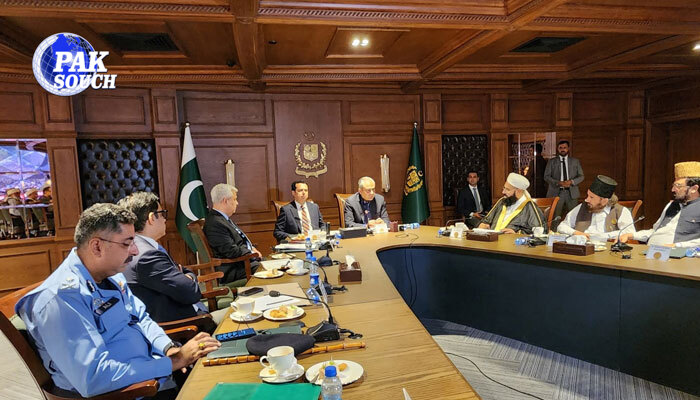
The remarks were made during a special meeting of the Paigham-e-Aman Committee, where the interior minister highlighted the importance of national unity, religious harmony, and collective efforts to maintain peace and stability across the country.
Scholars Have a Key Role in Promoting Peace
Addressing the gathering, Mohsin Naqvi praised religious scholars for their contribution to maintaining law and order and promoting social cohesion. He said that forums such as the Paigham-e-Aman Committee play a vital role in spreading a message of unity and tolerance throughout Pakistan.
“The message emerging from this platform should strengthen national solidarity,” Naqvi said. “Religious scholars have a significant responsibility in keeping the nation united and guiding society toward peace.”
He further emphasized that the committee should remain active at the district level so that its influence reaches local communities and contributes to resolving social and sectarian tensions before they escalate.
Collective Effort Needed Against Terrorism
The interior minister stressed that Pakistan’s fight against terrorism requires the support and cooperation of all segments of society, particularly religious leaders.
“We must stand together to eliminate terrorism,” he said. “The support of ulema and religious scholars is crucial in this struggle because they can help promote moderation and discourage extremist narratives.”
According to Naqvi, national unity remains one of the strongest tools available to counter security threats and ensure long-term stability.
Call for Harmony During Muharram
Referring to the upcoming observance of Muharram, the minister urged citizens to avoid sectarian divisions and work collectively to maintain peace.
“Ensuring law and order during Muharram is a shared responsibility,” he said. “The safest path is to avoid sectarianism and promote mutual respect among all communities.”
He noted that cooperation between religious leaders, local administrations, and security agencies would be essential to ensuring peaceful religious gatherings and processions throughout the country.
Pakistan’s Role in US-Iran Peace Efforts
Speaking about efforts related to a possible understanding between the United States and Iran, Mohsin Naqvi claimed that Pakistan played an active role in encouraging dialogue and reducing tensions.
He stated that Field Marshal Asim Munir’s reputation for honesty and direct communication enabled him to gain the confidence of all sides involved.
“Field Marshal Syed Asim Munir speaks the truth,” Naqvi said. “That is why both the United States and Iran placed complete trust in him during the negotiations.”
According to the interior minister, the military chief was viewed as a reliable figure by all stakeholders, making him uniquely positioned to contribute to peace initiatives.
“Every Side Trusted Him”
Naqvi further asserted that the field marshal was the only individual trusted by every party involved in the discussions.
“Every side had confidence in him,” he said. “Because of that trust, Pakistan was able to make meaningful efforts for peace.”
The minister described Pakistan’s involvement as part of a broader commitment to regional stability and diplomacy, emphasizing that peaceful solutions are always preferable to confrontation.
Prime Minister and Field Marshal Played Important Roles
Mohsin Naqvi credited both Prime Minister Shehbaz Sharif and Field Marshal Asim Munir for their efforts in promoting dialogue and supporting peace initiatives.
He said the prime minister provided political leadership while the field marshal played a central role in managing and advancing the process.
“Prime Minister Shehbaz Sharif led from the political front, while Field Marshal Asim Munir entered the field as the captain,” Naqvi remarked. “Together they played an important role in efforts aimed at achieving peace.”
“The Captain Led the Process”
Using a sporting analogy, the interior minister said that the field marshal acted as the “captain” of the peace effort and deserved recognition for guiding the process.
“He led this effort as a captain leads a team,” Naqvi stated. “Credit should go to the captain for steering the process forward, while the prime minister finalized matters at the leadership level.”
The comments underscored Naqvi’s view that both civilian and military leadership worked in coordination to support diplomatic engagement.
Tough Messages Delivered to Both Sides
One of the most notable parts of the minister’s speech was his claim that Field Marshal Asim Munir did not hesitate to convey difficult messages during discussions.
According to Naqvi, the military chief openly pointed out mistakes whenever necessary, regardless of which side was involved.
“He said things to both parties that many people would never imagine saying,” the minister claimed. “Whenever someone was wrong, he told them directly that they were wrong.”
Naqvi added that this straightforward approach strengthened confidence in the field marshal’s intentions because all parties knew he was being honest and impartial.
Emphasis on Credibility and Trust
Concluding his remarks, the interior minister argued that credibility and sincerity were the key reasons behind the trust placed in Pakistan’s leadership during sensitive diplomatic efforts.
He maintained that honesty, direct communication, and a commitment to peace helped create an environment in which dialogue could move forward, while also highlighting Pakistan’s desire to contribute positively to regional and international stability.
About The Author