

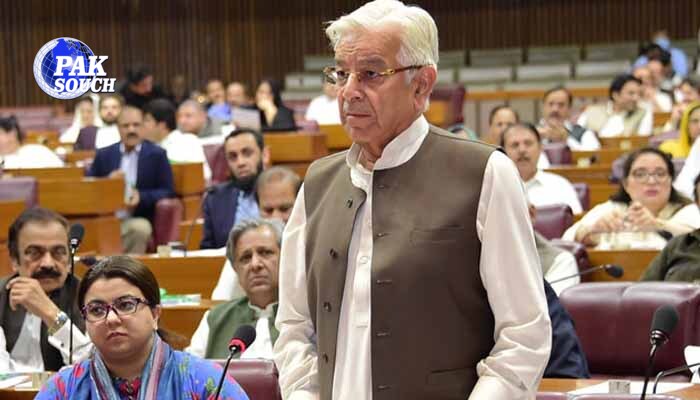
Islamabad: Defence Minister Khawaja Asif has said that if there had been stronger coordination between “Rawalpindi and Islamabad” in the past, Pakistan could have achieved several international honors much earlier.
He made these remarks while addressing the National Assembly session, where he described recent developments as a significant moment in Pakistan’s history and credited sustained efforts over the past few years for what he termed a major diplomatic breakthrough.
“Historic Moment for Pakistan”
Khawaja Asif said the country is passing through an important phase, claiming that Pakistan has achieved in recent times what it could not achieve in the past 78 years.
He stated that the outcome being discussed today is the result of continuous efforts over the past three years, and described it as a “major blessing from Allah” for Pakistan.
According to him, improved cooperation between key institutions and decision-making centers would have yielded better international outcomes much earlier in the country’s history.
“If there had been such coordination between Rawalpindi and Islamabad earlier, Pakistan would have received several international awards by now,” he said.
Praise for Iranian Leadership
The defence minister also extended congratulations to Iran, praising its leadership for representing the Iranian people effectively under difficult circumstances.
He said the Iranian leadership had handled complex regional challenges with resilience and dignity.
Khawaja Asif further remarked that longstanding injustices faced by Iran would now come to an end, referring to the broader context of evolving diplomatic developments in the region.
Context of US-Iran Agreement Reports
His comments come amid widespread reports of a possible agreement between the United States and Iran, which has been described by various officials as a major diplomatic development.
According to earlier statements, Prime Minister Shehbaz Sharif announced that a formal signing ceremony of the agreement is expected to take place on June 19 in Switzerland. The reported deal follows extended negotiations involving multiple regional stakeholders.
The agreement is being seen by some leaders as a potential breakthrough in reducing tensions in the Middle East, particularly between Washington and Tehran.
Regional Mediation and Diplomatic Efforts
Reports suggest that countries including Qatar, Saudi Arabia, and Türkiye played an important role in facilitating dialogue between the two sides. These diplomatic efforts are being credited with helping bridge gaps during negotiations.
However, officials have also cautioned that the situation remains sensitive, with final implementation still dependent on technical consultations and political stability in the region.
Mixed Reactions from Political Leadership
Political leaders in Pakistan have responded to the developments with a mix of optimism and emphasis on diplomatic success. While some have highlighted the importance of international cooperation, others have focused on Pakistan’s role in encouraging dialogue and supporting peaceful resolution of conflicts.
Khawaja Asif’s remarks reflect a broader narrative within the government that views recent diplomatic engagement as a significant achievement for Pakistan’s foreign policy approach.
Conclusion
As regional developments continue to unfold, Pakistani leadership has increasingly emphasized the importance of coordination between key national institutions and the value of sustained diplomatic efforts. Khawaja Asif’s statement highlights both domestic political reflections and Pakistan’s engagement with evolving international dynamics, particularly in relation to the reported US-Iran diplomatic progress.
About The Author