

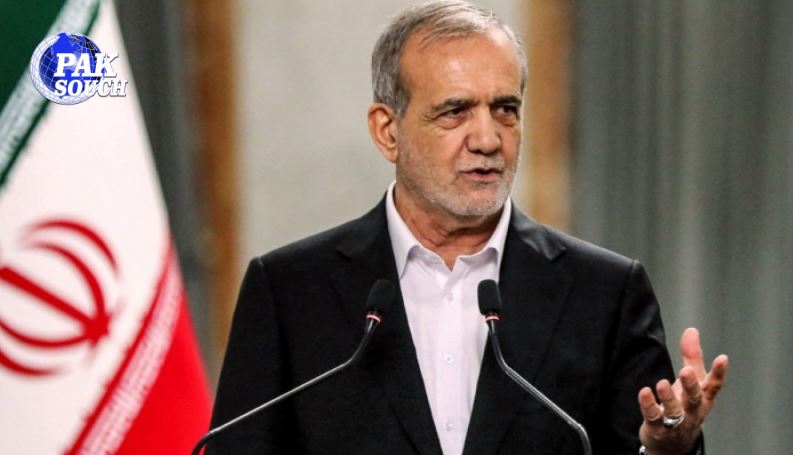
Tehran: Iranian President Masoud Pezeshkian has said that Iran will not bow to any external pressure, emphasizing that protecting national interests should not be misrepresented as betrayal.
In a recent statement, the Iranian president said that his government considers itself accountable and responsible to the Iranian people and remains committed to safeguarding the country’s sovereignty and strategic interests.
“Unjust to Target Those Performing Their Duties”
President Pezeshkian said that labeling officials as traitors for carrying out their constitutional responsibilities is unjust and harmful to political discourse.
He added that while criticism is a fundamental right in any society, it must remain within the boundaries of dignity and civility.
“Criticism is the right of society, but it must also respect the principles of decency,” he said.
The president stressed that those working within the framework of law and state institutions should not be subjected to personal attacks or accusations that undermine their integrity.
Firm Stance on Sovereignty
Reaffirming Iran’s position on national independence, Pezeshkian stated that the country would not submit to pressure from any power.
“We will not bow before any power,” he said, reiterating Iran’s long-standing policy of resisting external coercion and maintaining sovereign decision-making in national affairs.
His remarks come at a time when regional diplomacy and geopolitical developments have drawn renewed international attention to Iran’s foreign policy direction and internal political messaging.
Context of US-Iran Agreement
The statement comes shortly after reports of a peace agreement between the United States and Iran, which has been described as a major diplomatic development in international politics.
According to earlier announcements, the agreement was reportedly reached after extensive negotiations and is expected to be formally signed on June 19 in Switzerland, as stated by Pakistan’s Prime Minister Shehbaz Sharif.
The reported deal has been welcomed by several regional actors, with diplomatic observers noting its potential to reduce tensions in the Middle East and improve international stability.
Pakistan Welcomes Diplomatic Breakthrough
Pakistan has also expressed support for the reported agreement. Prime Minister Shehbaz Sharif described the development as a result of successful diplomacy and praised the efforts of countries that facilitated the dialogue process, including Qatar, Saudi Arabia, and Türkiye.
Islamabad has consistently advocated for peaceful resolution of disputes through negotiation and dialogue, particularly in regions experiencing prolonged geopolitical tensions.
Mixed Reactions and Regional Importance
The evolving situation between the United States and Iran continues to attract global attention due to its potential impact on energy markets, maritime security, and regional alliances.
Experts suggest that any easing of tensions could have significant consequences for trade routes such as the Strait of Hormuz, a critical chokepoint for global oil transportation.
At the same time, internal political messaging in Iran, such as President Pezeshkian’s remarks, reflects the sensitivity surrounding national sovereignty and domestic perceptions of foreign policy decisions.
Emphasis on Balanced Discourse
President Pezeshkian’s comments also highlight the importance of maintaining a balance between public criticism and respectful political dialogue within society.
By urging restraint in political labeling and emphasizing lawful conduct, he called for a more constructive environment in which governance and national decision-making can take place without undermining institutional credibility.
Conclusion
As regional diplomacy continues to evolve, Iran’s leadership is seeking to reaffirm its stance on sovereignty while responding to domestic and international narratives surrounding its policies.
President Masoud Pezeshkian’s remarks underline Tehran’s insistence on independence in decision-making and its rejection of external pressure, even as broader diplomatic developments suggest potential shifts in regional relations and global engagement.
About The Author