


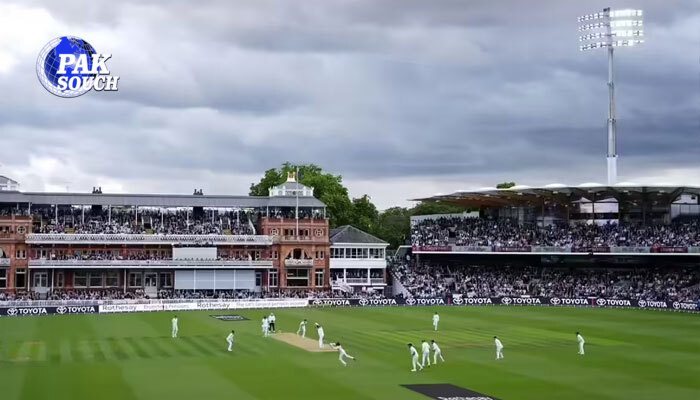
DUBAI: The International Cricket Council (ICC) has declared the pitches used at Lord’s Cricket Ground in England and Gaddafi Stadium in Lahore as “unsatisfactory,” awarding one demerit point each to both venues following concerns raised by match officials.
According to the ICC, the decisions were made after reviews of the pitches used during the England vs New Zealand Test match at Lord’s and the third One-Day International (ODI) between Pakistan and Australia at Gaddafi Stadium.
Concerns Over Lord’s Test Pitch
The Lord’s pitch came under scrutiny after match referee Andy Pycroft submitted a report highlighting issues that affected the balance between bat and ball.
Pycroft noted that the surface produced excessive seam movement and unpredictable bounce, conditions that significantly influenced play and made batting unusually difficult.
According to the referee’s assessment, the unusual behavior of the pitch reduced the fairness of the contest by creating conditions that heavily favored bowlers. The ICC subsequently determined that the pitch did not meet the expected standards for international Test cricket.
Lord’s, often referred to as the “Home of Cricket,” is one of the sport’s most iconic venues, making the decision particularly noteworthy within the cricketing community.
Gaddafi Stadium Pitch Also Criticized
The pitch used for the third ODI between Pakistan and Australia at Lahore’s Gaddafi Stadium also received criticism from match referee Graeme Labrooy.
In his report, Labrooy stated that the surface was slow and offered low bounce, making stroke play difficult and restricting scoring opportunities for batters. He observed that the pitch failed to provide the characteristics generally expected in modern One-Day International cricket.
The report further noted that spin bowlers received assistance from the surface from the early stages of the match, limiting the balance between batting and bowling.
As a result, the ICC concluded that the pitch was below the standard required for ODI cricket and classified it as unsatisfactory.
Reports Sent to ECB and PCB
The ICC has formally communicated its findings to both the England and Wales Cricket Board (ECB) and the Pakistan Cricket Board (PCB).
Under ICC regulations, both cricket boards have been given 14 days to lodge an appeal if they wish to challenge the findings or provide additional evidence regarding the condition of the pitches.
The appeals process allows venue authorities and national cricket boards to present their case before a final determination is confirmed.
First Demerit Point for Both Venues
Despite the criticism, neither Lord’s nor Gaddafi Stadium had any existing demerit points on their records before these rulings.
As a result, each venue now carries one demerit point, marking the first such penalty against both grounds under the ICC’s current pitch and outfield monitoring system.
The demerit point system is designed to encourage venue operators and cricket boards to maintain high-quality playing surfaces that provide a fair contest between bat and ball.
Understanding ICC’s Demerit Point System
The ICC’s Pitch and Outfield Monitoring Process categorizes venues based on the quality of their playing surfaces.
Under the system:
- An “Unsatisfactory” rating results in one demerit point.
- A “Poor” rating results in three demerit points.
- More severe ratings can attract additional sanctions depending on the circumstances.
Demerit points remain active on a venue’s record for a five-year period.
According to ICC regulations:
- A venue that accumulates six demerit points within five years can be suspended from hosting international cricket for one year.
- A venue that reaches 12 demerit points within the same period may be banned from hosting international matches for two years.
Implications for Future Matches
While the penalties currently have no immediate impact on the hosting status of either Lord’s or Gaddafi Stadium, the decisions serve as a warning to venue managers and cricket boards regarding pitch preparation standards.
Both grounds remain eligible to host international fixtures, but future pitch assessments will be monitored closely by the ICC. Any additional demerit points accumulated over time could place hosting rights at risk under the governing body’s disciplinary framework.
The rulings have sparked discussion among cricket analysts and former players, many of whom continue to debate the ideal balance between conditions that assist bowlers and surfaces that allow competitive batting.
For now, Lord’s and Gaddafi Stadium retain their places on the international cricket calendar, but both venues will be expected to address the concerns identified by ICC match referees to avoid further penalties in the future.
About The Author