

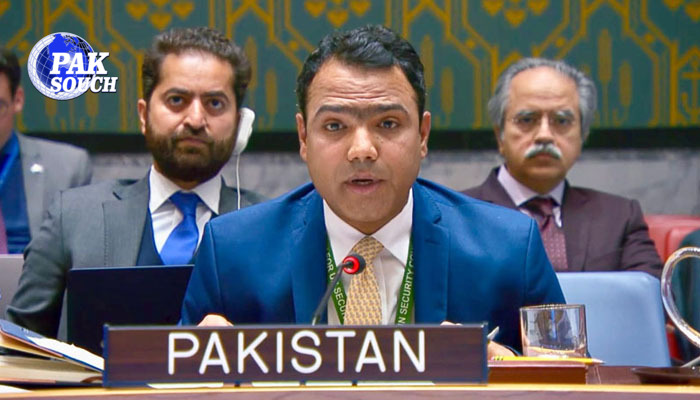
United Nations: Pakistan’s Counsellor at the Permanent Mission to the United Nations, Gul Qaiser Sarwani, has called on India to carefully examine the facts regarding Jammu and Kashmir rather than attempting to deny realities, divert attention, or mislead the United Nations about the disputed territory.
The remarks were made during a debate in the United Nations General Assembly on the annual report of the UN Security Council, where Pakistan exercised its right of reply in response to comments made by the Indian representative concerning the Kashmir issue.
Kashmir Remains an Internationally Recognized Dispute
Responding to India’s statements, Counsellor Gul Qaiser Sarwani emphasized that Jammu and Kashmir remains an internationally recognized dispute that continues to be listed on the agenda of the United Nations Security Council.
He stated that the status of the territory has been the subject of multiple UN resolutions and international discussions for decades. According to him, the dispute has not been resolved and remains a matter of concern for the international community.
Sarwani stressed that Pakistan rejects attempts to alter the historical and legal understanding of the Kashmir issue through political statements or diplomatic narratives.
“Jammu and Kashmir is an internationally recognized dispute that remains on the agenda of the Security Council,” he said while addressing the General Assembly session.
Response to Indian Representative’s Remarks
Pakistan’s response came after comments delivered by India’s representative during discussions on the Security Council’s annual report. While the specific remarks were not detailed in Pakistan’s statement, Islamabad used the opportunity to reiterate its longstanding position on the Kashmir dispute.
Sarwani argued that attempts to distort facts or create ambiguity cannot change the internationally recognized status of Jammu and Kashmir. He said that historical records, legal frameworks, and United Nations resolutions provide a clear basis for understanding the issue.
According to the Pakistani diplomat, efforts to reinterpret or downplay the dispute do not alter the reality that the matter remains unresolved under international law and continues to require attention from the United Nations.
Pakistan Reaffirms Its Position
During his statement, the counsellor reiterated Pakistan’s traditional stance that the future of Jammu and Kashmir should be determined in accordance with relevant UN Security Council resolutions and the aspirations of the Kashmiri people.
He maintained that any attempt to deny the existence of the dispute would be inconsistent with the historical record and the position adopted by the United Nations over the years.
“Any effort to distort reality or create confusion cannot change the historical, legal, and international status of this dispute,” Sarwani told delegates.
The Pakistani diplomat further asserted that Jammu and Kashmir has never been, is not, and will never be what he described as an “integral part” of India, reflecting Islamabad’s long-held position on the territory.
Call for India to Study the Facts
Sarwani urged India to focus on the factual and historical dimensions of the Kashmir issue rather than engaging in what he characterized as attempts to divert international attention from the dispute.
He said that instead of denying established facts or seeking to mislead international forums, India should carefully examine the historical background, legal context, and relevant United Nations resolutions concerning Jammu and Kashmir.
According to Pakistan, a realistic assessment of the dispute is essential for meaningful dialogue and any future efforts aimed at resolving the issue peacefully.
Ongoing Diplomatic Efforts
Pakistan has consistently raised the Kashmir issue at international forums, including the United Nations General Assembly, the Human Rights Council, and meetings of the Security Council. Islamabad maintains that the dispute remains unresolved and requires implementation of relevant UN resolutions.
India, on the other hand, has repeatedly stated that Jammu and Kashmir is an internal matter and rejects third-party involvement. The differing positions of the two countries have remained a central point of tension in bilateral relations for decades.
The issue gained renewed international attention following constitutional changes implemented by India in August 2019, when New Delhi revoked the special status previously granted to Jammu and Kashmir. Pakistan strongly opposed the move and has continued to raise concerns in international forums since then.
Pakistan’s Continued Appeal to the United Nations
In recent months, Pakistani officials, including Prime Minister Shehbaz Sharif and senior diplomats, have repeatedly called upon the United Nations Security Council to play a more active role in addressing the Kashmir dispute.
Pakistan argues that lasting peace and stability in South Asia require a just and peaceful resolution of the issue in accordance with international law and the wishes of the Kashmiri people.
The statement delivered by Counsellor Gul Qaiser Sarwani at the United Nations reflects Pakistan’s ongoing diplomatic campaign to keep the Kashmir issue on the international agenda and to challenge what it sees as attempts to redefine the status of the disputed territory.
As debates continue within international forums, Kashmir remains one of the most sensitive and longstanding disputes in South Asia, with both Pakistan and India maintaining firmly opposing positions on its future and legal status.
About The Author