

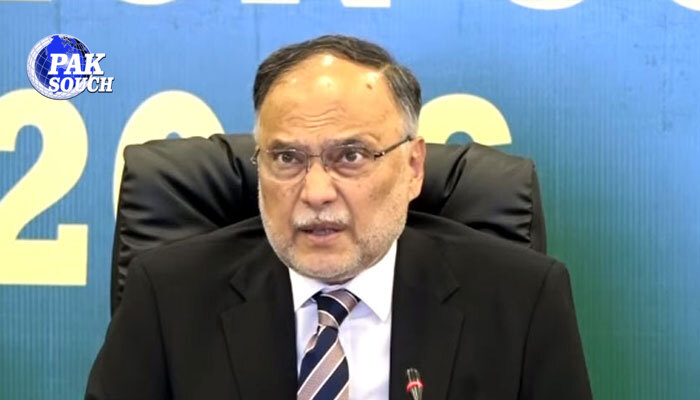
Islamabad: Federal Minister for Planning, Development and Special Initiatives Ahsan Iqbal has clarified that there is currently no proposal under consideration to bring Karachi under the direct administrative control of the federal government. His remarks came during an appearance on Geo News’ current affairs program Naya Pakistan, where he discussed issues related to the National Finance Commission (NFC) Award, provincial autonomy, development funding, and social welfare programs.
The minister’s statement comes amid periodic discussions in political and policy circles about governance challenges in Karachi, Pakistan’s largest city and economic hub. However, Ahsan Iqbal firmly dismissed suggestions that the federal government is considering taking administrative control of the metropolis.
Federal Government Facing Financial Constraints
During the interview, Ahsan Iqbal highlighted what he described as financial difficulties being faced by the federal government under the existing NFC Award formula. According to him, the current revenue-sharing mechanism allocates a substantial portion of national resources to the provinces, leaving the federal government with limited fiscal space to undertake strategic development projects and meet national obligations.
The NFC Award determines the distribution of tax revenues between the federal government and the provinces. It is one of the most significant financial arrangements in Pakistan’s constitutional framework and is closely linked to the principles of provincial autonomy introduced and strengthened through constitutional reforms.
Ahsan Iqbal argued that while the provinces receive a large share of resources under the current formula, the federal government remains responsible for numerous national-level commitments, including defense, foreign affairs, debt servicing, and large-scale infrastructure initiatives. He suggested that the existing arrangement has created challenges for the completion of strategic development projects that are important for the country’s long-term economic growth.
Concerns Over Strategic Development Projects
The planning minister stressed that limited federal resources have made it increasingly difficult to finance and complete major national projects. He noted that strategic initiatives often require substantial investment and coordination at the federal level, but budgetary constraints have reduced the government’s capacity to move forward with some of these programs at the desired pace.
According to Ahsan Iqbal, Pakistan’s economic future depends heavily on investments in infrastructure, connectivity, energy, technology, and human development. He emphasized that ensuring adequate funding for such projects is critical if the country is to achieve sustainable growth and compete effectively in the global economy.
The minister’s comments reflect a broader debate that has been ongoing in Pakistan regarding the balance between provincial autonomy and federal financial requirements. Supporters of the current NFC framework argue that provinces need sufficient resources to manage local governance and development, while critics contend that the federal government requires a larger share to effectively perform its national responsibilities.
Remarks on Benazir Income Support Programme
Ahsan Iqbal also addressed the issue of the Benazir Income Support Programme (BISP), one of Pakistan’s largest social protection initiatives aimed at providing financial assistance to low-income families.
He clarified that the government is not proposing the abolition of the BISP. Instead, he suggested that there should be a discussion about the administrative and financial responsibilities associated with welfare programs following the 18th Constitutional Amendment.
The minister explained that under the constitutional framework established by the amendment, poverty alleviation and social welfare fall largely within the domain of provincial governments. Therefore, he argued that provinces could take greater responsibility for providing financial support to beneficiaries residing within their jurisdictions.
“Our position is not that the Benazir Income Support Programme should be ended,” Ahsan Iqbal said. “Rather, the beneficiaries belonging to a particular province could be funded by that province because poverty reduction programs are a provincial responsibility under the 18th Amendment.”
His remarks are likely to generate debate among policymakers and political stakeholders, as the BISP has long been considered a flagship federal welfare initiative with nationwide coverage.
Debate Over the 18th Amendment
The minister’s comments also touched on the broader implications of the 18th Amendment, a landmark constitutional reform passed in 2010. The amendment significantly expanded provincial autonomy by transferring a number of subjects and responsibilities from the federal government to provincial administrations.
Supporters of the amendment view it as a major step toward decentralization and democratic governance. They argue that provincial governments are better positioned to understand and address local needs.
However, some policymakers have raised concerns over the years about whether the redistribution of powers and financial resources has created operational challenges for the federal government. Ahsan Iqbal’s remarks suggest that discussions on the practical implementation of the amendment and related financial arrangements continue within policy circles.
Karachi’s Status Remains Unchanged
Addressing speculation about Karachi’s administrative future, Ahsan Iqbal categorically rejected reports suggesting that the federal government is considering bringing the city under direct federal control.
Karachi, the capital of Sindh province, serves as Pakistan’s commercial and financial center and contributes significantly to the national economy. Because of its economic importance, proposals regarding its governance periodically become the subject of political debate.
Nevertheless, the planning minister made it clear that no such proposal is currently under review by the federal government. His statement is expected to ease concerns among political parties and stakeholders who have opposed any move that could alter the constitutional and administrative status of the city.
Conclusion
Ahsan Iqbal’s interview focused on the challenges facing the federal government under the current NFC revenue-sharing formula, the need for sustainable funding of strategic national projects, and the role of provinces in poverty alleviation efforts under the 18th Amendment. While advocating a discussion on financial responsibilities between the federation and provinces, he emphasized that there is no plan to abolish the Benazir Income Support Programme and no proposal under consideration to place Karachi under federal administration. His remarks are likely to contribute to ongoing national discussions about fiscal federalism, governance, and development priorities in Pakistan.
About The Author