


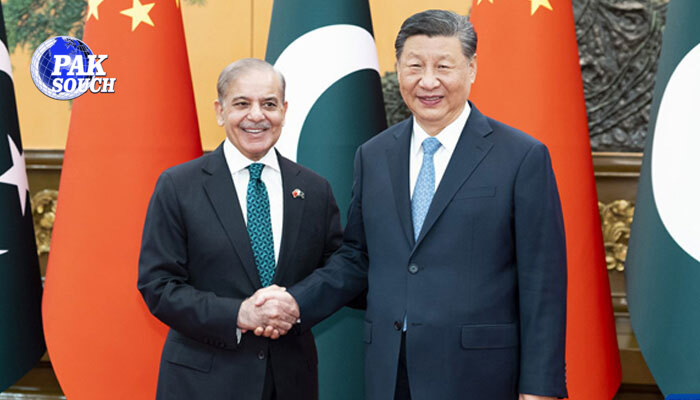
Prime Minister Shehbaz Sharif is set to spend a highly significant and busy day in Beijing today as part of his official visit to China, where he will meet Chinese President Xi Jinping, Premier Li Qiang, and other senior Chinese leaders to further strengthen bilateral ties between the two countries.
According to official sources, the Pakistani premier’s engagements in the Chinese capital are focused on enhancing political, economic, and strategic cooperation between Islamabad and Beijing. The visit is being viewed as an important step in deepening the longstanding friendship between Pakistan and China, often described by leaders of both nations as an “iron brotherhood.”
Upon arrival at the Great Hall of the People, Prime Minister Shehbaz Sharif will be presented with a guard of honor. Chinese Premier Li Qiang is expected to formally receive the Pakistani leader before the commencement of official talks.
The highlight of the day will be high-level meetings between Prime Minister Shehbaz Sharif and Chinese President Xi Jinping, during which both leaders are expected to discuss regional security, economic cooperation, connectivity projects, and matters related to international diplomacy. Officials say the discussions will also include the future expansion of the China-Pakistan Economic Corridor (CPEC), which remains a cornerstone of economic cooperation between the two countries.
Prime Minister Shehbaz Sharif will also hold delegation-level talks with Premier Li Qiang. Senior officials from both sides are expected to participate in these meetings, where multiple areas of cooperation will be reviewed, including trade, investment, energy, infrastructure, agriculture, information technology, and industrial collaboration.
One of the major outcomes anticipated from the visit is the signing of agreements and memorandums of understanding (MoUs) worth more than seven billion dollars between Pakistani and Chinese companies. These agreements are expected to cover several sectors and may pave the way for increased Chinese investment in Pakistan’s economy at a time when Islamabad is seeking stronger economic partnerships and foreign investment opportunities.
The two prime ministers will also witness a formal exchange ceremony of agreements and MoUs signed between institutions and companies from both countries. Officials believe these agreements could help accelerate development projects and expand industrial cooperation under the next phase of CPEC.
Following the official meetings, Prime Minister Shehbaz Sharif, accompanied by his delegation, will visit Tiananmen Square, where he will lay a floral wreath at the Monument to the People’s Heroes. The gesture is considered a symbol of respect and friendship between the peoples of Pakistan and China.
During the visit, Prime Minister Shehbaz Sharif is also scheduled to meet leading Chinese investors and chief executive officers of major Chinese companies. These interactions are expected to focus on attracting investment into Pakistan’s energy, mining, manufacturing, agriculture, and technology sectors. Pakistani officials hope the meetings will encourage Chinese businesses to expand their operations and partnerships in Pakistan.
Analysts believe the prime minister’s visit comes at an important time for Pakistan as the country seeks economic recovery and greater regional connectivity. China remains Pakistan’s largest strategic and economic partner, and both countries continue to cooperate closely on regional and international issues.
In addition to political and economic engagements, the Pakistani premier will also attend a special event marking the 75th anniversary of diplomatic relations between Pakistan and China. Senior Chinese leaders and officials are expected to participate in the ceremony, which will celebrate decades of friendship, cooperation, and mutual support between the two nations.
Pakistan and China established diplomatic relations in 1951, and over the years their partnership has expanded into defense, trade, infrastructure, education, and cultural exchanges. Chinese investment in Pakistan has significantly increased over the last decade, especially under the framework of CPEC, which includes major energy and infrastructure projects across the country.
Observers say Prime Minister Shehbaz Sharif’s meetings with the Chinese leadership are likely to reinforce bilateral trust and create new opportunities for cooperation in emerging sectors such as renewable energy, digital technology, and industrial modernization.
The visit is also expected to send a strong message regarding the strategic alignment between Islamabad and Beijing amid changing regional and global geopolitical dynamics. Both countries have repeatedly expressed their commitment to supporting each other on issues of mutual interest and maintaining close coordination at regional and international forums.
Officials from both sides have expressed optimism that the visit will produce positive outcomes and further strengthen the comprehensive strategic partnership between Pakistan and China.
About The Author