

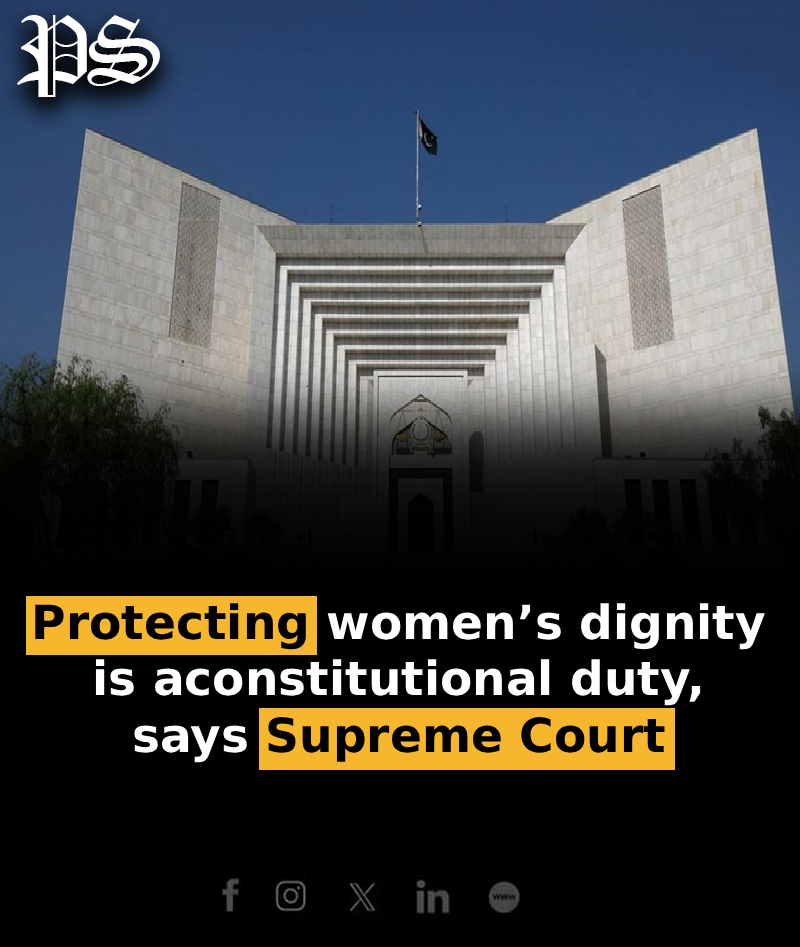
ISLAMABAD: Respect for a woman’s dignity is not merely a matter of personal morality but a constitutional obligation, the Supreme Court (SC) has ruled, observing that violence committed within the privacy of a home cannot be dismissed as a private matter.
The observation came as a two-member bench, headed by Justice Ayesha Malik and comprising Justice Shahid Waheed, dismissed an appeal filed by former Intelligence Bureau (IB) employee Jawad Abbasi against his compulsory retirement over allegations that he had set his wife on fire.
In a nine-page judgment authored by Justice Waheed, the court said a woman’s dignity, whether as a wife, sister, daughter, mother or fellow citizen, was a fundamental value protected by the Constitution. The state, it added, was entitled to expect every person in its service to uphold that dignity.
“The walls of a home are not a jurisdictional boundary, and violence does not become private because it is committed behind a closed door,” the judgment stated, adding that the Constitution’s protection of life and human dignity extended to women within their homes.
The court observed that a civil servant’s conduct was not assessed solely on the basis of performance at the workplace. Their character and private conduct could also become relevant where these affected their suitability for public office, service discipline or public confidence in the institution they served.
Abbasi, who worked as a cook in the IB, had challenged a Jan 15 decision of the Federal Service Tribunal (FST), which upheld the department’s decision to compulsorily retire him. Disciplinary proceedings against him were initiated under the Civil Servants (Efficiency and Discipline) Rules, 2020, following allegations that he had set his wife on fire and displayed conduct considered criminal, unprofessional and prejudicial to service discipline.
The charges against him also included allegations of ill-mannered and short-tempered behaviour and conduct that adversely affected the reputation and discipline of the IB.
The departmental inquiry found the charges established, and Abbasi was awarded the penalty of compulsory retirement through an order issued on June 14, 2024. His departmental appeal was subsequently rejected, while the FST also dismissed his challenge to the punishment.
Abbasi’s counsel, Aftab Alam Yasir, argued before the SC that the matter concerned a private dispute between spouses, had no connection with his client’s official duties and could not constitute misconduct under the civil servants’ rules. The counsel also referred to Abbasi’s acquittal by a trial court in the criminal case and claimed that his wife had attempted suicide.
The court, however, held that an acquittal in criminal proceedings did not automatically absolve a government employee of responsibility under a separate departmental inquiry.
“Off-duty conduct of sufficient gravity may constitute misconduct and acquittal in a criminal case does not undo misconduct independently established in departmental proceedings,” Justice Waheed wrote.
Rejecting the argument that the matter was purely domestic, the court noted that the FIR had been registered under Section 324 of the Pakistan Penal Code, which relates to attempted murder, while the woman’s burn injuries also attracted provisions dealing with offences affecting the human body.
The judgment said the law treated such violence as a public wrong rather than a private dispute between spouses. It also referred to Articles 9, 14 and 25(3) of the Constitution, which protect the right to life, the dignity of individuals and permit special provisions for women’s protection. Pakistan’s obligations under the Convention on the Elimination of All Forms of Discrimination against Women were also cited.
The court further observed that the burning of women in their homes, sometimes portrayed as kitchen accidents or attempted suicide, remained a serious social concern. It said a public institution could not remain indifferent when allegations of such violence involved one of its employees.
According to the judgment, a civil servant found through a proper inquiry to have subjected his spouse to potentially lethal violence could be considered unsuitable for public service, as such conduct was incompatible with the discipline and standards expected of a government employee.
Maintaining that public service was a trust, the Supreme Court held that respect for women was part of the character expected of the state and those who served it. It consequently dismissed Abbasi’s appeal and upheld the decision to compulsorily retire him.
PAK SOUCH MEDIA GROUP
Daily Pak Souch Newspaper Sukkur – Daily Pak Special Newspaper Karachi – Daily Pak Today Newspaper Karachi – Daily Pak Jazbo Newspaper Sukkur
Head Office : Ayub Gate Shaikh Muhalla Near Rabbania Masjid Sukkur
Karachi Office : Office No. 1901-B, 19th Floor Saima Trade Tower (B) Block I.I Chandigarh Road Near Jung Press, Shaheen Complex & National Museum of Pakistan Karachi Sindh Pakistan.
Contact : 03009319022
Website 1 : https://paksouch.com/
Website 2 : https://sindhi.paksouch.com/
Website 3 : https://pakjazbo.com/
Website 4 : https://urdu.pakjazbo.com/
About The Author