

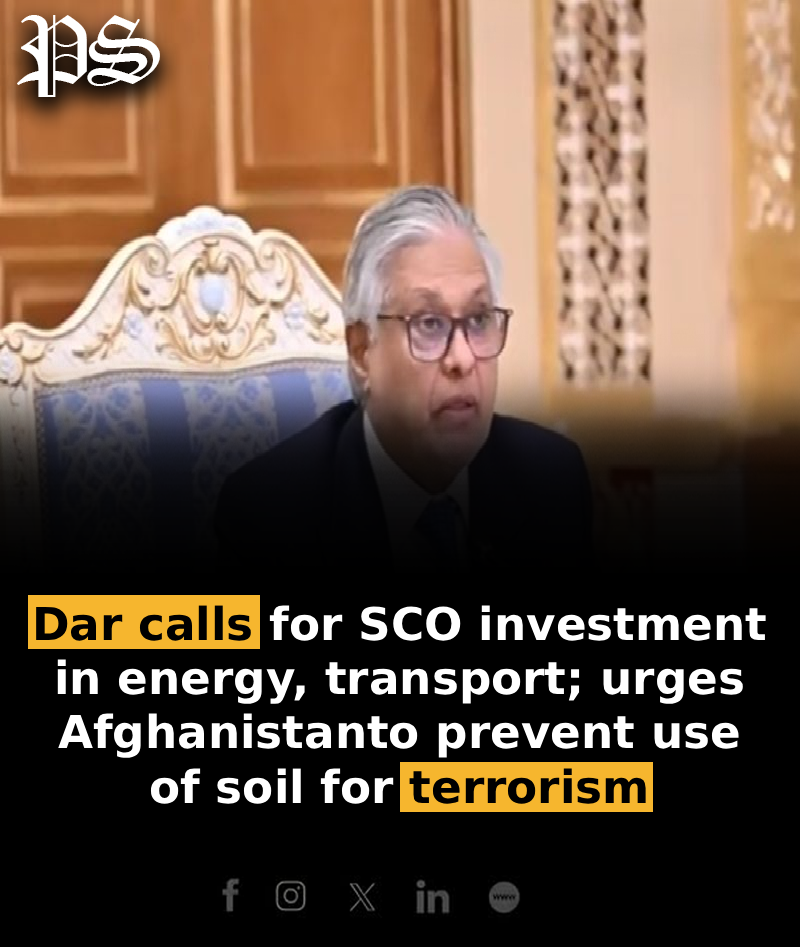
Deputy Prime Minister and Foreign Minister Ishaq Dar on Tuesday called for greater investment in transport and energy infrastructure across the Shanghai Cooperation Organisation (SCO) region, while urging member states to expand economic cooperation, promote settlements in national currencies and move towards establishing an SCO Development Bank and related financing mechanisms.
Addressing the SCO Council of Heads of Government meeting in Dushanbe, Dar said seamless regional economic integration required targeted investment in core sectors, particularly energy and transport, alongside greater investment in agriculture, mining and minerals, and information technology.
“Strategic investment in transport and energy infrastructure is not merely beneficial, it is absolutely imperative for true regional economic integration,” he said.
Dar also reiterated Pakistan’s support for increasing the use of national currencies for mutual settlements and accelerating work towards an SCO Development Bank, SCO Development Fund and investment fund, arguing that such mechanisms could support development projects and help member states absorb international financial shocks.
He said the China-Pakistan Economic Corridor (CPEC) offered SCO members an opportunity to participate in a wider regional integration drive, while artificial intelligence, digital transformation, innovation, energy cooperation and international information security should become major pillars of future cooperation within the organisation.
Dar said Pakistan’s approach was guided by the theme unveiled by Prime Minister Shehbaz Sharif for its SCO chairmanship — “Turning Vision into Action: Connectivity, Innovation and Shared Prosperity” — with five priorities: peace and security, regional connectivity and trade, artificial intelligence and digital transformation, climate resilience and sustainable energy, and people-to-people exchanges.
Dar warns against protectionism, calls for reform of global financial system
The deputy prime minister also criticised protectionist policies and unilateral coercive measures, saying they were inconsistent with international law and restricted economic and technological development.
He argued that such measures slowed economic growth, obstructed technological progress and widened inequality, calling for reform of the international financial architecture and global trade regimes to ensure more equitable development.
Dar said the SCO had expanded considerably over its 25-year history while remaining anchored in what he described as the “Shanghai Spirit” of mutual trust, respect and diversity.
He highlighted Pakistan’s own engagement with the organisation, including hosting the Council of Heads of Government meeting in Islamabad in 2024 and completing its chairmanship of the SCO’s Regional Anti-Terrorist Structure this year.
Pakistan also chairs the SCO working group on poverty alleviation, Dar said, adding that Islamabad intended to use the platform this year to highlight the role of small and medium enterprises in reducing poverty.
Pakistan has previously outlined a broader SCO agenda centred on connectivity, innovation and shared prosperity, including cooperation in artificial intelligence, energy, poverty reduction, disaster management, health, culture and sports.
Afghanistan stability ‘imperative’ for regional peace
Dar said sustained economic development within the SCO region could not be separated from peace and security, placing particular emphasis on Afghanistan.
“Ensuring stability in Afghanistan is imperative for safeguarding peace and stability of our region,” he said.
Pakistan, Dar added, wanted a peaceful, stable, regionally integrated and prosperous Afghanistan that remained at peace internally and with its neighbours.
He said Islamabad had made “sincere efforts” to support Afghanistan’s development and the welfare of its people, but stressed that Pakistan had one fundamental expectation from the Taliban authorities.
“The Afghan territory must not be used for terrorism against Pakistan or any other country,” Dar said.
The remarks echoed Pakistan’s wider security position within the SCO. At the September summit in Bishkek, Prime Minister Shehbaz identified terrorism as a major regional threat and warned that attacks originating from Afghan territory could undermine regional stability.
Dar meets Tajik president on sidelines
Dar’s address came during a two-day visit to Dushanbe, where he is leading Pakistan’s delegation at the SCO Council of Heads of Government meeting.
Earlier on Tuesday, he called on Tajik President Emomali Rahmon alongside other heads of government delegations from SCO member states.
Rahmon welcomed the leaders and stressed the importance of strengthening regional economic cooperation to promote connectivity, stability and shared prosperity.
Dar arrived in Dushanbe on October 19 at the invitation of Tajik Prime Minister Qohir Rasulzoda and was received by Tajikistan’s Minister of Energy and Water Resources Daler Juma and other senior officials.
The Council of Heads of Government is the SCO’s second-highest decision-making body. The Dushanbe meeting has focused on economic, financial and trade cooperation, connectivity, socio-economic development and budgetary matters.
Prime ministers from Belarus, China, Kazakhstan, Kyrgyzstan, Russia, Tajikistan and Uzbekistan are participating, while Iran is represented by its vice president and India by its external affairs minister.
Dar said the joint communiqué and other documents prepared for adoption reflected the collective aspirations and commitments of SCO member states.
Pakistan looks ahead to 2027 SCO summit
Dar also congratulated Uzbekistan’s prime minister on assuming the chair of the SCO Council of Heads of Government for 2026-27, while reiterating that Pakistan would host the organisation’s Council of Heads of State summit in Islamabad in August 2027.
Pakistan has been preparing for the summit as part of its wider SCO responsibilities. Plans include upgrading the Jinnah Convention Centre, constructing an additional block and expanding hotel capacity in Islamabad ahead of the gathering.
Pakistan has also undertaken a series of SCO-related responsibilities during the year, including hosting a meeting of border services chiefs in July and chairing the organisation’s Regional Anti-Terrorist Structure.
Lahore has meanwhile been designated the SCO’s Tourism and Cultural Capital for 2026-27, aimed at promoting tourism and people-to-people engagement among member states.
Dar said Pakistan intended to remain an active participant in shaping the SCO’s future, particularly through greater Eurasian connectivity and economic integration.
“The fundamental strength of SCO is anchored not only in our deeply intertwined histories, but more importantly in the resilient shared future that we collectively choose to forge,” he said.
Pakistan, he added, stood ready to help shape “the next decade of Eurasian connectivity and economic prosperity”.
PAK SOUCH MEDIA GROUP
Daily Pak Souch Newspaper Sukkur – Daily Pak Special Newspaper Karachi – Daily Pak Today Newspaper Karachi – Daily Pak Jazbo Newspaper Sukkur
Head Office : Ayub Gate Shaikh Muhalla Near Rabbania Masjid Sukkur
Karachi Office : Office No. 1901-B, 19th Floor Saima Trade Tower (B) Block I.I Chandigarh Road Near Jung Press, Shaheen Complex & National Museum of Pakistan Karachi Sindh Pakistan.
Contact : 03009319022
Website 1 : https://paksouch.com/
Website 2 : https://sindhi.paksouch.com/
Website 3 : https://pakjazbo.com/
Website 4 : https://urdu.pakjazbo.com/
About The Author