

ISLAMABAD: The year-long closure of major trade routes between Pakistan and Afghanistan has cost businesses billions, disrupted the livelihoods of thousands of workers and pushed Afghan traders towards more expensive alternatives, with Pakistani traders reporting losses running into hundreds of billions of rupees and Pakistan risking a loss of its position as a key transit route linking South Asia with Afghanistan and Central Asia.
The closure, which began in October 2025 following deadly clashes between the two countries, has brought regular commercial activity at the principal border crossings to a standstill, disrupting bilateral trade and the movement of goods through Pakistan into Afghanistan.
The economic consequences extend well beyond exporters and importers. Farmers, transporters, customs clearing agents, warehouse operators, shopkeepers and daily-wage labourers have also been affected, particularly in Khyber Pakhtunkhwa and Balochistan and Afghanistan’s border regions.
Although the two countries have reported substantial losses, estimates vary considerably depending on whether they account for lost export orders, disrupted imports, stranded cargo, transport costs, foregone earnings or wider economic activity.
How much have Pakistan and Afghanistan lost?
Pakistani traders and business associations have reported losses running into hundreds of billions of rupees since the shutdown began.
According to a report published by Profit by Pakistan Today on October 12, traders estimated that the closure had caused losses of between Rs380 billion and Rs400 billion, affecting exporters, importers, transporters and businesses in areas dependent on cross-border commerce.
The estimates reflect the reported impact on trade and related economic activity rather than an independently audited calculation of the net loss to Pakistan’s economy.
A separate report published by Business Recorder on August 22, citing a study by the Pakistan Institute of Development Economics (PIDE), said Pakistani exporters had suffered losses estimated at $4.5 billion since the closure. The report also noted that the methodology behind the figure was not clearly explained, meaning it should be treated as an indicative estimate rather than a verified measure of losses.
The scale of the disruption is nevertheless evident in the decline in bilateral trade. According to figures released by Afghanistan’s Ministry of Industry and Commerce, trade between the two countries fell from approximately $2.46 billion in 2024 to $1.77 billion in 2025, a reduction of about $695 million, or 28 per cent.
The figures cover the entire calendar year of 2025, including the period before the October shutdown. They therefore reflect the broader deterioration in trade during the year and should not be interpreted as the value of goods lost solely because of the closure.
Pakistan’s exports to Afghanistan fell from around $1.64 billion in 2024 to $1.26 billion in 2025. Afghanistan’s exports to Pakistan declined from approximately $817 million to $505 million over the same period, according to the Afghan ministry’s figures reported by Pajhwok Afghan News.
The decline affected both sides, although Pakistan had more to lose in terms of its established export market for manufactured goods, while Afghan producers faced difficulties accessing Pakistani buyers and the established transport corridor to Karachi’s seaport.
A sharp decline in Pakistan’s export market
Afghanistan had been an important destination for Pakistani goods, including cement, medicines, rice, flour, sugar, textiles, steel products and other consumer and industrial items.
The shutdown has deprived Pakistani businesses of a major neighbouring market, leaving exporters with orders that could not be delivered, cargo stranded at border terminals and additional costs associated with storage, financing and transport.
According to the Pakistan Economic Survey 2025-26, Afghanistan’s share of Pakistan’s total exports fell from 4.3 per cent to 1.5 per cent during the reported July-March period.
The reduction has implications for industries that had developed distribution networks and commercial relationships specifically for the Afghan market. Exporters may seek buyers elsewhere, but establishing new markets requires time, competitive pricing and additional investment.
The disruption has also affected Pakistan’s ambitions to use its geographical position to facilitate trade between Afghanistan and Central Asian countries. Goods that previously moved through Pakistani roads and border crossings may now travel through alternative routes, reducing demand for Pakistani transport and logistics services.
Afghanistan turns to alternative routes
For Afghanistan, a landlocked country that relies on neighbouring states for access to seaports, the shutdown has increased the importance of alternative trade corridors through Iran and Central Asia.
Afghan traders have increasingly explored routes through Iran’s Chabahar port and overland connections via Uzbekistan, Turkmenistan and Tajikistan. These alternatives have helped sustain the country’s broader international trade, although they do not necessarily replace the convenience and cost advantages of the established Pakistani route.
Reuters reported on January 6 that Afghanistan’s total international trade rose to nearly $13.9 billion in 2025, with exports of approximately $1.8 billion and imports exceeding $12.1 billion, according to Afghan commerce ministry data.
The figures demonstrate an important distinction: the closure has severely disrupted Pakistan-Afghanistan trade, but it has not stopped Afghanistan’s overall international trade. Afghan businesses have continued importing goods and exporting products through other countries.
However, switching routes can increase freight charges, transit times and uncertainty. The impact varies by commodity, destination, availability of transport and the capacity of alternative ports and road networks.
Afghanistan’s efforts to diversify trade routes could also have longer-term consequences for Pakistan. Even if the border reopens, some Afghan importers and exporters may retain alternative suppliers and transport arrangements to reduce their exposure to future political disputes.
Afghan fruit and vegetable exporters among the hardest hit
Afghanistan’s agricultural sector has been particularly vulnerable because fresh produce is perishable and depends on timely transportation to markets.
Before the closure, Pakistani markets provided an important destination for Afghan fruit and vegetables. Some produce was also moved through Pakistan towards other markets, including India.
With established routes unavailable, Afghan growers and traders have faced difficulties moving their produce, increasing the risk of spoilage and oversupply in local markets.
Such price declines can severely affect farmers and traders who have already invested in cultivation, harvesting, packaging and transportation. When export channels disappear, producers may be forced to sell locally at lower prices or allow unsold produce to deteriorate.
The impact is not uniform across Afghanistan. Traders who can access alternative export destinations may continue selling their products, while those dependent on the Pakistani market face greater difficulties.
Imports through Karachi become more expensive
The closure has also complicated Afghanistan’s access to imported goods shipped through Pakistan’s seaports.
Karachi has historically served as an important maritime gateway for Afghan imports, with cargo transported inland under transit-trade arrangements. The shutdown has disrupted this established supply chain, forcing importers to consider other ports and routes.
Khan Jan Alokozay, head of the Pakistan-Afghanistan Joint Chamber of Commerce and Industry, told the BBC Urdu that transporting a container to Afghanistan, which previously cost up to $2,500 through Pakistan, could cost as much as $10,000 using alternative routes.
If applied to comparable shipments, that would represent a fourfold increase in transport costs. The figure is an estimate attributed to the chamber’s representative, however, and should not be treated as a universal rate for all containers or routes.
Higher freight costs can ultimately feed into the prices paid by importers, wholesalers and consumers. Businesses may also face additional expenses from longer journeys, handling charges, delays and the need to arrange new transport and distribution networks.
Afghan importers who already had cargo at Pakistani ports or in transit have faced particular difficulties, including delays and additional costs associated with holding shipments.
Pakistani border communities face unemployment
The economic damage has been especially visible in communities whose livelihoods depend on cross-border trade.
At Torkham, Chaman and other crossings, thousands of people traditionally earned their income by loading and unloading goods, driving trucks, processing customs documents, operating warehouses, running hotels and restaurants or selling food and other essentials to travellers and transport workers.
When commercial movement stops, these services lose their customers almost immediately.
A report by Voicepk published in August described labourers and customs clearing agents struggling with unemployment and debt after months without regular work.
Aziz-ur-Rehman, a daily-wage labourer at Torkham, told the publication that he had been without work for 10 months and that his household was relying on credit to buy groceries.
Merajuddin, chairman of the Customs Clearing Agents Association, said traders, transporters, labourers and customs agents had all suffered because their incomes depended on border trade.
The consequences extend to businesses that are not directly involved in importing or exporting. Transport yards, fuel stations, roadside restaurants, small shops and accommodation providers also lose customers when trucks and traders stop arriving.
In areas with limited alternative employment, prolonged disruption can push households into debt, reduce spending and weaken local markets.
The impact on ordinary consumers
The shutdown has affected consumers differently on either side of the border.
In Pakistan, traders and retailers have reported disruption to supplies of Afghan fruit, vegetables and other products. Reduced availability can push up prices, although the scale of any increase depends on domestic production, imports from other countries, seasonal conditions and the availability of substitute goods.
For Afghan consumers, the consequences include the higher cost of transporting some imported goods and the loss of access to competitively priced Pakistani products.
Longer routes can increase the cost of food, construction materials, medicines and other goods, but it would be misleading to attribute every price increase in either country to the border closure alone.
The effects are also uneven. Consumers and businesses with access to alternative suppliers may adjust, while low-income households and small enterprises with limited purchasing power have fewer options.
Why were the border crossings closed?
The shutdown followed a sharp escalation in tensions between Islamabad and Kabul in October 2025, including armed clashes and attacks along the frontier.
Pakistan suspended customs clearance at Torkham, Ghulam Khan, Kharlachi and Angoor Adda from October 12, 2025. Customs operations at Chaman were suspended from October 15, according to statements issued by Pakistan’s Federal Board of Revenue and the Press Information Department.
In an October 23 statement, Pakistan’s government said customs clearance had been suspended because of security concerns and attacks that jeopardised the safety of customs inspectors and other personnel at the border stations.
The shutdown was part of a wider deterioration in relations between the two countries over security, cross-border militancy and the presence of armed groups in Afghanistan.
Pakistan has repeatedly accused the Afghan Taliban authorities of allowing the banned Tehreek-e-Taliban Pakistan (TTP) and other militant groups to use Afghan territory to plan and carry out attacks inside Pakistan. Islamabad has demanded verifiable action against militant sanctuaries and has argued that border security cannot be separated from trade.
The Taliban authorities have rejected Pakistan’s accusations and criticised restrictions on trade, arguing that commercial relations should not be used as a political instrument.
The two sides have therefore presented different explanations for the continuing disruption. Pakistan has emphasised security concerns and the safety of its personnel, while Afghan officials have objected to the closure and sought the restoration of normal trade.
The shutdown has continued despite diplomatic efforts and attempts to ease tensions, leaving businesses and border communities caught between the two governments.
Five major crossings and a disrupted trade network
The closure has affected the principal commercial routes connecting Pakistan and Afghanistan.
Torkham, in Khyber Pakhtunkhwa, is a major crossing for bilateral trade and transit cargo. Chaman, opposite Spin Boldak in Afghanistan, is another important route, particularly for trade involving Balochistan and southern Afghanistan.
The other major crossings include Ghulam Khan in North Waziristan, Kharlachi in Kurram and Angoor Adda in South Waziristan.
Before the shutdown, these routes supported the movement of Pakistani exports into Afghanistan, Afghan agricultural and mineral products into Pakistan, and transit cargo destined for Afghan markets.
Their closure has disrupted not only trade between the two countries but also the transport networks, customs services and local businesses built around these routes.
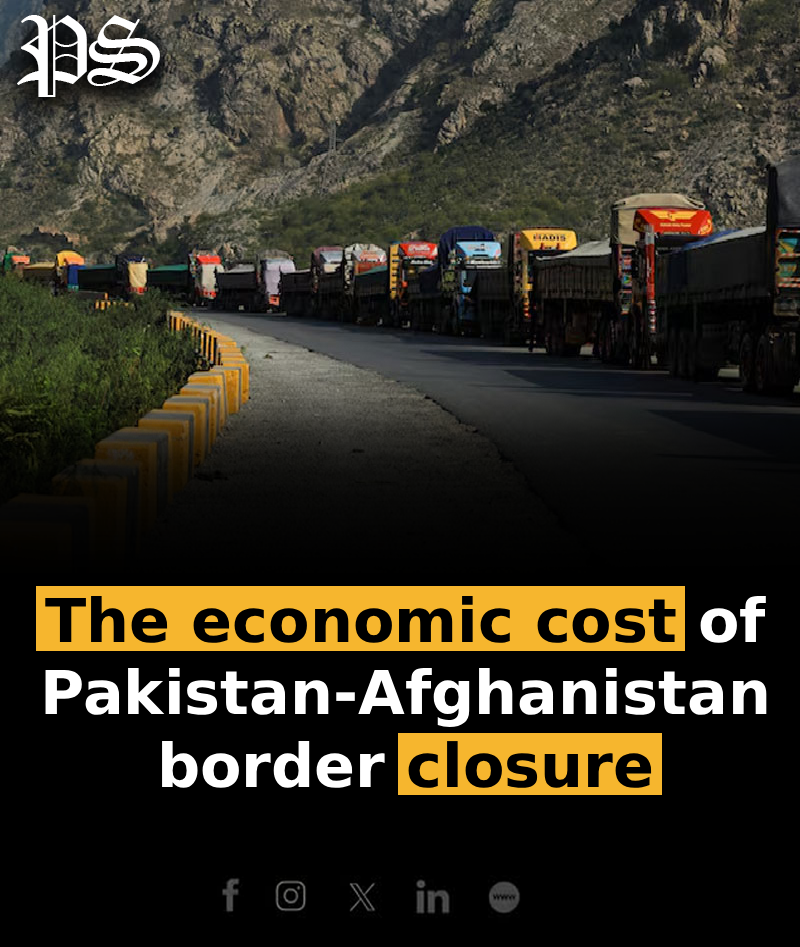
In October 2025, Pakistan’s government reported that hundreds of vehicles carrying import, export and transit cargo were waiting at the affected customs stations. These included vehicles stranded at Torkham and along the Jamrud-Landi Kotal road, as well as transit consignments awaiting permission to cross.
The backlog illustrated how quickly a border shutdown can disrupt a supply chain involving exporters, shipping agents, customs officials, transporters, warehouses and buyers.
A long-term setback for regional connectivity
The effects of the closure could persist beyond the immediate shutdown.
For Pakistan, the loss extends beyond bilateral exports. Its ambition to serve as a trade and transit corridor for Afghanistan and Central Asia depends on reliable transport links, predictable customs procedures and confidence among traders.
When commercial routes are repeatedly disrupted, importers and exporters have an incentive to invest in alternative supply chains, even if those routes are more expensive initially.
Afghanistan’s growing use of Iranian ports and Central Asian routes demonstrates that diversification is possible. The extent to which these alternatives permanently replace Pakistani routes will depend on costs, infrastructure, border procedures and the future security environment.
For border communities, reopening the crossings would restore opportunities for employment and commerce, but recovery may take time. Businesses that have accumulated debts, lost customers or closed operations may need working capital and renewed confidence before they can resume activity.
The prolonged shutdown has therefore become more than a dispute over border management. It has disrupted a network of economic relationships that supports businesses and households on both sides.
The way forward
Traders in Pakistan and Afghanistan have repeatedly called for trade to be separated from political disputes and for commercial routes to be reopened.
Pakistan’s security concerns, including its demands for action against militant groups, remain central to the dispute. Afghan authorities, meanwhile, have sought the resumption of trade and objected to restrictions that affect their businesses and consumers.
Analysts say Pakistan and Afghanistan need a framework that addresses security concerns while ensuring predictable cross-border trade. This would require agreed procedures for reopening crossings, safeguards for customs staff and transporters, and mechanisms to prevent political or security disputes from disrupting commerce for months. They also call for an assessment of economic losses and possible relief for affected businesses and workers.
Ultimately, the prolonged closure has exposed the enormous economic cost of allowing political and security disputes to paralyse cross-border trade. While governments negotiate and tensions persist, the burden falls on traders facing mounting losses, farmers unable to reach markets, transporters left idle and workers stripped of their livelihoods. Unless Pakistan and Afghanistan establish a lasting mechanism to resolve disputes without repeatedly shutting down trade, the damage will extend beyond immediate financial losses, eroding business confidence, disrupting regional commerce and undermining Pakistan’s ambitions of becoming a key trade and transit corridor connecting South Asia with Afghanistan and Central Asia.
PAK SOUCH MEDIA GROUP
Daily Pak Souch Newspaper Sukkur – Daily Pak Special Newspaper Karachi – Daily Pak Today Newspaper Karachi – Daily Pak Jazbo Newspaper Sukkur
Head Office : Ayub Gate Shaikh Muhalla Near Rabbania Masjid Sukkur
Karachi Office : Office No. 1901-B, 19th Floor Saima Trade Tower (B) Block I.I Chandigarh Road Near Jung Press, Shaheen Complex & National Museum of Pakistan Karachi Sindh Pakistan.
Contact : 03009319022
Website 1 : https://paksouch.com/
Website 2 : https://sindhi.paksouch.com/
Website 3 : https://pakjazbo.com/
Website 4 : https://urdu.pakjazbo.com/
About The Author