


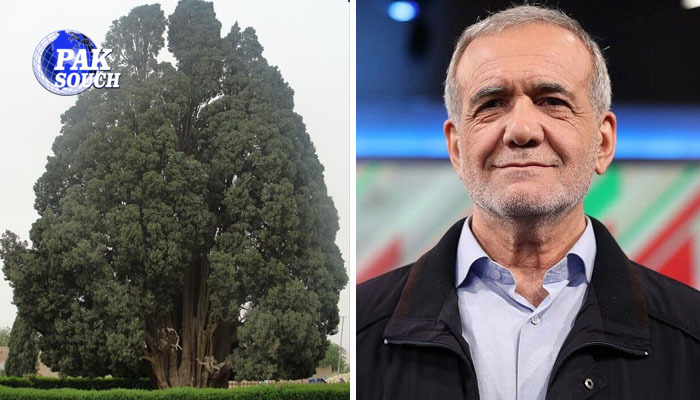
Iranian President Masoud Pezeshkian shared a photograph of a 4,500-year-old tree on social media in what many observers viewed as a symbolic message about Iran’s deep historical roots and enduring national identity.
Without directly naming former US President Donald Trump or any specific political figure, Pezeshkian posted the image of the ancient “Sarv” (cypress) tree on the social media platform X and highlighted its historical significance.
In his post, the Iranian president wrote that the tree is approximately 4,500 years old and is considered the oldest living organism in Asia.
“This Sarv tree is 4,500 years old,” he wrote. “It has stood on this land that was known as Iran even 4,500 years ago.”
The statement was widely interpreted as a subtle response to foreign criticism and political pressure on Iran, particularly amid continuing tensions between Tehran and Washington.
By referring to the ancient tree and emphasizing the historical existence of Iran, Pezeshkian appeared to be underscoring the idea that Iran’s civilization and identity are centuries old and resilient despite international disputes and geopolitical challenges.
The symbolic use of historical and cultural references is common in Iranian political discourse, especially when leaders seek to emphasize national pride, continuity, and sovereignty.
The cypress tree mentioned by the Iranian president is believed to be one of the oldest trees in the world and holds cultural and historical importance in Iran. Ancient cypress trees are often associated with endurance, strength, and permanence in Persian culture and literature.
Social media users and political analysts quickly reacted to the post, with many interpreting it as a message that Iran’s history and identity cannot be erased or undermined by political pressure or external threats.
The timing of the post also attracted attention due to ongoing tensions between Iran and the United States over regional security, sanctions, and nuclear-related disputes.
Although Pezeshkian did not directly mention Donald Trump in his message, some observers linked the post to previous statements and policies by US leaders toward Iran.
The Iranian president’s post gained widespread engagement online, with supporters praising the symbolic reference to Iran’s ancient civilization and cultural heritage.
Political commentators noted that such messaging is often intended not only for international audiences but also for domestic audiences, reinforcing national unity and pride during periods of political tension.
Iran frequently highlights its thousands of years of history and civilization in diplomatic and political messaging. Iranian leaders often use historical symbols, poetry, architecture, and cultural heritage to project resilience and continuity on the global stage.
The image of the ancient tree therefore carried significance beyond nature or history alone, serving as a reminder of Iran’s longstanding identity and presence in the region.
The post also sparked discussions about the role of symbolism in international politics, where leaders increasingly use social media platforms to send subtle political messages without direct confrontation.
About The Author