

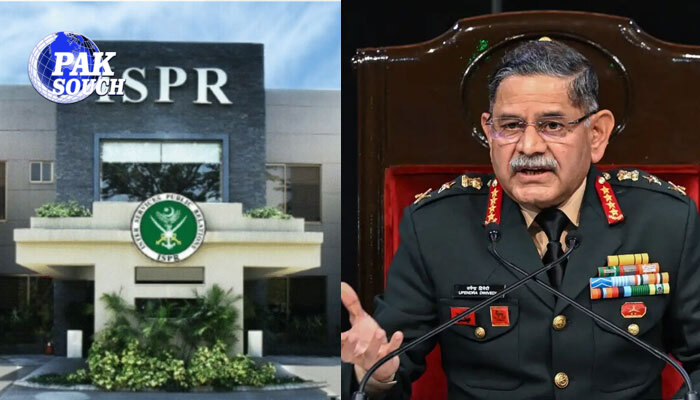
Pakistan’s military has issued a strong response to recent remarks made by Indian Army Chief General Upendra Dwivedi, describing the statement as provocative and irresponsible while emphasizing that Pakistan is a recognized nuclear power and an undeniable part of South Asia’s geography and history.
According to a statement released by the Inter-Services Public Relations (ISPR), the media wing of the Pakistan Army, the comments made by the Indian Army chief reflected an aggressive mindset and a failure to accept Pakistan’s existence despite more than seven decades having passed since independence.
The controversy emerged after General Upendra Dwivedi, during a recent interview, reportedly stated that Pakistan would have to decide whether it wanted to remain part of geography and history. The remarks drew immediate criticism from Pakistan’s military establishment.
Reacting to the statement, ISPR said that unlike the ideology of Hindutva, Pakistan is an important global state and an internationally recognized nuclear power. The military spokesperson stressed that Pakistan is an inseparable and undeniable component of South Asia’s geography, politics, and history.
The ISPR further stated that the Indian Army chief’s remarks revealed that the Indian leadership has still not accepted the reality of Pakistan’s existence. It added that even after eight decades, Indian policymakers have failed to learn from history.
According to the statement, such arrogant, militaristic, and narrow-minded thinking has repeatedly pushed South Asia toward conflicts, wars, and regional crises. Pakistan’s military warned that threatening to erase a sovereign nuclear state from the map is neither strategic signaling nor diplomatic pressure.
Instead, the ISPR described such language as a sign of “mental bankruptcy, extremism, and war hysteria.”
The statement emphasized that responsible nuclear states demonstrate patience, restraint, and strategic maturity rather than using threatening language or claims of civilizational superiority.
Pakistan’s military also accused India of involvement in state-sponsored terrorism and destabilizing activities across the region. According to ISPR, India has a documented history of cross-border targeted killings and spreading disinformation campaigns internationally.
The military media wing further stated that New Delhi’s aggressive behavior stems from frustration over its inability to harm Pakistan strategically or politically.
Referring to what it called “Marka-e-Haq” (Battle for Truth), the ISPR claimed that India’s failures and frustrations had been exposed before the international community. The statement warned Indian leadership against pushing South Asia toward another military confrontation or regional crisis.
Pakistan’s military also cautioned that any attempt to target Pakistan would not remain limited to geographical boundaries. The consequences, it said, would extend beyond the region and could become strategically and politically unacceptable for India itself.
“The effects would not only impact the entire region but could also have destructive consequences beyond South Asia,” the statement noted.
The ISPR reiterated that India must recognize Pakistan’s significance in the region and adopt a path of peaceful coexistence rather than hostility and confrontation.
The latest exchange of statements comes amid already tense relations between the two neighboring nuclear powers. Pakistan and India have long-standing disputes over various issues, including Kashmir, border tensions, and regional security concerns.
Diplomatic and military observers often warn that hostile rhetoric between the two countries can increase instability in South Asia, especially given that both nations possess nuclear capabilities. International analysts frequently stress the importance of dialogue, diplomatic engagement, and confidence-building measures to avoid escalation.
The strong reaction from Pakistan’s military reflects the seriousness with which Islamabad viewed the Indian Army chief’s comments. Political analysts believe such statements can further strain already fragile relations between the two countries at a time when regional peace remains a major concern.
Despite recurring tensions, global powers and international organizations have repeatedly encouraged both Pakistan and India to resolve disputes through diplomacy and maintain stability in the region.
The ISPR concluded its statement by urging India to abandon aggressive posturing and move toward peaceful coexistence, warning that confrontational policies could endanger not only the two countries but the broader region as well.
About The Author