

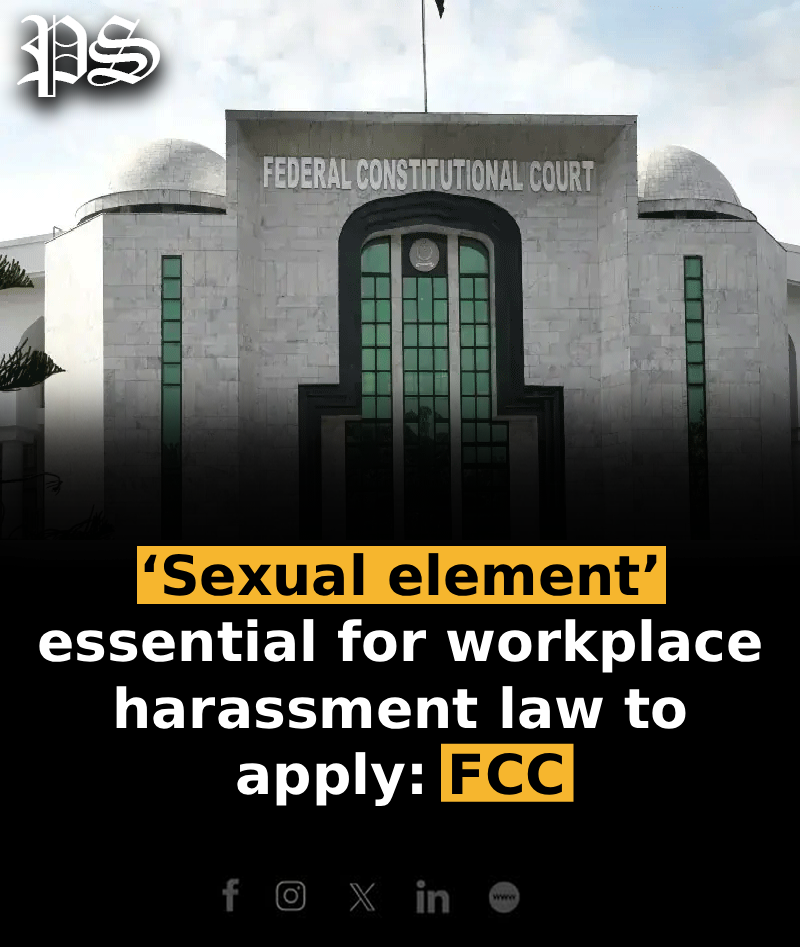
ISLAMABAD: The Federal Constitutional Court (FCC) has ruled that a ‘sexual element’ is necessary for conduct to be treated as harassment under the Protection Against Harassment of Women at the Workplace Act, 2010, saying that not every inappropriate, unwanted or harmful act falls under the law.
The court set aside the Islamabad High Court’s (IHC) December 31, 2024 judgment in a workplace harassment case involving a National Bank of Pakistan (NBP) employee and restored an order passed by the President of Pakistan that had modified the penalty imposed on two bank officials.
The judgment was issued on appeals filed by NBP officials Usman Shahid and Aqeel Abbas in the case of Nadia Sarwar versues Aqeel Abbas and others.
A three-member FCC bench headed by Chief Justice Aminuddin Khan and comprising Justice Ali Baqar Najafi and Justice Syed Arshad Hussain Shah heard the matter. Justice Najafi authored the 18-page judgment.
The court held that the definition of harassment under Section 2(h) of the 2010 Act was exhaustive and that an act, conduct or attitude must have a sexual nature to constitute actionable harassment under the law.
It observed that conduct could be undesirable, inappropriate or harmful without necessarily falling within the statutory definition of sexual harassment.
“In such cases, the Federal Ombudsman for Protection against Harassment of Women at Workplace would not have jurisdiction under the Act, although the organisation concerned could take disciplinary action under its own service rules,” the ruling said.
The FCC also held that the Act could not be applied to every complaint of a general nature, saying its purpose was to protect women and men at workplaces from sexual harassment.
Case background
The dispute dates back to 2012, when Nadia Sarwar, an NBP employee who had been working at the bank since 2008, complained to the bank’s president against Aqeel Abbas and Usman Shahid.
According to the record before the IHC, Sarwar alleged that she was being subjected to harassment and victimisation and that the conduct of the two officials had created an intimidating, hostile and offensive work environment.
She submitted her first complaint to the NBP president on September 24, 2012.
After receiving no relief, Sarwar approached the bank’s divisional head and raised her allegations by telephone and email.
She subsequently submitted another complaint to the NBP president on July 2, 2013, in which she referred to specific instances of what she described as harassment. She alleged that no inquiry or effective action was taken by the bank.
Sarwar then approached the Federal Ombudsman for Protection against Harassment of Women at Workplace on September 3, 2013, invoking the Protection Against Harassment of Women at the Workplace Act, 2010.
The Ombudsman ruled in her favour and imposed a major penalty on the two officials.
The FCC’s cause-list record describes the original penalty as compulsory retirement, while APP reported it as dismissal from service.
The president subsequently accepted the officials’ representations and modified the punishment to censure/reprimand.
Sarwar challenged the president’s decision before the Islamabad High Court.
IHC restored Ombudsman’s decision
The IHC, in its judgment on December 31, 2024, allowed Sarwar’s petition and set aside the president’s order, thereby restoring the Ombudsman’s decision.
The two officials then approached the Federal Constitutional Court, challenging the IHC ruling.
The FCC has now set aside the IHC judgment and restored the president’s order, effectively reinstating the punishment modified by the president rather than the more severe penalty imposed by the Ombudsman.
FCC on limits of High Court jurisdiction
The FCC also dealt with the scope of the high court’s power to interfere with decisions of the Federal Ombudsman.
It held that the high court, while exercising constitutional jurisdiction, could interfere where there had been an abuse or excess of jurisdiction, a violation of law, an erroneous assumption or misreading of facts, or a breach of principles of natural justice.
The FCC said the high court could not simply substitute its own assessment of the evidence for that of the relevant tribunal or authority unless one of those recognised grounds for constitutional intervention was established.
The court further held that the President was competent to hear representations against decisions of the Federal Ombudsman, rejecting the basis on which the IHC had interfered with the President’s order.
FCC’s interpretation of harassment
The FCC drew a distinction between general workplace misconduct and harassment falling within the specific statutory framework.
It said that while conduct might generally be described as harassment in ordinary language, not every form of harassment or misconduct was actionable under the workplace harassment law. For the Federal Ombudsman to exercise jurisdiction, the conduct must satisfy the statutory definition.
The court therefore held that undesirable or harmful conduct without a sexual element could not be entertained by the Ombudsman under the Act, though the employer could still proceed against the employee under applicable service rules.
Ruling differs from recent Supreme Court interpretation
The FCC ruling comes against the backdrop of a 2025 Supreme Court judgment that took a broader view of workplace harassment.
In “Muhammad Din versus Province of Punjab” case, the Supreme Court dealt with a complaint against a driver accused of verbal abuse, character assassination, inappropriate conduct and other behaviour towards a female doctor.
Former SC Judge Syed Mansoor Ali Shah held that workplace harassment could arise from power and gender dynamics and was not necessarily dependent on sexual desire or conduct.
That judgment also discussed the 2022 amendment to the workplace harassment law, which expanded the statutory definition to include gender-based discrimination that may or may not be sexual in nature when it stems from a discriminatory or prejudicial mindset and results in discriminatory behaviour.
The FCC’s ruling, however, arose from the legal framework applied to the Nadia Sarwar case and focused on the scope of the Ombudsman’s jurisdiction and the statutory definition of actionable harassment.
The decision has consequently put the interpretation of workplace harassment under renewed judicial scrutiny, particularly over the extent to which non-sexual but gender-based or otherwise hostile conduct can be dealt with under the 2010 law as amended.
PAK SOUCH MEDIA GROUP
Daily Pak Souch Newspaper Sukkur – Daily Pak Special Newspaper Karachi – Daily Pak Today Newspaper Karachi – Daily Pak Jazbo Newspaper Sukkur
Head Office : Ayub Gate Shaikh Muhalla Near Rabbania Masjid Sukkur
Karachi Office : Office No. 1901-B, 19th Floor Saima Trade Tower (B) Block I.I Chandigarh Road Near Jung Press, Shaheen Complex & National Museum of Pakistan Karachi Sindh Pakistan.
Contact : 03009319022
Website 1 : https://paksouch.com/
Website 2 : https://sindhi.paksouch.com/
Website 3 : https://pakjazbo.com/
Website 4 : https://urdu.pakjazbo.com/
About The Author