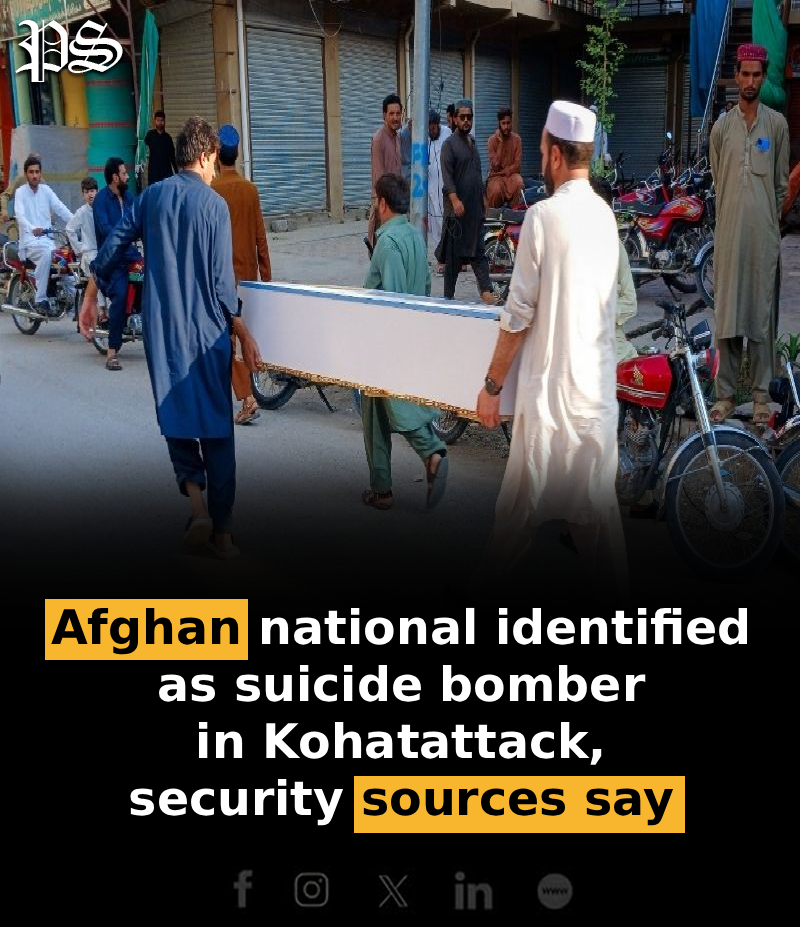
An Afghan national has been identified as one of the suicide bombers involved in the attack on Kohat Police Lines, security sources said on Saturday, as an overnight clearance operation ended with eight militants killed.
Eight militants were killed in the operation, which continued for around 22 hours, according to the Central Police Office. Security sources said the final phase was carried out by Army commandos after dawn, when the remaining militants, including two suicide bombers, were killed.
The suicide bomber was identified as Mutiullah, an Afghan citizen, the sources said, adding that authorities were still working to establish the identity of another militant involved in the attack.
The sources said the identification of the bomber was evidence that, according to them, Afghan territory was being used to facilitate attacks against Pakistan. They also accused the Afghan Taliban of making misleading claims to divert attention from militant activity.
Eight militants killed in clearance operation
Police and security forces completed an overnight clearance operation at the old Kohat Police Lines after militants infiltrated the compound following an attack during Friday prayers.
The attack began at around 1:20pm on Friday, when a suicide bomber detonated near the Police Lines mosque, followed by an exchange of fire between the attackers and security forces.
Officials said at least 21 people, including 15 police personnel, were killed and more than 100 injured in the attack.
Elite Force commandos, Counter-Terrorism Department personnel and other security forces took part in the clearance operation. The operation was supervised by the GOC Kohat, while KP Inspector General of Police Zulfiqar Hamid and other senior police officers remained at the scene.
The CTD said its additional inspector general, who was overseeing the operation from the frontline, sustained a hand injury when militants targeted him with a grenade but returned to duty after receiving initial treatment.
The identity of the second suspected militant remains under investigation, the security sources said.
PAK SOUCH MEDIA GROUP
Daily Pak Souch Newspaper Sukkur – Daily Pak Special Newspaper Karachi – Daily Pak Today Newspaper Karachi – Daily Pak Jazbo Newspaper Sukkur
Head Office : Ayub Gate Shaikh Muhalla Near Rabbania Masjid Sukkur
Karachi Office : Office No. 1901-B, 19th Floor Saima Trade Tower (B) Block I.I Chandigarh Road Near Jung Press, Shaheen Complex & National Museum of Pakistan Karachi Sindh Pakistan.
Contact : 03009319022
Website 1 : https://paksouch.com/
Website 2 : https://sindhi.paksouch.com/
Website 3 : https://pakjazbo.com/
Website 4 : https://urdu.pakjazbo.com/
About The Author