

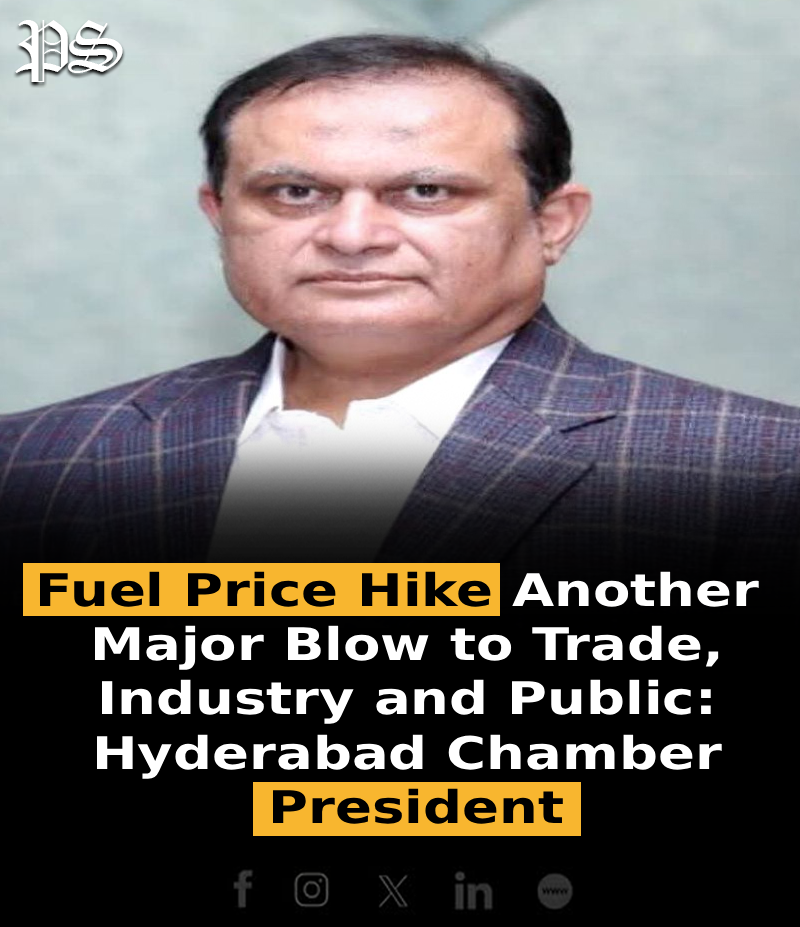
HYDERABAD: President of the Hyderabad Chamber of Small Traders and Small Industry, Muhammad Saleem Memon, has described the recent increase in petrol and diesel prices as another major blow to traders, industrialists and the general public, urging the government to immediately withdraw the additional burden imposed through higher fuel prices.
Memon said the prices of petrol and diesel had reportedly increased by nearly Rs21 within three days, creating further difficulties for businesses and households already struggling with rising costs and declining purchasing power.
He said repeated increases in petroleum product prices had become an easy way of transferring the burden of economic mismanagement onto the business community and ordinary citizens.
According to Memon, petrol and diesel are not merely fuels but essential components of the country’s entire economic system. Whenever their prices increase, the impact is quickly felt across multiple sectors, including transportation, industry, agriculture, wholesale and retail trade, and eventually the household budgets of ordinary citizens.
The chamber president said traders and industrialists were already facing several serious economic challenges. These included high electricity costs, elevated interest rates, increasing business expenses, declining purchasing power and weak demand in the markets.
In such circumstances, he said, another increase in fuel prices would make it increasingly difficult for small traders and small industries to continue operating and maintain their businesses.
Memon said the government could not continue following a policy in which the public was treated merely as a source of taxes and revenue.
If petroleum prices were repeatedly increased, he argued, the government must also explain what practical relief measures were being offered to the public and business community to help them absorb the additional financial burden.
He questioned why the entire impact of higher fuel prices was being transferred to consumers when the government had a responsibility to protect purchasing power, economic activity and businesses.
The chamber president pointed out that small traders were particularly vulnerable because they could not pass every increase in their operating costs on to consumers.
When consumers were already under pressure because of declining purchasing power, further increases in prices could result in lower sales, reduced profit margins and growing pressure on businesses to cut expenses.
He warned that in some cases, businesses could be forced to reduce their workforce or even close down completely if rising operating costs continued unchecked.
Memon said small-scale industries were facing a similar situation. Increasing production, transportation, delivery and distribution costs were making it difficult for small industrial units to remain competitive in the market.
He stressed that the government must recognize that there was a limit to generating revenue through taxes, duties and levies.
According to him, excessive financial pressure on businesses and consumers could ultimately weaken economic activity and reduce demand, creating additional challenges for the overall economy.
Memon urged the government to immediately review the recent increase in petroleum prices and consider a temporary reduction or appropriate adjustment in taxes and levies imposed on petroleum products.
He said such a measure would prevent the entire burden of the extraordinary increase from being transferred directly to consumers.
The Hyderabad Chamber president said the business community was not opposed to reasonable economic measures or necessary fiscal adjustments. However, traders and industrialists strongly rejected policies under which the burden of repeated economic adjustments was consistently shifted onto businesses and ordinary citizens.
He emphasized that the government should adopt a balanced approach that takes into account both its revenue requirements and the financial capacity of businesses and consumers.
Memon said fuel prices had a far-reaching impact on the economy because transportation costs were directly linked to the prices of petroleum products.
An increase in fuel prices raises the cost of transporting raw materials, agricultural produce and finished goods. These additional costs are then reflected in wholesale and retail prices, placing further pressure on consumers.
For small businesses operating with limited profit margins, even a relatively modest increase in operating expenses can have a significant impact on profitability.
He also warned that higher prices could further weaken consumer purchasing power. When households are forced to spend more on essential goods and transportation, they have less money available for other purchases, which can reduce demand in the market.
This decline in demand, combined with higher operating costs, can put additional pressure on small traders and businesses.
Memon called for a comprehensive economic strategy aimed at reducing pressure on businesses while also protecting consumers from further inflation.
He reiterated his demand that the government reconsider the recent increase in petrol and diesel prices and introduce temporary relief through adjustments in taxes and petroleum levies.
He said the business community needed an environment in which traders and industrialists could continue investing, maintaining employment and contributing to economic growth.
The chamber president also stressed that protecting small businesses was particularly important because they played a significant role in generating employment and sustaining economic activity at the local level.
He said repeated increases in operating costs without corresponding relief measures could weaken the small-business sector and affect thousands of traders and workers.
Memon urged the authorities to take immediate and practical steps to prevent further pressure on trade, industry and household budgets.
He concluded that the business community supported sensible economic policies but expected the government to demonstrate through concrete measures that public relief, purchasing power and business protection were also among its priorities.
He called for an immediate review of petroleum prices and appropriate adjustments in taxes and levies to ensure that the latest increase did not place an excessive burden on traders, industrialists and the general public.
About The Author