

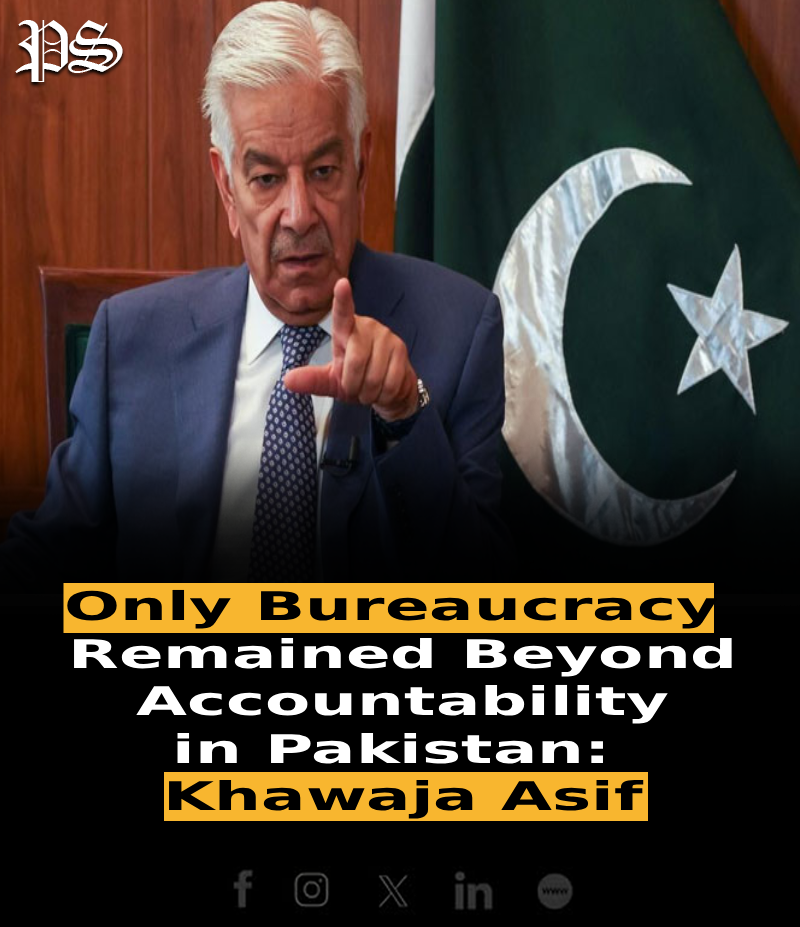
ISLAMABAD: Defence Minister Khawaja Asif has said that almost every section of Pakistan’s ruling elite has had to pay a price for its actions, while bureaucracy remained the only powerful segment that largely stayed beyond accountability.
Khawaja Asif said that members of the ruling elite had faced action over various allegations, including corruption and mismanagement. However, he argued that the bureaucracy remained relatively protected from accountability and continued to be difficult to hold responsible.
The defence minister said that many Pakistanis may not fully realise that bureaucrats have also played a significant role in governing the country throughout its history.
He pointed to several prominent figures from Pakistan’s political history who had backgrounds in the civil bureaucracy.
According to Khawaja Asif, former Governor-General Ghulam Muhammad was a bureaucrat, while former Prime Minister Chaudhry Muhammad Ali had also served as a bureaucrat. He further noted that former presidents Iskander Mirza and Ghulam Ishaq Khan were also bureaucrats.
He said this influence of bureaucrats existed even during periods when, on the surface, political leaders appeared to hold the reins of power.
Politicians Also Responsible
Khawaja Asif clarified that he did not intend to blame bureaucrats alone for the situation.
Instead, he argued that the incompetence, internal divisions and disagreements among politicians created space for the bureaucracy to expand its influence over state affairs.
He suggested that politicians must first put their own house in order if they want to reduce bureaucratic dominance and improve accountability within the system.
The defence minister said that political reform and greater competence among politicians would ultimately lead to improvements within the bureaucracy as well.
According to him, if politicians succeed in reforming themselves and strengthening political institutions, reform and accountability in the bureaucracy would also follow naturally.
His remarks highlight a long-standing debate in Pakistan over the balance of power between elected political governments and the civil bureaucracy.
Bureaucrats have historically played an important role in running the state machinery, particularly because of their control over administration, policy implementation and government institutions. Khawaja Asif’s comments suggest that political weaknesses have contributed to the continuation of that influence.
He also appeared to argue that accountability should not be limited to elected representatives or political leaders. Instead, all sections of the ruling structure should be subject to effective checks and accountability.
The minister’s statement comes amid continuing discussions about governance, institutional reform and accountability in Pakistan. His comments put particular emphasis on the need for politicians to address their own shortcomings rather than placing the entire responsibility for institutional problems on the bureaucracy.
Khawaja Asif’s central argument was that stronger political leadership and greater political unity could reduce the space available for unelected administrative structures to exercise excessive influence.
He maintained that meaningful reform would require politicians to improve their own performance first, after which broader reforms within the bureaucracy and state institutions could follow.
About The Author