

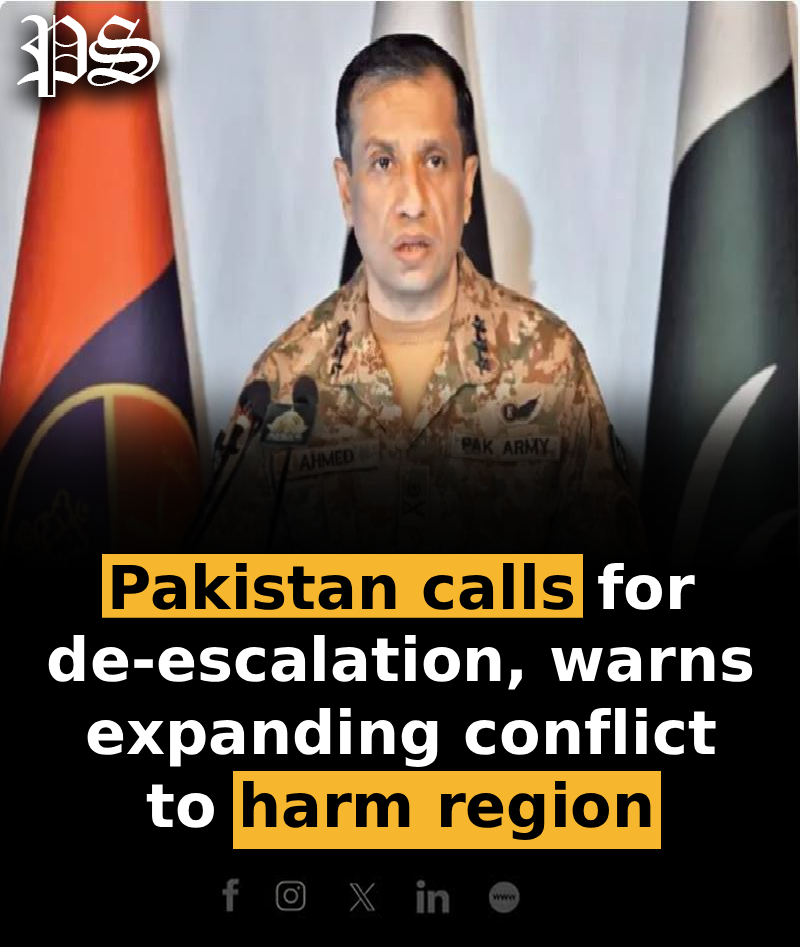
Inter-Services Public Relations (ISPR) Director General Lt-General Ahmed Sharif Chaudhry has reaffirmed Pakistan’s commitment to reducing regional tensions through diplomatic engagement with Iran while warning that any threat to Saudi Arabia’s sovereignty, territorial integrity or Islamic holy sites would face a collective response under the Makkah Defence Alliance.
In an Interview with Independent Arabia, Lt-Gen Ahmed Sharif Chaudhry said that “the concern about escalation is always present because we are witnessing a recurring cycle of de-escalation and escalation, then de-escalation and escalation again,” explaining that Pakistan and its partners in the region continue to engage with the relevant parties to try to break this cycle.
He added, “We constantly emphasise to them that this cycle is not good, and it does not serve the interests of the region, nor the interests of the parties involved in the conflict itself,” stressing that Islamabad will continue its diplomatic efforts aimed at reducing tensions.
The military spokesperson said Pakistan was maintaining communication with Tehran and other regional stakeholders to prevent further escalation and pursue peaceful solutions to ongoing conflicts. He also confirmed that the collective deterrence mechanism established under the Pakistan-Saudi Arabia-Türkiye defence arrangement was already being implemented, describing it as a defensive framework intended to discourage aggression and preserve regional stability.
Discussing Pakistan’s communication with Iran, the ISPR DG said the country’s political and military leadership had maintained contacts with Tehran for several months, focusing on restraint and preventing further escalation. He explained that Pakistan’s engagement with the relevant parties was aimed at narrowing differences and encouraging negotiated solutions rather than allowing the conflict to expand.
He said Pakistan and its regional partners were working to prevent the conflict from expanding geographically or intensifying militarily.
When asked whether Islamabad had conveyed a direct warning to Tehran following the attacks on Saudi Arabia, he neither confirmed nor denied such communication. However, he emphasised that Pakistan’s diplomatic exchanges remained focused on reducing tensions.
The military spokesperson also warned that continued regional confrontation would not serve the interests of the countries involved, stressing the importance of negotiations and diplomatic engagement.
The ISPR DG reaffirmed Pakistan’s commitment to protecting Saudi Arabia’s sovereignty, territorial integrity and the security of the Two Holy Mosques. He said Pakistan was already providing the necessary support to Saudi Arabia and would continue doing so under its existing defence commitments.
While declining to disclose operational details because of military confidentiality, he maintained that Islamabad remained prepared to employ the means available to fulfil its security obligations.
His remarks came against the backdrop of Houthi attacks on Saudi Arabia, which have raised concerns about regional security and the protection of Islamic holy sites.
The DG ISPR said the attacks had generated anger among Pakistan’s political and military leadership and the wider public, reflecting the importance attached to the security of Makkah and Madinah.
Explaining the Pakistan-Saudi Arabia-Türkiye defence arrangement, Lt-Gen Chaudhry described the Makkah Alliance as a defensive mechanism grounded in the right of self-defence under Article 51 of the United Nations Charter.
He said the alliance was not directed against any particular country and had no offensive objectives. Instead, its purpose was to strengthen collective security, discourage aggression and support regional peace.
According to the ISPR DG, any direct or indirect war against one of the three member countries would trigger a collective response under the alliance’s commitments. He also highlighted progress in the alliance’s institutional development, including the establishment of its secretariat and a strategic political and defence committee involving senior officials from the three countries.
Lt-Gen Chaudhry said the arrangement built upon longstanding defence cooperation and historical relations among Pakistan, Saudi Arabia and Türkiye. He further clarified that the alliance did not replace existing bilateral defence agreements or security partnerships.
Addressing those responsible for attacks against Saudi Arabia, the military spokesperson said Pakistan’s defence commitments were intended to send an unmistakable message to both the perpetrators and those supporting them.
He stressed that the collective deterrence framework was designed to demonstrate the willingness and capability of member countries to respond to threats.
Referring to Pakistan’s experience in dealing with non-state armed groups, Lt Gen Chaudhry argued that such organisations often operated differently from states and could be difficult to deter through conventional diplomatic signals alone.
He maintained that clear and decisive security commitments were necessary to discourage further attacks and prevent militant groups from exploiting regional instability.
The ISPR DG also cautioned that expanding military confrontation would harm regional interests and complicate efforts to reach negotiated settlements.
Discussing the future of the Makkah Alliance, Lt-Gen Chaudhry said the arrangement was not necessarily limited to its three founding members. He indicated that countries sharing its objectives of regional stability and collective security could potentially become part of the framework.
However, he did not confirm reports concerning the possible inclusion of other countries, explaining that decisions about membership rested with the political and strategic leadership of the existing member states.
The military spokesperson reiterated that the alliance was intended to promote peace and security rather than create confrontation with any particular regional actor.
The ISPR DG also discussed maritime security challenges in the Strait of Hormuz and Bab el-Mandeb, highlighting the importance of international cooperation to protect shipping routes and regional trade.
He referred to Pakistan’s participation in multinational maritime security arrangements and said regional countries were increasingly recognising the importance of collective security cooperation.
PAK SOUCH MEDIA GROUP
Daily Pak Souch Newspaper Sukkur – Daily Pak Special Newspaper Karachi – Daily Pak Today Newspaper Karachi – Daily Pak Jazbo Newspaper Sukkur
Head Office : Ayub Gate Shaikh Muhalla Near Rabbania Masjid Sukkur
Karachi Office : Office No. 1901-B, 19th Floor Saima Trade Tower (B) Block I.I Chandigarh Road Near Jung Press, Shaheen Complex & National Museum of Pakistan Karachi Sindh Pakistan.
Contact : 03009319022
Website 1 : https://paksouch.com/
Website 2 : https://sindhi.paksouch.com/
Website 3 : https://pakjazbo.com/
Website 4 : https://urdu.pakjazbo.com/
About The Author