


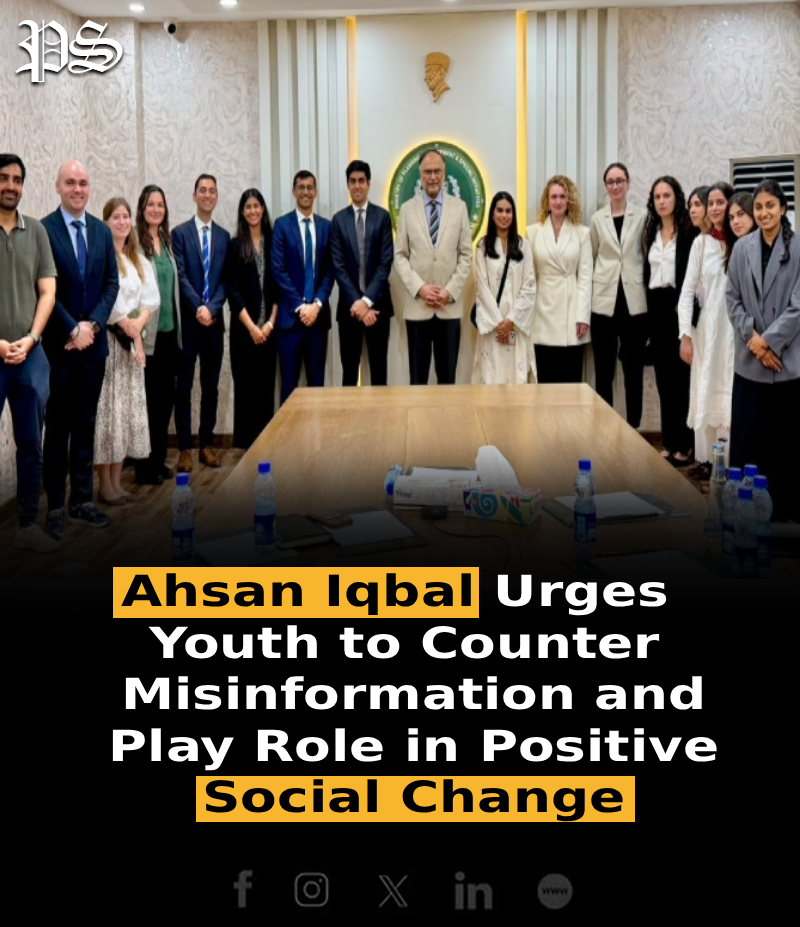
ISLAMABAD: Federal Minister for Planning and Development Ahsan Iqbal has urged young people to play an effective role in countering misinformation and promoting positive change in society.
The federal minister made these remarks during a meeting with a delegation of MBA students from Harvard Business School at the Ministry of Planning and Development.
During the meeting, Ahsan Iqbal briefed the students about the government’s “Uraan Pakistan” initiative, describing it as a comprehensive national roadmap for transforming the country’s economy and development trajectory.
He said Pakistan had set a target of becoming a $1 trillion economy by 2035. According to the minister, achieving this goal would require the country to significantly increase its productive capacity and develop products and services that can compete successfully in international markets.
Ahsan Iqbal said Pakistan needed to move beyond simply consuming emerging technologies and should instead become a creator and developer of technology tailored to its own requirements.
He highlighted several areas in which Pakistan needs to strengthen its technological and research capabilities, including artificial intelligence, biotechnology, advanced manufacturing, agriculture and space sciences.
The minister stressed that investment in research, innovation and human capital would be essential if Pakistan wanted to become a competitive participant in the global economy.
He said the country needed to develop the capacity to create new technologies and adapt emerging innovations to local economic and social needs rather than remaining dependent on imported technological solutions.
During the meeting, Ahsan Iqbal also discussed the changing role of the China-Pakistan Economic Corridor (CPEC).
He explained that the first phase of CPEC had focused primarily on infrastructure development and energy projects. The next phase, he said, would place greater emphasis on industrial cooperation, technology transfer, agriculture, exports and stronger linkages between businesses in Pakistan and China.
According to the minister, the evolution of CPEC is intended to move the initiative towards areas that can directly contribute to industrial development, productivity and export growth.
He said greater industrial collaboration and technology transfer could help Pakistan develop stronger domestic production capabilities and improve its position in international markets.
Ahsan Iqbal also encouraged the Harvard Business School students to consider returning to Pakistan in the future.
He invited them to return not merely as tourists or visitors, but as investors, entrepreneurs and partners in Pakistan’s economic transformation.
The minister said young Pakistanis with international education and exposure could make an important contribution to the country’s economic development by bringing knowledge, investment and innovative ideas back to Pakistan.
He also emphasised the broader social responsibilities of young people.
Ahsan Iqbal urged the youth to actively counter misinformation and contribute to positive change in society. He stressed that young people should play a constructive role in shaping public discourse and helping build a more informed and progressive society.
The issue of misinformation has become increasingly significant with the rapid expansion of social media and digital platforms. False or misleading information can spread quickly, influencing public opinion and creating confusion on important national and social issues.
The minister’s appeal therefore focused on the need for young people to become responsible participants in the digital environment and to help distinguish reliable information from misleading or false claims.
He also linked the role of youth to Pakistan’s broader development ambitions, suggesting that educated and skilled young people would be central to achieving the country’s economic and technological goals.
Pakistan has a large young population, making youth development and employment important components of its long-term economic strategy. Expanding opportunities in technology, entrepreneurship, research and industry could help the country make better use of its human capital.
The government’s Uraan Pakistan programme is intended to provide a broader framework for economic transformation, with emphasis on productivity, exports, innovation and sustainable growth.
The $1 trillion economic target for 2035 represents an ambitious objective and would require sustained economic growth, increased investment, higher productivity and a significant expansion of exports.
The minister’s discussion with international business students also highlighted the importance of attracting investment and encouraging members of the Pakistani diaspora and internationally trained professionals to contribute to the domestic economy.
Ahsan Iqbal’s invitation to the Harvard Business School students reflects the government’s interest in attracting international expertise and investment into Pakistan.
He said Pakistan should be viewed not simply as a market but as a potential destination for entrepreneurship, industrial investment and technological innovation.
The minister’s comments on CPEC also suggest that the government wants the next phase of the project to generate broader economic benefits beyond infrastructure development.
Industrial cooperation, technology transfer and export-oriented Modern technology and improved research capabilities could play an important role in increasing agricultural productivity and developing higher-value products for export markets production could potentially help Pakistani businesses integrate more deeply into regional and global supply chains.
Agriculture was another area highlighted by the minister. Modern technology and improved research capabilities could play an important role in increasing agricultural productivity and developing higher-value products for export markets.
Similarly, advances in artificial intelligence, biotechnology and advanced manufacturing could open new opportunities for Pakistan’s technology sector and skilled workforce.
The inclusion of space sciences in the minister’s remarks reflects the government’s broader emphasis on developing capabilities in emerging and high-technology fields.
For these ambitions to become reality, Pakistan would need continued investment in education, research institutions, digital infrastructure and technical skills.
The minister’s message to young people therefore extended beyond economic participation. He called on them to contribute to social development by promoting accurate information and constructive dialogue.
Ahsan Iqbal said youth should become active agents of positive social change rather than passive consumers of information.
The meeting with the Harvard Business School delegation provided an opportunity to present Pakistan’s economic priorities to students with international business and management backgrounds.
The government hopes that such engagement can encourage internationally educated professionals and potential investors to explore opportunities in Pakistan.
Ahsan Iqbal’s remarks ultimately centred on three interconnected priorities: economic transformation, technological development and responsible youth participation.
He said Pakistan’s ambition to become a $1 trillion economy by 2035 would require stronger productive capacity, greater innovation and increased competitiveness in global markets.
At the same time, he urged young people to help build a healthier information environment by challenging misinformation and contributing positively to society.
The minister’s appeal reflects the government’s broader effort to link Pakistan’s economic future with technology, entrepreneurship, research and the participation of its young population.
About The Author