

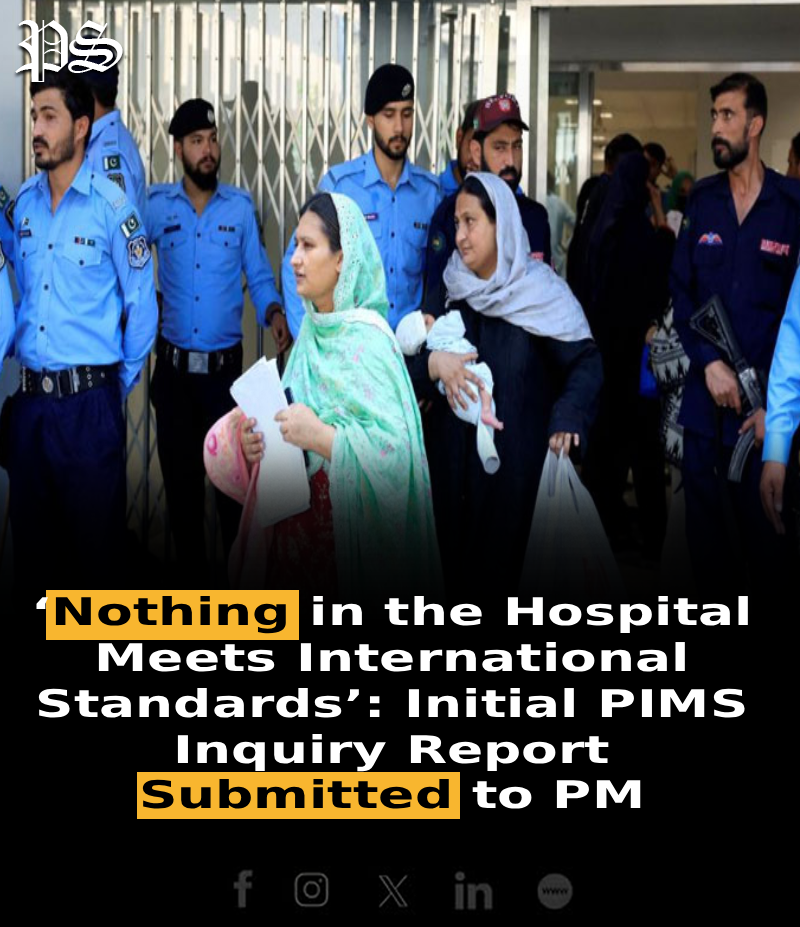
ISLAMABAD: The initial inquiry report into the tragic incident at the Pakistan Institute of Medical Sciences (PIMS) has been submitted to Prime Minister Shehbaz Sharif, with the report highlighting serious shortcomings in hospital facilities, emergency response and staff performance, according to sources.
Sources said the inquiry committee, headed by former Interior Secretary Shahid Khan, submitted the report to the Prime Minister’s Office late at night through the office of Prime Minister’s Adviser Tauqeer Shah.
According to sources, Tauqeer Shah forwarded the report to Prime Minister Shehbaz Sharif and also briefed him on its key findings and recommendations.
Sources within the inquiry committee confirmed that the report had been sent to the Prime Minister’s Office. They said the authority to make the report public now rests with the prime minister.
The report has reportedly been signed by all members of the inquiry committee. The committee has also determined the causes of the PIMS tragedy and identified those considered responsible, according to sources familiar with the findings.
The inquiry examined several aspects of the incident, including the hospital’s preparedness, emergency response, availability of facilities and the performance of relevant staff members.
Sources said the report contains details about the difficulties faced by rescue teams during emergency and relief operations. It reportedly highlights several shortcomings that affected the ability of rescue personnel to respond effectively to the incident.
The committee has recommended action against relevant PIMS employees who were absent from duty at the time of the tragedy. It has also proposed measures aimed at preventing similar incidents in the future.
Interviews with PIMS administration officials and doctors are reportedly included in the inquiry report. Statements from fire brigade officials and rescue teams have also been incorporated into the document.
One of the most serious observations attributed to the report concerns the overall standard of treatment and facilities at PIMS. Sources said the report points to inadequate healthcare facilities and states that nothing at the hospital meets international standards.
The observation raises serious questions about the condition of the hospital’s infrastructure, medical services, emergency preparedness and safety systems.
According to sources, the inquiry committee examined not only the immediate circumstances surrounding the tragedy but also broader institutional weaknesses. The panel reportedly looked into whether shortcomings in management, staffing, equipment and emergency response contributed to the severity of the incident.
The committee has also made recommendations for improving the hospital’s systems and preventing similar tragedies in the future. These recommendations reportedly cover emergency preparedness, staff availability, rescue operations and hospital facilities.
Sources said the report contains evidence and statements collected during the inquiry process. The inclusion of interviews with doctors, administrators, firefighters and rescue personnel indicates that the committee examined the incident from multiple perspectives.
The report has reportedly recommended immediate action against those found responsible. The recommendation has now been placed before the prime minister, who will decide what action should be taken.
The submission of the report comes after a tragic incident at PIMS that sparked widespread concerns about patient safety, hospital management and emergency preparedness. The incident involved a fire in the paediatric intensive care unit and resulted in the deaths of 14 children.
Following the tragedy, the federal government formed a high-level inquiry committee to investigate the circumstances surrounding the incident. The committee was tasked with determining the causes, identifying those responsible and proposing measures to prevent similar incidents.
The findings could have significant consequences for PIMS officials and management. If the prime minister accepts the committee’s recommendations, disciplinary or administrative action could be taken against officials found responsible for negligence or other failures.
The report’s assessment of hospital facilities is also likely to intensify public debate over the quality of healthcare and safety standards at major public-sector hospitals.
PIMS is one of the largest public hospitals in Islamabad and provides healthcare services to a large number of patients from the federal capital and other parts of Pakistan. Any deficiencies in its infrastructure, staffing or emergency systems therefore have implications beyond the hospital itself.
The inquiry committee’s recommendations are expected to focus on improving fire safety, emergency response systems, medical facilities, staffing arrangements and coordination with rescue agencies.
The report’s observations regarding difficulties faced by rescue teams are particularly significant. During a hospital emergency, quick access, effective communication and coordination between hospital staff and rescue agencies can be critical in saving lives.
The government has not yet officially released the full inquiry report. Until it is made public, details of its findings and recommendations remain based on information provided by sources familiar with the investigation.
However, the reported conclusions point to serious institutional and operational shortcomings at PIMS. The prime minister will now have to decide whether to approve the recommended action against those held responsible and what measures should be taken to address the hospital’s broader deficiencies.
The tragedy has also renewed calls for stronger safety standards and better emergency preparedness at public hospitals across Pakistan. Experts and members of the public are likely to demand that lessons from the PIMS incident be translated into concrete reforms.
For the families affected by the tragedy, accountability and meaningful improvements in hospital safety remain among the most important concerns. The effectiveness of the government’s response will depend not only on action against individuals but also on whether the underlying weaknesses identified by the inquiry are addressed.
The prime minister’s decision on the inquiry report is therefore expected to be closely watched, particularly given the committee’s reported recommendation for immediate action and its assessment that hospital facilities do not meet international standards.
About The Author