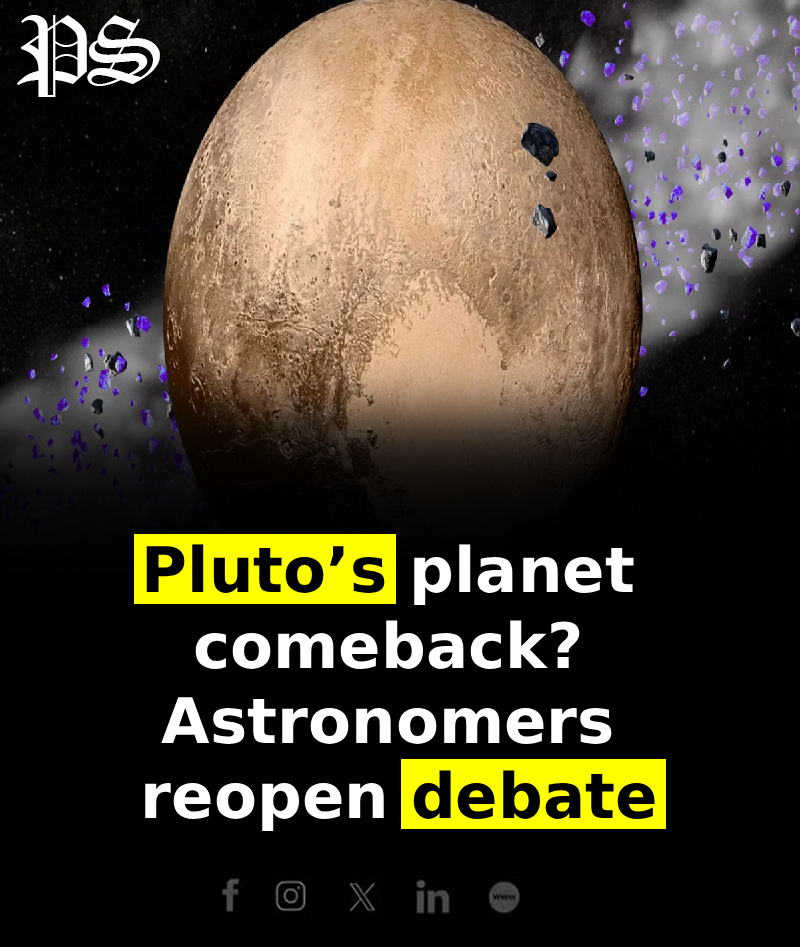
Scientists look again to a controversial decision twenty years later August 2026 will mark 20 years since one of astronomy’s biggest debates was finally put to bed: an argument over whether Pluto is officially a planet. Pluto had all of its major planet status status stripped and the number of planets that make up our solar system were dwindled down from 9 to 8 as a result of the International Astronomical Union’s voting process on August 24, 2006.
Fast forward 20 years with missions traveling through the outer solar system we continue to hear of scientists wondering if the IAU made the wrong choice.
Pluto demoted: so what exactly happened?
The debate over Pluto reached tipping point in the late 1990s when telescopes found hundreds of icy bodies in the Kuiper Belt behind Neptune.
It was 2005 when the International Astronomical Union reclassified Pluto, finding a planet that matched size Pluto was somewhat larger but more massive- and that scientists feared other bodies of its kind were being found constantly, meaning we would need to begin labelling all of them as planets. They developed a three part rule: It had to orbit the Sun.
It had to have its own gravity strong enough to take a roughly round shape.
Its own orbit had to be cleared out enough to fall through without other debris cluttering up the orbit. All objects other than planets would have to fall in line with these regulations and that also included dwarf planets Ceres, Haumea, Makemake, Eris and now Pluto. It simply failed to comply.
So what’s caused scientific disagreement over the definition again?
According to some scientists the ruling wasn’t as precise as it should be because the classification of planets hinges on orbital mechanics rather than geology- the actual structure or characteristics of the object. “Yes, Pluto is a planet”, Dr. Paul Byrne, a planetary scientist at the University of St.
Louis, who continues to be a vocal advocate for Pluto being an independent planet stated. While acknowledging the debate largely revolves around labels of taxonomy, Byrne maintained that a planets should also be classified by geophysical parameters “Nature really does not care what we call Pluto but these things shape the discussion that researchers like ourselves and the public have about the discussion about science.
Exoplanet GJ 3378b emerges as a better candidate to host life than previously expected
As further explorations expand our view of the outer solar system the possibility is that the focus of research is shifting towards giving it a clear definition.
About The Author