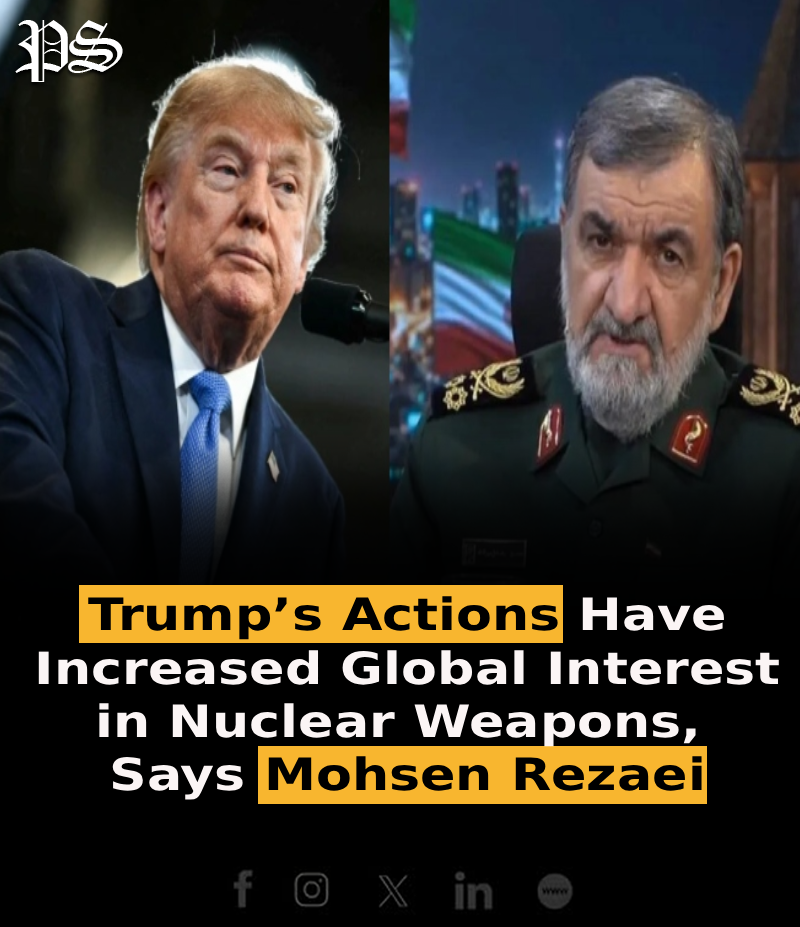
Iranian official Mohsen Rezaei has claimed that US President Donald Trump’s policies and what he described as attacks against Iran have increased interest among countries around the world in acquiring nuclear weapons.
According to an Iranian news agency, Rezaei argued that the desire to obtain nuclear weapons had particularly increased after countries concluded that membership in international nuclear institutions and treaties had failed to prevent US attacks.
He specifically referred to the International Atomic Energy Agency (IAEA) and the Treaty on the Non-Proliferation of Nuclear Weapons (NPT), arguing that international mechanisms intended to support nuclear security and prevent proliferation had not been effective in stopping military action against Iran.
Rezaei said that, rather than strengthening nuclear security, Trump’s policies had created what he described as “nuclear insecurity.” He maintained that Iran had accepted international safeguards and complied with its obligations, while remaining a member of the NPT and allowing international inspections.
According to Rezaei, Iran has gone further than other countries in complying with international nuclear regulations. His comments reflect Tehran’s broader argument that its nuclear program has been subject to international oversight and that military pressure undermines global non-proliferation efforts.
Rezaei also called for a change in Iran’s approach to its confrontation with the United States and in its diplomatic conduct. He said that Iran today is different from the country it was before the conflict, suggesting that recent developments have fundamentally changed Tehran’s strategic outlook.
He pointed to recent military appointments by Iran’s Supreme Leader, Mojtaba Khamenei, as an indication that Iran intends to remain prepared for potential conflict. Rezaei said the new appointments demonstrated Tehran’s determination to maintain a high level of military readiness.
The Iranian official also claimed that perceptions of the United States among Iranian youth had changed significantly. He argued that the image of America as a peace-oriented country had been replaced by a much more negative perception following recent developments.
Rezaei used particularly strong language when discussing Trump, claiming that the world had come to view the US president as foolish. His remarks reflect the increasingly hostile rhetoric surrounding relations between Tehran and Washington.
The Iranian official also issued a warning to countries that cooperate with the United States in imposing economic measures against Iran. He urged neighboring and regional countries not to support what he described as an American economic war against Tehran.
Rezaei warned that countries assisting US economic pressure could face retaliation against their interests. He specifically referred to oil exports through the Persian Gulf and the Strait of Hormuz.
He claimed that if countries surrounding Iran supported US economic measures, Iran could prevent oil from leaving the Persian Gulf and could also target other routes used for oil exports from the region.
Such remarks represent a serious escalation in rhetoric because the Persian Gulf and Strait of Hormuz are among the world’s most important energy corridors. Any disruption to oil shipments through the area could have significant consequences for global energy markets.
Rezaei also alleged that Trump had been persuaded by Israeli Prime Minister Benjamin Netanyahu to impose economic pressure on Iran. According to Rezaei, Trump initially had doubts about the policy but was persuaded to test it for two or three months before deciding whether it should continue for another six months.
The claims about Netanyahu’s influence and the decision-making process were presented by Rezaei as part of his assessment of the US strategy toward Iran.
Rezaei’s comments come amid heightened tensions between Iran, the United States and Israel. Tehran has increasingly emphasized military preparedness while warning regional countries against cooperating with Washington.
His remarks also link the immediate security confrontation with the broader global debate over nuclear proliferation. By arguing that military attacks can encourage countries to seek nuclear weapons, Rezaei presented Iran’s experience as a warning about the potential consequences of weakening international non-proliferation mechanisms.
The Iranian government has consistently maintained that its nuclear activities are subject to international safeguards, while Western governments and other countries have raised concerns about aspects of Iran’s nuclear program.
The debate over Iran’s nuclear activities therefore remains closely connected to wider questions of international security, inspections, sanctions and military deterrence.
Rezaei’s latest statements suggest that Tehran sees the current confrontation not only as a dispute with Washington but also as a test of the international nuclear order. His warnings about regional oil supplies further demonstrate the potential for the dispute to affect countries well beyond Iran, the United States and Israel.
About The Author