


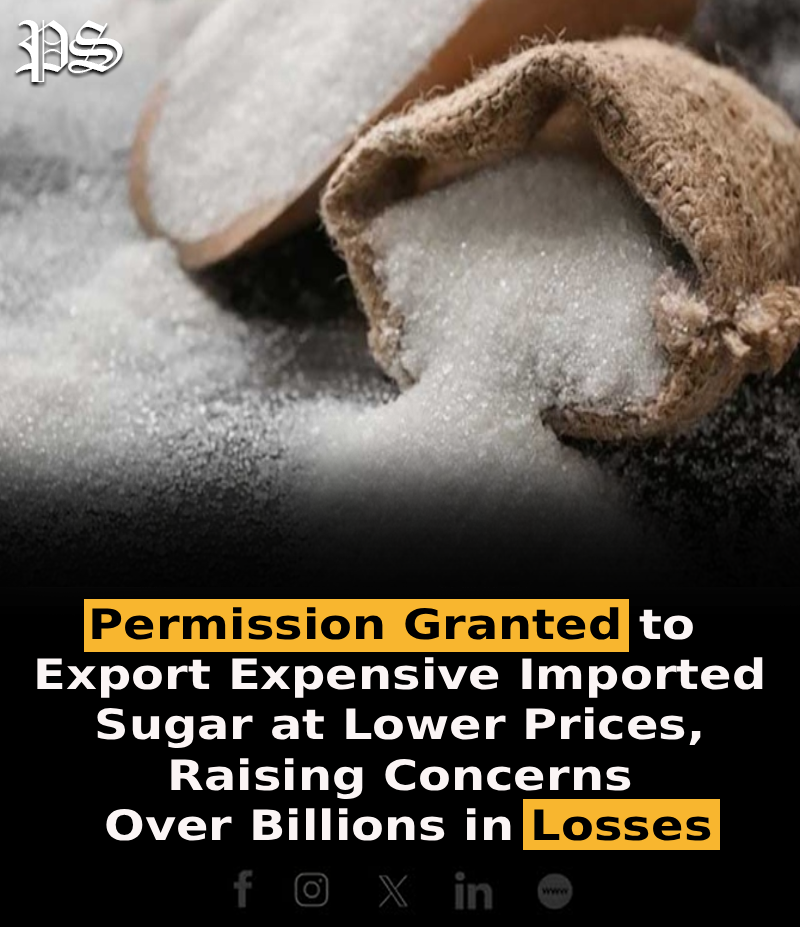
Lahore: The federal Ministry of Industries and Production has reportedly allowed the export of imported sugar at a lower price, a decision that sources say could cause losses of billions of rupees to the national exchequer.
According to sources within the Ministry of Industries and Production, the government has permitted the export of 100,000 tonnes of sugar. The decision has raised concerns because the sugar being exported was reportedly imported at a relatively high cost, meaning that selling it in international markets at a lower price could result in a significant financial loss.
Sources described the decision to export 100,000 tonnes of sugar as disappointing. They said the government had been considering the export of a larger quantity of locally produced sugar, but a decision to export 250,000 tonnes of relatively cheaper domestic sugar could not be reached.
The controversy comes at a time when the government is attempting to manage sugar supplies, prices and the interests of consumers, farmers and sugar mill owners. Decisions regarding imports and exports can have a direct impact on domestic prices and the availability of sugar in the local market.
According to ministry sources, the decision to permit the export of imported sugar could result in a loss of billions of rupees for the national treasury. The concern is primarily linked to the difference between the cost at which the sugar was brought into the country and the price at which it may now be sold abroad.
The issue has also raised concerns among sugar mill owners regarding the upcoming sugarcane procurement season. Sources said mill owners had already informed the Ministry of Industries and Production that purchasing sugarcane from farmers could become difficult under the prevailing circumstances.
Sugar mills depend heavily on the ability to sell their existing stocks and maintain sufficient financial liquidity before purchasing the next sugarcane crop. If mills face financial pressure because of unfavorable sugar prices or export decisions, they could potentially face difficulties in making timely payments to growers.
Sources therefore argue that the decision could have implications beyond the immediate financial loss to the government. It may also affect farmers, sugar mills and the broader sugar supply chain.
The failure to approve the export of 250,000 tonnes of cheaper locally produced sugar has been described by sources as another major concern. They believe that exporting locally produced stocks rather than imported sugar could have been a more economically viable option.
The government, meanwhile, faces the challenge of balancing several competing interests. It must ensure adequate sugar supplies for domestic consumers, protect farmers and maintain stability in the sugar industry while also preventing unnecessary pressure on public finances.
Sugar policy in Pakistan has frequently involved debates over imports, exports, prices and government intervention. Importing sugar is generally intended to address shortages and stabilize domestic prices, while exports are permitted when domestic production exceeds local requirements.
However, when imported sugar is subsequently exported at a lower price, questions can arise regarding the economic rationale of the transaction and its impact on public finances.
The latest decision is therefore likely to face scrutiny from stakeholders, particularly if the reported financial loss materializes. Policymakers may also come under pressure to explain why imported sugar was selected for export while a larger quantity of cheaper locally produced sugar remained without an export decision.
The concerns raised by sugar mill owners regarding the purchase of sugarcane could further complicate the situation. If mills are unable to purchase the next crop as expected, farmers could face difficulties in selling their produce, potentially creating additional pressure on the agricultural sector.
For consumers, the impact will depend on how the government manages domestic stocks and future imports and exports. Any reduction in local availability could contribute to price pressures, while excessive stocks could create financial difficulties for producers.
The reported decision has therefore opened a wider debate about the government’s sugar management policy and the economic consequences of exporting imported commodities at prices below their procurement cost. Further details regarding the export price, original import cost and the government’s financial calculations will be important in determining the actual scale of any loss to the national exchequer.
Pak Souch Media Group
Daily Pak Souch Newspaper – Daily Pak Special Newspaper – Daily Pak Today Newspaper
Head Office
Ayub Gate Shaikh Muhalla Near Rabbania Masjid Sukkur
Karachi Office
Office No. 1901-B, 19th Floor Saima Trade Tower (B) Block I.I Chandigarh Road Near Jung Press, Shaheen Complex & National Museum of Pakistan Karachi Sindh Pakistan.
Contact
03009319022
About The Author