

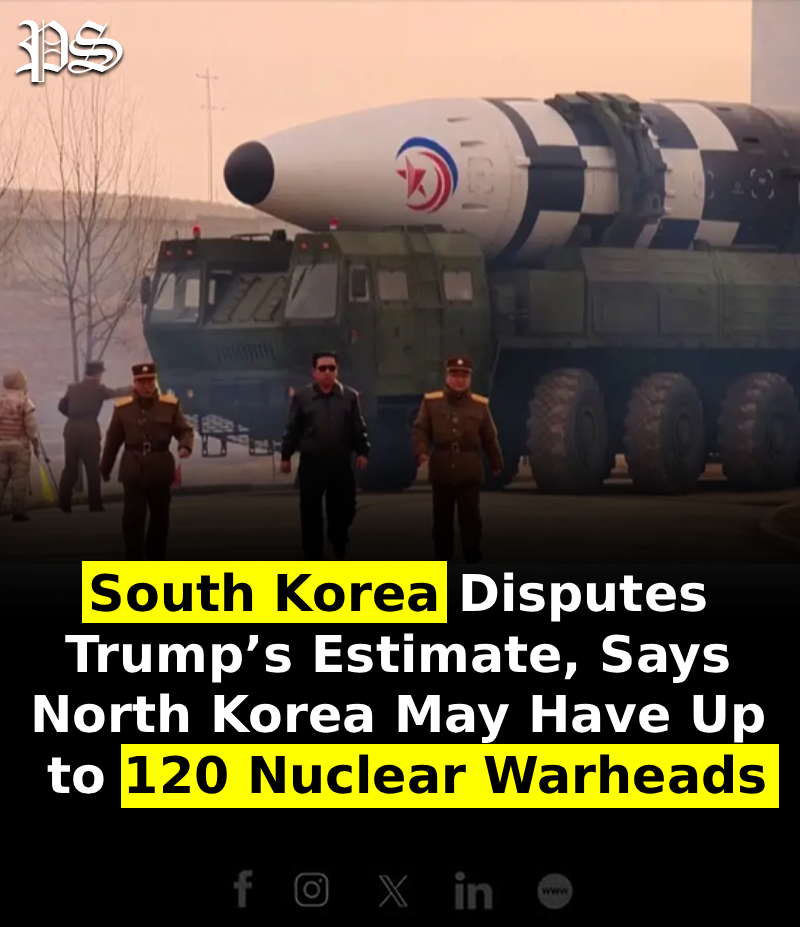
South Korea’s defence minister has disputed US President Donald Trump’s recent estimate of North Korea’s nuclear arsenal, saying Seoul believes Pyongyang may possess between 80 and 120 nuclear warheads.
South Korean Defence Minister Ahn Gyu-baek gave the estimate while briefing lawmakers during a parliamentary committee session. He said the commonly held assessment is that North Korea has approximately 80 to 120 nuclear warheads, although he cautioned that determining the exact number is extremely difficult.
The estimate is significantly higher than Trump’s reported claim that North Korea possesses 57 nuclear weapons. The differing figures highlight the uncertainty surrounding the size of Pyongyang’s nuclear stockpile, which is one of the least transparent nuclear arsenals in the world.
North Korea does not publicly disclose detailed information about the number of nuclear warheads it possesses. As a result, foreign governments and research organisations rely on intelligence assessments, estimates of nuclear-material production and analysis of the country’s nuclear facilities to determine the likely size of its arsenal.
A nuclear warhead estimate is particularly difficult because the number of weapons a country possesses cannot necessarily be determined simply by counting missile launchers or known nuclear facilities. Analysts must also assess how much weapons-grade material may have been produced, how efficiently it could have been used and how many completed warheads may have been assembled.
South Korea, which shares a heavily militarised border with North Korea, closely monitors developments in Pyongyang’s nuclear and missile programmes. The country works closely with the United States on intelligence and security matters, making estimates of North Korea’s nuclear capabilities an important element of regional defence planning.
The difference between the two estimates does not necessarily mean that one side has definitive information about North Korea’s arsenal. Instead, it reflects the difficulty of assessing a nuclear programme that operates with limited transparency.
Minister Ahn reportedly emphasised this uncertainty while giving his parliamentary briefing. Although he cited the 80-to-120 range as the commonly accepted estimate, he warned that establishing the precise number of nuclear warheads remains challenging.
North Korea has spent decades developing its nuclear weapons programme and has conducted multiple nuclear tests. It has also developed a variety of missile systems, including weapons designed to extend its potential strike capability beyond the Korean Peninsula.
The size of North Korea’s nuclear stockpile has therefore remained a major concern for South Korea, the United States and other countries in the region. Any significant increase in the number of warheads could affect assessments of the threat posed by Pyongyang and influence regional defence strategies.
The latest South Korean estimate also illustrates the broader challenge of measuring nuclear capabilities. Public estimates can differ because governments may have access to classified intelligence that cannot be fully disclosed, while independent analysts often use publicly available information and modelling.
For North Korea, maintaining uncertainty around its nuclear capabilities may itself have strategic value. A lack of reliable information about the precise number of warheads makes it more difficult for other countries to assess the full scale of its nuclear deterrent.
South Korea’s defence minister has nevertheless placed the country’s current assessment substantially above the figure cited by Trump. According to Ahn, the more widely accepted estimate is that North Korea has between 80 and 120 nuclear warheads.
The minister’s comments are likely to draw renewed attention to North Korea’s expanding nuclear capabilities and the difficulties involved in accurately determining the size of its arsenal. For now, however, the exact number remains unknown, with South Korea acknowledging that only an approximate range can be established.
About The Author