

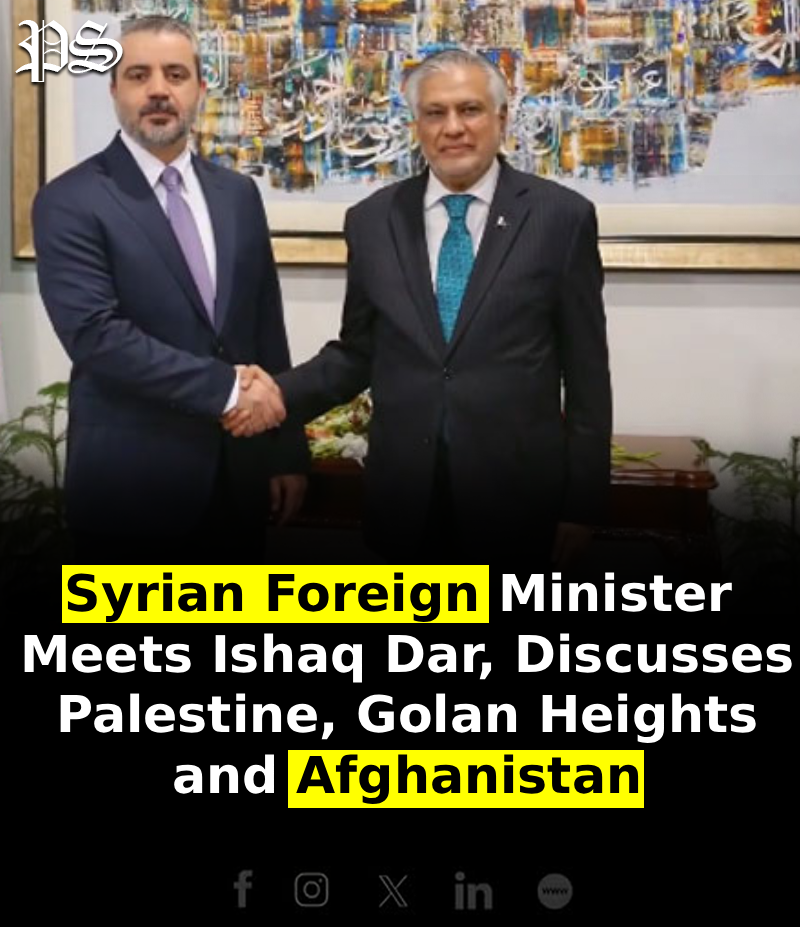
Islamabad: Syrian Foreign Minister Asaad Hassan al-Shibani, accompanied by a high-level delegation, met Pakistan’s Deputy Prime Minister and Foreign Minister Ishaq Dar in Islamabad. The two sides agreed to further expand cooperation in areas of mutual interest, according to Pakistan’s Foreign Office.
The talks covered a range of regional and international issues, including the situation in Palestine, the Golan Heights and Afghanistan. The two foreign ministers also exchanged views on developments in South Asia and the Middle East.
According to the Foreign Office spokesperson, the discussions focused on strengthening bilateral relations while also addressing regional security and political developments.
Ishaq Dar reaffirmed Pakistan’s support for Syria’s sovereignty, unity and territorial integrity. He said Pakistan would continue to support efforts aimed at maintaining Syria’s stability and strengthening its position in the region.
The Syrian foreign minister welcomed Pakistan’s signing of the Makkah Joint Defence Agreement. He also praised Pakistan’s constructive role in promoting regional peace and stability.
Al-Shibani also expressed appreciation for Pakistan’s efforts to reduce tensions between the United States and Iran. According to the Pakistani Foreign Office, the Syrian side welcomed Islamabad’s diplomatic efforts aimed at easing regional tensions.
The two countries reiterated their commitment to continued cooperation for peace, stability and prosperity. The discussions reflected a shared interest in strengthening political coordination and expanding bilateral engagement.
The Syrian delegation also held a separate meeting with Pakistan’s Federal Minister for Commerce Jam Kamal Khan at the Ministry of Commerce.
During the meeting, Jam Kamal Khan said Pakistan attaches great importance to its longstanding fraternal relations with Syria. He emphasised the importance of strengthening economic ties alongside political and diplomatic relations.
The two sides agreed to work towards increasing bilateral trade, investment and economic cooperation. Discussions focused on identifying opportunities that could help businesses in both countries develop stronger commercial links.
The Syrian foreign minister proposed establishing a Pakistan-Syria Joint Business Council to provide a formal platform for businesses and investors from the two countries to interact and explore new opportunities.
Jam Kamal Khan proposed identifying priority economic sectors and preparing a practical economic roadmap to translate bilateral commitments into concrete projects.
The proposed business council could potentially help facilitate greater contact between private-sector representatives, identify trade opportunities and encourage investment between Pakistan and Syria.
The discussions at the Ministry of Commerce also highlighted the importance of moving beyond diplomatic engagement towards practical economic cooperation. Both sides expressed interest in creating mechanisms that could support increased trade and investment.
The Syrian foreign minister’s visit therefore covered both political and economic dimensions of Pakistan-Syria relations. While the talks with Ishaq Dar focused heavily on regional and international issues, the meeting with Jam Kamal Khan concentrated on trade, investment and economic cooperation.
The two countries’ officials reiterated their commitment to strengthening bilateral relations and expanding cooperation in areas of mutual interest. The meetings also provided an opportunity to discuss regional developments and ways in which Pakistan and Syria could coordinate their positions.
Pakistan has emphasised its support for Syria’s sovereignty and territorial integrity, while Syria has welcomed Pakistan’s diplomatic role in regional peace and stability.
With the proposal for a Pakistan-Syria Joint Business Council and the suggestion to develop a practical economic roadmap, the latest meetings could also provide a basis for expanding commercial relations between the two countries.
The talks concluded with a renewed commitment to cooperation for peace, stability and prosperity, alongside efforts to strengthen bilateral political, economic and diplomatic ties.
About The Author