


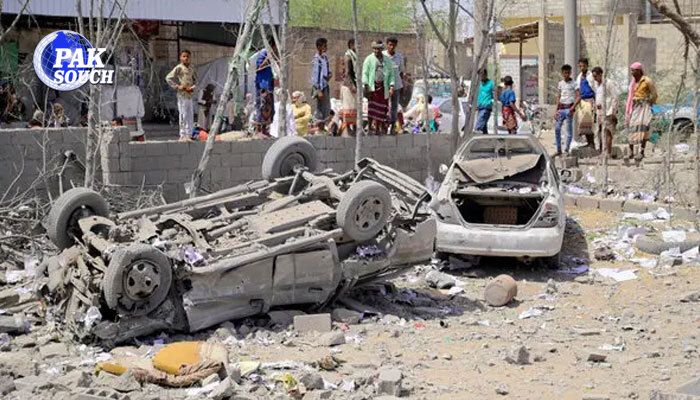
WASHINGTON: The United States has acknowledged that its military airstrikes in Yemen last year resulted in the deaths of 153 civilians, while another 243 people were injured, according to documents from the Pentagon cited by a US newspaper.
The report said the Pentagon has acknowledged civilian casualties resulting from US military operations carried out in Yemen during 2025.
According to the Pentagon’s assessment, the majority of the reported civilian deaths occurred during three US military operations in April 2025.
The first incident reportedly took place on April 6, 2025, when the US carried out an airstrike in Sana’a, Yemen’s capital. According to the reported Pentagon figures, the strike resulted in the deaths of five civilians.
A second and significantly deadlier attack took place on April 17, when US forces targeted the Ras Isa port. The Pentagon assessment reportedly attributed 80 civilian deaths to the operation.
The third major incident occurred on April 28 near Saada, where a US strike reportedly killed 47 civilians.
Together, the three incidents accounted for the overwhelming majority of the 153 civilian deaths acknowledged in the Pentagon’s assessment.
The figures also indicate that hundreds of civilians were affected by the US military campaign, with 243 people reportedly injured in addition to those killed.
The revelations have renewed scrutiny of US military operations in Yemen and the potential impact of airstrikes on civilians.
According to the US newspaper report, the Pentagon documents provide an official assessment of civilian casualties connected to American military activity in Yemen.
The acknowledgment is significant because civilian casualty figures arising from military operations in conflict zones can be difficult to establish independently, particularly where access to affected areas is limited.
The Pentagon’s reported figures cover deaths and injuries attributed to US operations, although the circumstances surrounding individual incidents may continue to be examined.
The April 17 strike on Ras Isa port stands out as the deadliest of the three incidents identified in the report, with 80 civilian deaths reportedly attributed to the attack.
The April 28 operation near Saada was also reported to have caused a substantial number of civilian fatalities, with 47 people killed.
The April 6 strike in Sana’a reportedly resulted in five civilian deaths.
The Pentagon’s acknowledgment comes amid continuing international scrutiny of military operations in Yemen and their humanitarian consequences.
Yemen has experienced years of conflict involving multiple armed and political actors. US military operations in the country have largely been linked to efforts against the Houthi movement and concerns regarding attacks on shipping and regional security.
The civilian casualty figures disclosed in the Pentagon documents are likely to attract further attention from humanitarian organizations and rights groups concerned about the protection of civilians during military operations.
The report also said that 15 additional US military operations in Yemen remain under review.
This means that the number of civilian casualties acknowledged by the Pentagon could potentially be subject to further assessment as additional cases are examined.
The review process is intended to assess the circumstances surrounding military operations and determine whether civilian casualties occurred and, where applicable, whether they were connected to US strikes.
The reported figures highlight the broader challenge of conducting military operations in densely populated or civilian-accessible areas while attempting to minimize harm to non-combatants.
Under international humanitarian principles, parties involved in armed conflict are expected to take precautions to protect civilians and distinguish between military targets and civilian objects.
The Pentagon’s reported acknowledgment therefore provides an important basis for further examination of the individual attacks, the targets involved and the measures taken to reduce civilian harm.
The figures also underline the human cost of the continuing conflict in Yemen, where civilians have repeatedly faced the consequences of military confrontation.
According to the newspaper report, the Pentagon documents represent an official US assessment rather than an independent humanitarian investigation.
Further details about the 15 operations still under review could provide additional information about civilian casualties and the circumstances of US military actions in Yemen.
For now, the Pentagon reportedly recognizes 153 civilian deaths and 243 injuries linked to US airstrikes in Yemen during the previous year.
The disclosure is expected to fuel further debate over US military policy in Yemen, civilian protection and accountability for casualties resulting from air operations.
About The Author