


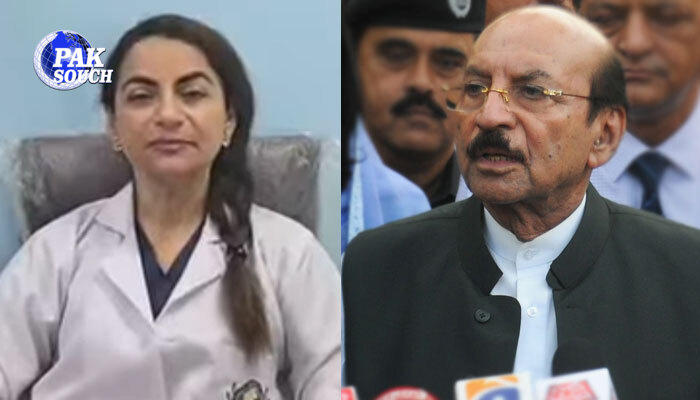
KARACHI: The Sindh government has directed Jinnah Sindh Medical University (JSMU) to consider appointing Professor Dr. Nighat Shah, daughter of former Sindh Chief Minister Qaim Ali Shah, as a professor for another three years, just one day before her scheduled retirement.
According to the details, the directive was issued on the basis of a decision taken by the Sindh provincial cabinet. Secretary Boards and Universities Abbas Baloch has also issued a formal notification regarding the matter.
The proposed appointment has raised questions because the notification cited as the legal and regulatory basis for the decision does not specifically require universities to reappoint retired faculty members.
The notification issued by the Pakistan Medical and Dental Council (PM&DC) states that government medical and dental institutions may engage retired faculty members on a contractual basis up to the age of 65. However, it explicitly clarifies that the provision is “enabling in nature”, meaning that it merely allows institutions to do so and does not make such appointments mandatory.
Under the PM&DC policy, the relevant institution retains the authority to decide whether it needs the services of a retired faculty member, taking into account its own requirements, rules, regulations and available resources.
The Sindh government notification refers to Agenda Item No. 16 of the provincial cabinet meeting held on August 5. According to the notification, the cabinet directed the Vice Chancellor of JSMU to consider appointing Dr. Nighat Shah as a professor for three years in the broader public interest.
The stated objectives include ensuring continuity of specialized medical services, academic leadership, postgraduate medical education, research, innovation and institutional standards.
However, the wording of the directive appears to go beyond merely asking the university to consider the appointment.
While the cabinet decision reportedly used the phrase “consider the appointment,” the subsequent portion of the government letter instructs the Vice Chancellor to take immediate necessary action for the appointment of Professor Dr. Nighat Shah as a professor for a period of three years.
The notification further directs that the cabinet decision be implemented “without delay and in letter and spirit”, with a report on the action taken to be submitted to the Department of Universities and Boards on a priority basis.
The development has prompted questions regarding the process through which the appointment was initiated and the role of the provincial cabinet in the matter.
The PM&DC notification dated May 19, 2026, which has been cited as the basis for the decision, permitted government medical and dental institutions to hire retired faculty members on a purely contractual basis until the age of 65.
However, the PM&DC document also clearly states that the policy does not impose an obligation on any institution to employ retired faculty. The decision remains subject to the requirements, rules, regulations and resources of the respective institution.
The PM&DC notification further states that contractual engagement of retired faculty would not create any right to permanent appointment, seniority or absorption into regular employment.
Importantly, the policy also says that such appointments should not adversely affect the promotion opportunities, career progression or cadre structure of junior faculty members.
This provision has become particularly relevant in the case of Dr. Nighat Shah’s proposed appointment.
According to the report, the appointment could potentially affect the seniority and career progression of several associate professors at Jinnah Sindh Medical University, including Dr. Shazia Naseeb, Dr. Nasreen Fatima, Dr. Saba Khan, Dr. Iram Majid and Dr. Maimoona Rehman.
The issue has consequently raised concerns about whether the proposed three-year appointment could have implications for the existing faculty structure and the professional advancement of junior members of the teaching staff.
Questions have also emerged over why the appointment of a particular retired faculty member was taken to the provincial cabinet when the PM&DC policy had left the decision to the concerned medical institution.
The PM&DC notification is a general policy applicable to government medical and dental institutions and does not direct the appointment of any specific individual.
This has led to questions about the circumstances under which the provincial cabinet became involved in the appointment and why immediate action and a compliance report were sought in relation to a particular individual.
The matter is particularly noteworthy because Dr. Nighat Shah was reportedly due to retire just one day after the directive concerning her three-year appointment was issued.
The Sindh government’s position, as reflected in the notification, is that the appointment is being considered in the broader public interest and is intended to ensure continuity in specialized medical services, academic leadership, postgraduate education, research and institutional development.
However, the PM&DC framework makes clear that the availability of such a contractual mechanism does not automatically create an entitlement for a retired professor to continue in service.
The final authority to determine whether a retired faculty member should be retained rests with the relevant institution, subject to applicable rules and requirements.
The controversy has therefore centered not only on the proposed appointment itself but also on the procedure followed and its possible implications for other faculty members.
The issue of seniority is particularly important in academic institutions because promotions and career progression are generally linked to established service structures and institutional regulations. Any decision affecting the existing faculty hierarchy can therefore have long-term consequences for other teaching staff.
The university administration may now have to consider the regulatory framework, institutional requirements and potential impact on the seniority and career progression of existing faculty members before proceeding with the appointment.
The case has also generated broader questions about the interpretation of the PM&DC policy and the extent to which provincial authorities can direct a university to take action concerning a specific retired faculty member.
While the government notification cites public interest and the need for continuity of specialized services as reasons for the proposed appointment, the PM&DC policy itself does not mandate the retention of retired faculty.
The controversy is likely to remain under scrutiny as the university considers the directive and determines the appropriate course of action under its rules and the applicable regulatory framework.
For now, the key issue is whether the proposed three-year appointment can be implemented without affecting the seniority, promotion opportunities and career progression of existing faculty members, as specifically cautioned in the PM&DC’s May 19 notification.
The matter also highlights the need for transparency in appointments to public-sector medical universities, particularly when decisions concern senior academic positions and have potential implications for the careers of other faculty members.
About The Author