


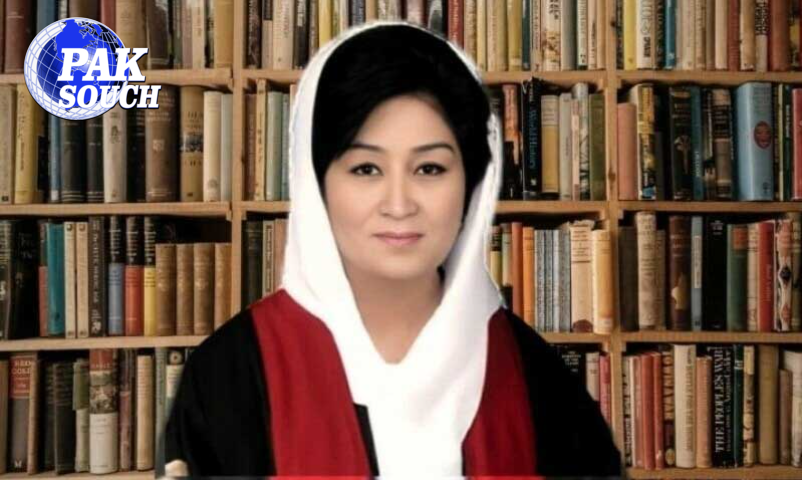
ISLAMABAD: Supreme Court Justice Musarrat Hilali retired from her position on Friday, with a full court reference held under the chair Chief Justice Yahya Afridi . Nine judges attended the reference at the Supreme Court’s principal seat, while four judges joined from Karachi and three from Lahore via video link.
At the reference, a message from Attorney General Mansoor Usman Awan was read out by Additional Attorney General Aamir Rehman.
“Justice Hilali was the first woman to serve as Chief Justice of the Peshawar High Court,” the attorney general said in his message, going on to recall several of her notable judicial contributions.
He noted that she had declared null and void an earlier decision that had barred the trial of civilians in military courts, and that she had opposed the suspension of military courts’ verdicts during an intra-court appeal, in a case where the Supreme Court had directed that individuals convicted by military courts be granted the right to appeal. “She also ruled that a suit for dissolution of marriage (tanseekh-e-nikah) could not be converted into a khula plea,” the attorney general noted.
Following the Supreme Court’s December 13, 2024 order, Hilali was part of the bench, conditionally greenlighting military courts to pronounce verdicts against civilians tried over the May 9, 2023 riots, several lawyers had voiced serious concerns. Critics argued the order “diluted the issue without deciding it,” with some suggesting bail would have been fairer while the case’s legality remained pending. Others called it a consequence of the 26th Amendment, noting it marked the first time military trials had been allowed during peacetime rather than under martial law or emergency rule.
Legal commentators had pointed out that the apex court had previously declared such trials unconstitutional, describing the reversal as “a sad consequence” of the 26th Amendment, and warned it raised concerns about judicial independence and civilians’ right to a fair trial. Others said that while accountability for the May 9, 2023 riots mattered, they remained unconvinced civilians should be tried under the Army Act, citing the erosion of constitutional guarantees.
About Justice Hilali
Justice Hilali was born in Peshawar on August 8, 1961, at the home of her father Mir Hilali, an activist with the Khudai Khedmatgar movement. She received her law degree from Khyber Law College, Peshawar University, and enrolled as an advocate of the district courts in 1983, becoming a high court advocate in 1988 and an advocate of the Supreme Court in 2006.
At the Bar, she broke several barriers as a woman: she was the first female elected Secretary of the Peshawar Bar Association (1988-1989), served twice as its Vice President (1992-1994), and later became its first female General Secretary (1997-1998). She was also twice elected as an Executive Member of the Supreme Court Bar Association (SCBA), in 2007-2008 and 2008-2009. Her career included several first-of-their-kind appointments as well: she served as Khyber Pakhtunkhwa’s first female Additional Advocate General from November 2001 to March 2004, became the first female Chairperson of the Khyber Pakhtunkhwa Environmental Protection Tribunal, and was appointed the province’s first female Ombudsperson for Protection against Harassment of Women at the Workplace.
On the bench, Justice Hilali was elevated as an Additional Judge of the Peshawar High Court on March 26, 2013, and confirmed as a permanent judge on March 13, 2014. She also attended seminars in the USA (1993), UK (1993), Japan (1999), Singapore (2000), Nepal (2008) and India (2009) over the course of her career.
In 2023, she reached a series of milestones as she took oath as Acting Chief Justice of the Peshawar High Court on April 1, becoming the first woman to hold the position, and was formally sworn in as Chief Justice of the Peshawar High Court on May 12. Later that year, on July 7, she was sworn in as a judge of the Supreme Court of Pakistan, becoming only the second woman in the court’s 75-year history to be elevated to the apex court, and the first woman from Khyber Pakhtunkhwa to do so.
About The Author