


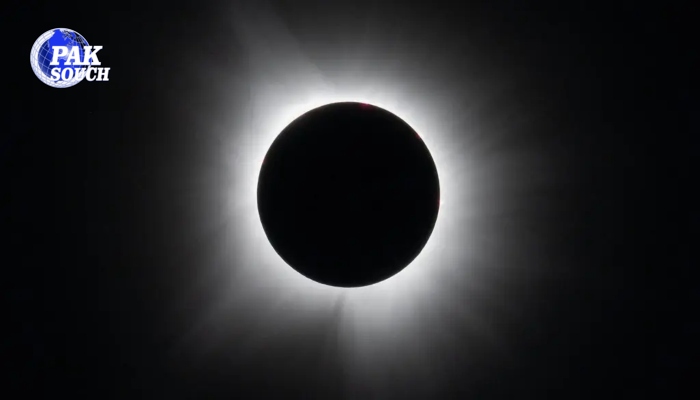
Washington: Skywatchers in parts of Europe and the North Atlantic are set to witness a total solar eclipse on 12 August, with astronomers describing the event as particularly special because, in some locations, the eclipse will occur at sunset—a rare celestial phenomenon.
According to the US National Aeronautics and Space Administration (NASA), only a limited number of countries will experience the eclipse in its totality.
Residents of Greenland, Iceland, northern Spain, and a small part of Portugal will be able to observe the Moon completely covering the Sun.
One of the most remarkable views is expected in northern Spain, where the total eclipse will coincide with sunset, creating a dramatic spectacle as the Sun disappears below the horizon while eclipsed.
A sunset total solar eclipse is an uncommon event that occurs only after many years, making this year’s eclipse especially significant for astronomers and eclipse enthusiasts.
People across much of Europe and North Africa will also have the opportunity to witness a partial solar eclipse, although the Sun will not be completely obscured in those regions.
Most European countries and several parts of northern Africa will experience varying degrees of partial eclipse.
Russia will offer another unusual viewing opportunity. On the remote Taymyr Peninsula, the partial eclipse will begin at sunrise, while in another part of the country, the eclipse will still be visible at sunset, allowing observers to experience the event at opposite ends of the day.
According to NASA, the eclipse schedule in Pakistan Standard Time (PST) is as follows:
- Partial eclipse begins: 10:34 pm on 12 August
- Total eclipse begins: 12:12 am
- Eclipse ends: 2:58 am
The eclipse will not be visible in its total phase from Pakistan, but astronomy enthusiasts in the regions along the eclipse path are expected to witness one of the most striking celestial events of the year.
Experts advise anyone observing the eclipse to use certified solar viewing glasses or appropriate solar filters, as looking directly at the Sun without proper eye protection can cause permanent eye damage.
About The Author