

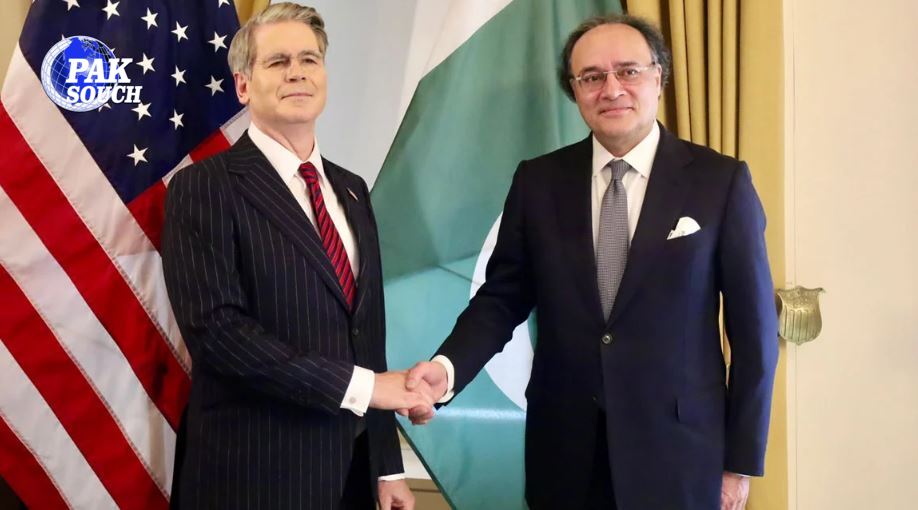
Federal Minister for Finance and Revenue Muhammad Aurangzeb met with U.S. Treasury Secretary Scott Bessent in Washington D.C.
During the meeting, he highlighted Pakistan’s journey from macroeconomic stabilization to sustainable, export-led growth, while noting economy’s vulnerability to regional geopolitical developments.
The Finance Minister sought greater U.S. support for Pakistan’s improved access to international capital markets, higher foreign exchange reserves, and enhanced sovereign credit ratings.
Both sides reaffirmed their commitment to deepening bilateral economic cooperation, promoting greater U.S. investment, and advancing strategic projects.
Pakistan remains under $7 billion IMF discipline that has required politically unpopular tax increases, spending restraint and reforms.
Exchange stabilization facilities are rare U.S. Treasury backstops, usually routed via the Exchange Stabilization Fund, that provide dollars, swaps or guarantees to support reserves and steady currencies.
These facilities are different from the permanent standing dollar swap lines that the U.S. Federal Reserve has with some major central banks and act as an international supply line of U.S. dollars to underpin financial stability.
A 2025 Argentina package was the first new foreign-government exchange stabilization facility operation since Uruguay in 2002, aside from Mexico’s long-standing swap line, dating to the 1940s and now sized at $9 billion.
Pakistan narrowly avoided default in 2023 with a $3 billion IMF standby deal and later secured a $7 billion Extended Fund Facility, along with a separate $1.3 billion loan to build up its resilience to climate change and natural disasters. But its reserves still depend on official financing, rollovers and deposits from China and Saudi Arabia.
About The Author