

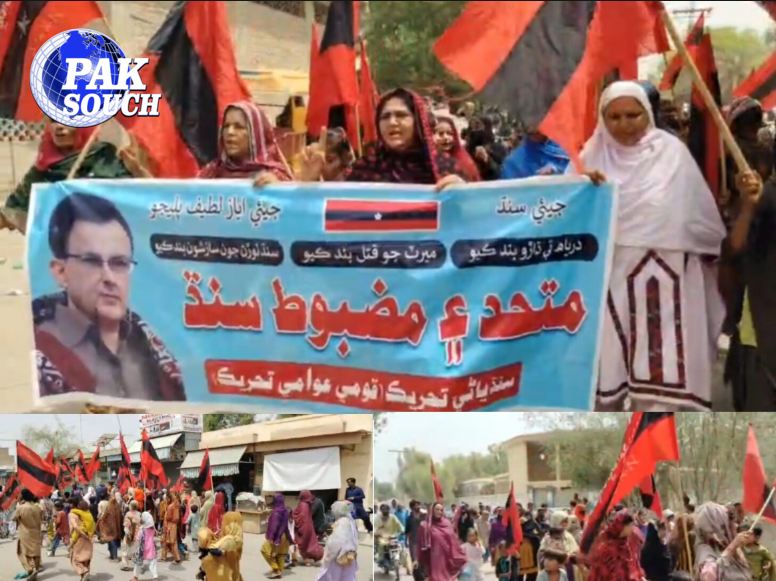
Dadu, Pakistan: A large protest rally titled “United and Strong Sindh” was held in Dadu for the 24th consecutive day under the call of the Sindhiyani Tehreek and Qaumi Awami Tehreek. Demonstrators protested against water shortages in Sindh, the Zulfiqarabad project, controversial plans on the Indus River, the proposed 28th Constitutional Amendment, corporate farming, and what organizers described as anti-Sindh policies, including projects related to Karachi.
The rally began at the Allama I.I. Qazi Library and marched through various roads before concluding at the Dadu Press Club. Thousands of women, children, senior citizens, and political and social activists participated. The march was led by Zeenat Samoon, Ameerzadi Brahmani, Azra Rind, Khair-un-Nisa Soomro, Somar Chandio, Advocate Mir Khoso, Advocate Munawar Jatoi, Asghar Rind, Munawar Mallah, Nazeer Ahmed Lund, and other leaders.
Addressing the gathering, the speakers alleged that Sindh had become unsafe for women, minorities, and children. They criticized the authorities for failing to recover kidnapped girls, including Ajala Parveen from Mehar and Priya Kumari, despite swift official action in less significant cases.
The leaders further alleged that corruption and lawlessness had reached alarming levels, claiming that districts in Sindh had effectively become the personal domains of influential politicians and feudal elites. They said the “United and Strong Sindh” movement aimed to unite people across the province on a common platform.
They accused the Indus River System Authority (IRSA) of facilitating water theft, claiming that while Sindh faces severe water shortages, additional water is being diverted through the Chashma and Taunsa canals in Punjab. They demanded the protection of the Indus River and called for the immediate withdrawal of what they described as anti-Sindh canal and dam projects.
The speakers also opposed the proposed 28th Constitutional Amendment, alleging that it threatened Sindh’s unity. They warned that if such measures continued, women activists of the Sindhiyani Tehreek, along with thousands of supporters, would intensify their protests.
The protest leaders rejected corporate farming and the Green Pakistan initiative, alleging that these projects would make Sindh’s land barren and lead to the occupation of local resources and agricultural land. They also expressed reservations about the Zulfiqarabad Town project, calling it suspicious.
They further highlighted concerns over so-called honor killings, forced marriages, and the abduction of girls, while criticizing the closure of more than 7,000 schools and colleges in Sindh and the lack of quality educational facilities for girls. They argued that feudalism and illiteracy continued to fuel serious human rights violations.
The speakers also alleged widespread corruption in public sector recruitment, claiming that merit had been undermined and that the Public Service Commission had become a marketplace for the sale of jobs. They accused the government of attempting to divide Sindhis along ethnic and tribal lines to weaken resistance against policies affecting Sindh’s resources, water, the Indus River, and provincial unity.
The rally concluded with a call for all people of Sindh to remain united and work together to protect the province’s resources, unity, and national interests.
About The Author