

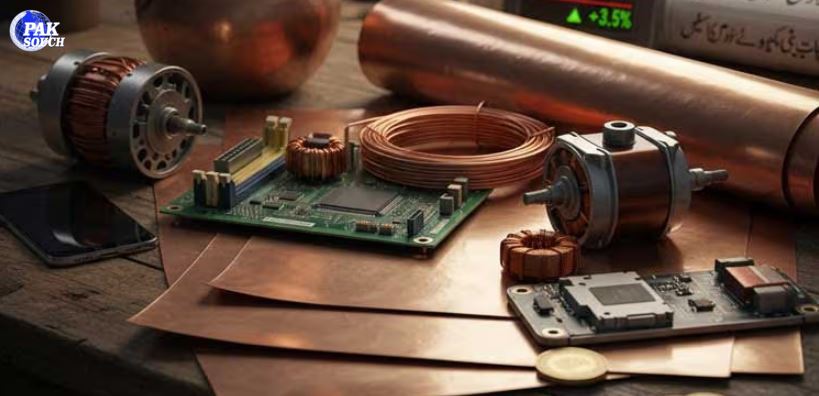
Domestic copper rates in Pakistan remain steady today, driven by strong industrial demand and prevailing international benchmarks on the London Metal Exchange.
High-quality Millberry copper scrap serves as the core benchmark for recycled metals across the country and is currently trading at approximately Rs. 5,500 per kilogram.
This specific grade is highly sought after by local recycling units due to its minimal contamination and high melting efficiency. Meanwhile, refined new copper, which is essential for specialized manufacturing and high-grade electrical work, maintains a higher premium, commanding between Rs. 5,800 and Rs. 6,200 or more per kilogram depending on the localized supplier networks and exact purity levels.
For commercial projects operating on a tighter budget, mixed or standard copper scrap provides a cheaper alternative. This broad, secondary tier generally shifts within a wide pricing band of Rs. 2,100 to Rs. 3,500 per kilogram. This variation relies entirely on the precise percentage of clean metal present, the presence of insulating sheaths or soldering material, and the physical location of the warehouse.
While these baseline metrics represent a unified national consensus, actual transaction rates fluctuate slightly based on major trading hubs. Bazaars such as the Shershah Market in Karachi and the Misri Shah network in Lahore typically dictate the nationwide baseline because of the sheer volume of material moving through their gates each morning, whereas inland centers like Islamabad, Gujranwala, or Peshawar might include minor premiums to absorb secondary freight over-the-road transport costs.
Global Market Context and London Metal Exchange Trends
On the international front, copper continues its strong performance, providing a highly supportive foundation for Pakistani commodity dealers. The current international benchmark spot price settled near $6.43 per pound, which mathematically translates to roughly $13,603 per metric tonne on the London Metal Exchange. This current push represents a healthy recovery from a minor 3.14% dip experienced earlier in the month, marking an assertive daily advance of about 2.7% as global industrial buyers step back into the market.
When assessing the broader timeline, global copper prices stand more than 35% higher than this time last year, driven by a tight physical supply deficit and speculative stockpiling ahead of international tariff decisions. This global strength directly funnels into domestic valuation mechanics. Factoring in a baseline state bank interbank exchange rate holding near 280 Pakistani Rupees per US Dollar, the raw, unadjusted international value of copper converts to roughly Rs. 3,950 to Rs. 4,000 per kilogram.
However, local manufacturing plants cannot source raw metal at this base rate. By the time international shipments clear the port, the final price must incorporate substantial additional layers including ocean freight, customs clearing charges, regulatory duties, domestic transportation fees, and handling margins. This disparity explains why processed local copper commands a visible premium over the raw international spot price.
Historically nicknamed “Dr. Copper” by financial analysts for its ability to accurately diagnose the overall health of the global economy, the metal is experiencing an aggressive demand phase driven by structural shifts in modern technology. The transition toward clean energy infrastructures serves as a primary catalyst, as solar farms, wind turbine systems, and heavy-duty regional electrical grids require significantly more copper wiring per megawatt than legacy fossil-fuel alternative installations.
Simultaneously, the global push toward electric mobility is accelerating consumption, as a standard electric vehicle integrates significantly more internal copper components and specialized battery structuring than an ordinary internal combustion engine car. Beyond transportation, the physical footprint of artificial intelligence is placing unique pressure on global supplies. Modern high-density data centers require immense volumes of copper to support advanced thermal cooling units, multi-layered circuit boards, and fast-speed interconnect cabling networks.
Despite these intense demand pressures, the market benefits from the fact that copper can be recycled repeatedly without losing its inherent chemical performance. Industrial estimates indicate that approximately 80% of all copper ever mined throughout human history remains in active circulation today through various secondary recycling scrap lifecycles, which acts as a crucial buffer preventing severe, unchecked market deficits.
About The Author