

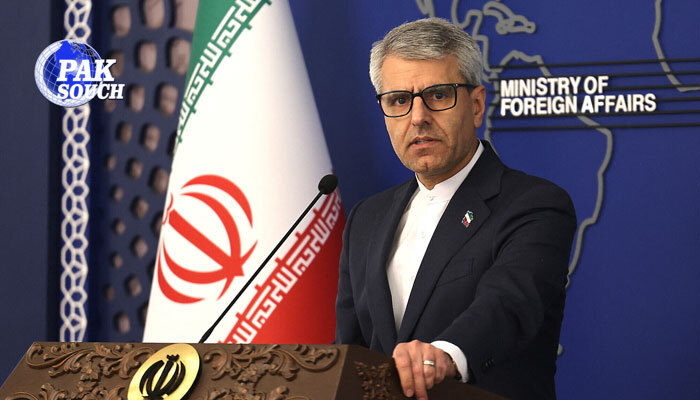
Tehran: Iran’s Foreign Ministry spokesperson Esmail Baghaei has said that contradictory and inconsistent policies of the United States have undermined diplomatic channels and contributed to renewed tensions in the region.
Speaking at a press conference in Tehran, Baghaei accused Washington of being directly responsible for recent developments, saying that Israel cannot act in the region without American approval.
“US Responsible for Escalation”
Baghaei stated that recent ceasefire violations and escalating tensions were directly linked to U.S. policy decisions. He argued that Israel’s actions should not be viewed separately from Washington’s regional strategy.
“Israel cannot move in the region without full coordination with the United States,” he said, adding that no one can believe such operations occur without U.S. alignment.
He further claimed that the events of the past 24 hours were “designed and orchestrated” by the United States, which he said had led to a renewed surge in regional instability.
Allegations Over Ceasefire Violations
The Iranian spokesperson alleged that Washington bears direct responsibility for violations of the ceasefire. He insisted that while Iran had remained committed to the agreement, other parties were not honoring their obligations.
According to Baghaei, these violations have weakened diplomatic efforts and complicated attempts to restore calm in the region.
“Diplomacy and Defense Go Together”
Despite the sharp criticism, Baghaei emphasized that Iran remains prepared to defend its national security and strategic interests.
He said that diplomacy and defensive readiness must operate simultaneously, and that Iran’s leadership is committed to ensuring the country’s highest national interests are protected through both political and security measures.
“Our readiness to defend the country remains intact,” he said, adding that Iran continues to pursue diplomatic channels while also maintaining military preparedness.
Growing Regional Tensions
The remarks come amid heightened tensions in the Middle East, where ceasefire arrangements and diplomatic initiatives have repeatedly faced setbacks due to conflicting positions among regional and global powers.
Iranian officials have frequently accused the United States of influencing Israeli policy decisions and contributing to instability in the region. Washington, however, has consistently denied such claims and maintains that it supports regional stability and diplomatic solutions.
Diplomatic Efforts Under Strain
Analysts say that ongoing accusations and counter-accusations between Tehran and Washington are further straining already fragile diplomatic efforts.
With trust between key regional actors remaining low, observers warn that sustained dialogue will be difficult unless both sides reduce rhetorical escalation and re-engage through formal diplomatic channels.
For now, Iran maintains that it will continue to combine diplomatic engagement with security preparedness as regional tensions remain unresolved.
About The Author