

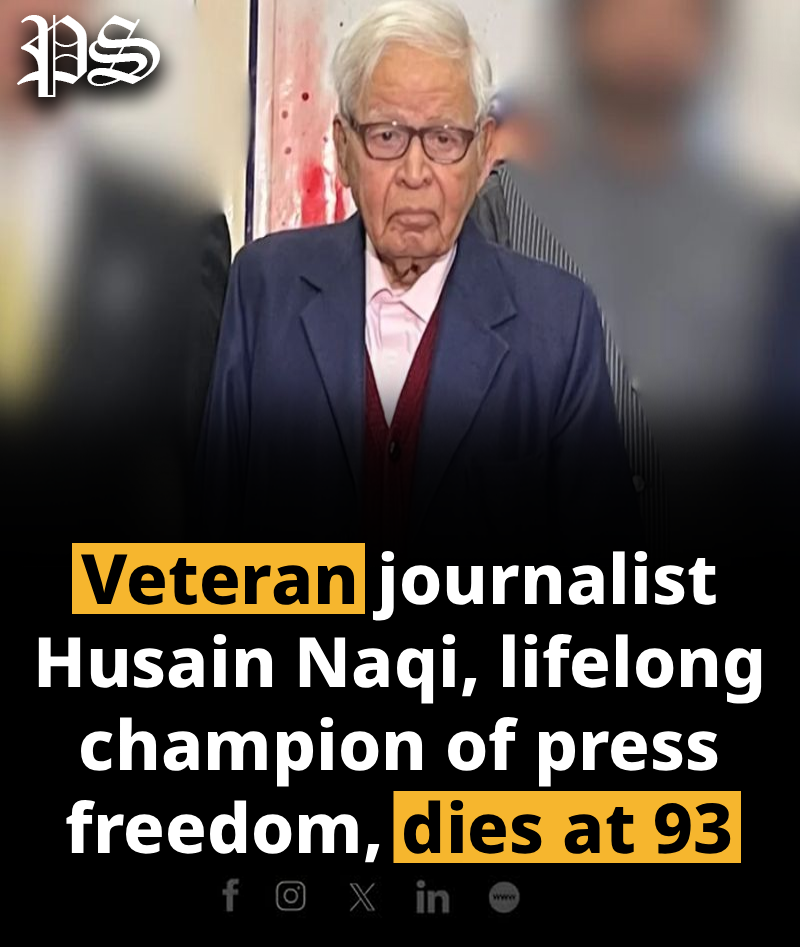
LAHORE: Veteran Pakistani journalist and human rights activist Husain Naqi, whose career spanned more than seven decades and who repeatedly faced imprisonment for speaking out against successive governments, died in Lahore on Sunday. He was 93.
Naqi, a former editor of English-language newspaper The News and a longtime member of the Human Rights Commission of Pakistan (HRCP), remained actively involved in campaigns for press freedom, democracy and human rights until his final days.
His death prompted an outpouring of tributes from political leaders, journalists, lawyers and rights activists, who remembered him as an unwavering voice against authoritarianism and a lifelong advocate for the rights of ordinary people.
In a statement, the HRCP expressed deep sorrow over his death, describing him as a veteran journalist, trade unionist and human rights defender whose resolve to speak truth to power remained undiminished despite repeated imprisonments and what it called vindictive actions by the authorities.
“One of the strongest voices for people’s rights and democracy in Pakistan has gone silent,” the commission said.
President Asif Ali Zardari also expressed deep sorrow over Naqi’s death, paying tribute to his longstanding contributions to journalism, freedom of expression and human rights.
In a statement issued by the Presidency, Zardari said Naqi had played a prominent role in promoting journalism and democratic values, adding that his services would always be remembered. He extended condolences to the bereaved family and prayed for the departed soul.
His death came a day after he attended a book launch in Lahore, where he presided over the ceremony for a collection of poetry by journalist and poet Ahmad Farhad.
Farhad said Naqi had attended the event despite being seriously unwell and physically frail. He recalled that the veteran journalist told him he had received a copy of the book the previous afternoon and, after starting to read it, decided he should attend the launch.
Despite his weakness, Naqi delivered his presidential remarks at the event, reading out passages from nearly half of the book, Farhad said in a post on X.
Farhad said he later learnt that Naqi’s health had deteriorated while he was on his way home and that he had been taken to hospital. He described him as a pioneering figure in Pakistan’s human rights and journalistic history and a representative of Lucknow’s refined cultural traditions.
Pakistan Tehreek-e-Insaf Secretary General and lawyer Salman Akram Raja, who also attended the gathering, said the book launch had turned out to be the final farewell to a long and meaningful journey.
Recalling their decades-long association, Raja said Naqi had continued to discuss the possibility of a popular movement against oppression in Pakistan during their meeting the previous evening.
“He was still dreaming of a popular uprising against oppression in our country,” Raja wrote on X, adding that Naqi had promised to send him a copy of his autobiography.
Raja also remembered other prominent rights campaigners and journalists, including IA Rehman, Asma Jahangir and Professor Amin Mughal, saying their passing represented the loss of people who had worked for human dignity and the rights of the poor.
A video clip from the book launch, shared by journalist Rai Ghulam Ali, showed Naqi advising Raja that bringing change to Pakistan would require people to take to the streets and struggle for it.
Such a struggle, Naqi said, would inevitably involve sacrifices, including deaths and imprisonment. Without a willingness to face those consequences, he warned, people would remain bound by the chains of subjugation.
A career marked by resistance
Journalist Hamid Mir recalled Naqi’s repeated confrontations with successive governments, including his opposition to the rule of former prime minister Zulfikar Ali Bhutto.
In a post on X accompanying an older column, Mir said Naqi had publicly disagreed with Bhutto, Pakistan’s first civilian chief martial law administrator, and was subsequently arrested, tried by a military court and sentenced to one year’s imprisonment.
Naqi was arrested again after General Zia-ul-Haq imposed martial law in 1977 and was detained at Lahore’s Shahi Qila interrogation centre, Mir said.
Recalling an exchange between Naqi and a police officer who had come to question him, Mir said the officer had remarked that Naqi had also been arrested under Bhutto and asked why he seemed to disagree with every government.
Naqi’s response was characteristically defiant: “It is not that I disagree with governments. Governments end up disagreeing with me.”
His repeated arrests and confrontations with the authorities became emblematic of his commitment to freedom of expression and his refusal to compromise on principles.
Journalist Ismatullah Niazi paid tribute to Naqi, recalling his warm personality, sense of humour and encouragement of younger journalists.
Naqi served the HRCP in various capacities for three decades, including as its treasurer, and was an active member of its council at the time of his death. He had also been recently elected to the council, according to Niazi.
Niazi said Naqi had devoted his life to human rights, freedom of expression and press freedom, regularly attending conferences, seminars and protests in Lahore, Karachi and Islamabad.
He also recalled Naqi’s involvement in the recent HRCP council elections, saying he had secured 999 votes and played a key role in helping journalist Nasir Zaidi get elected chairman, despite supporting a rival group.
Former information minister Fawad Chaudhry described Naqi as a towering journalist and tireless campaigner for human rights, saying his contributions to journalism and the rights movement would be remembered.
Journalist Nadeem Raza said Naqi had died at the age of 93, describing him as an embodiment of integrity and principle whose contributions to journalism, democracy and human rights movements spanned six decades.
His death, Raza said, marked not merely the passing of a veteran journalist but the end of an important chapter in Pakistan’s journalistic and democratic history.
PAK SOUCH MEDIA GROUP
Daily Pak Souch Newspaper Sukkur – Daily Pak Special Newspaper Karachi – Daily Pak Today Newspaper Karachi – Daily Pak Jazbo Newspaper Sukkur
Head Office : Ayub Gate Shaikh Muhalla Near Rabbania Masjid Sukkur
Karachi Office : Office No. 1901-B, 19th Floor Saima Trade Tower (B) Block I.I Chandigarh Road Near Jung Press, Shaheen Complex & National Museum of Pakistan Karachi Sindh Pakistan.
Contact : 03009319022
Website 1 : https://paksouch.com/
Website 2 : https://sindhi.paksouch.com/
Website 3 : https://pakjazbo.com/
Website 4 : https://urdu.pakjazbo.com/
About The Author