

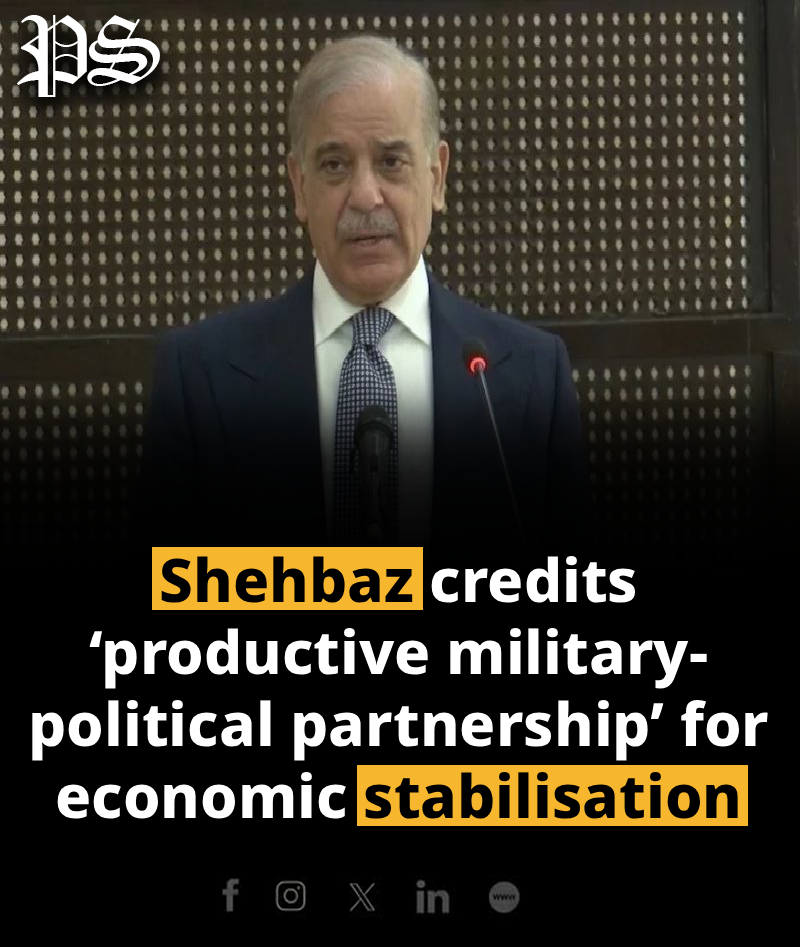
ISLAMABAD: Prime Minister Shehbaz Sharif on Thursday credited what he described as an unprecedented partnership between Pakistan’s political and military leadership for the country’s economic stabilisation, saying closer coordination had created an opportunity to accelerate growth and attract investment.
Addressing a ceremony organised by the American Business Council of Pakistan in Islamabad, Sharif said such cooperation between the political and military hierarchies had never existed in the country’s history.
“When was the last time, when you had struck a very productive partnership between military and political hierarchy? Never in the history of Pakistan, such a partnership hasn’t been there in the past,” he said.
He credited Chief of Defence Forces Field Marshal Syed Asim Munir and his team, alongside the government, for working together in what he called the national interest, adding that the country could now move beyond economic stabilisation towards stronger growth in agriculture, industry, artificial intelligence, information technology, and mining and minerals.
Sharif said Pakistan’s foreign exchange reserves had risen to around $27 billion, including holdings of commercial and state-owned banks, while inflation had declined from 32 per cent to 11.5 per cent. The policy interest rate had also fallen from 23.5 per cent to 12 per cent, he added.
Recalling the economic difficulties of 2023, when Pakistan faced a serious threat of default, the prime minister said the country had made progress despite continuing external pressures, including the Gulf crisis.
He said Pakistan remained heavily dependent on imported energy, with more than 90 per cent of its requirements sourced from abroad, but the government had managed to avoid fuel shortages and unrest at petrol stations while introducing subsidies to protect vulnerable sections of society.
The prime minister said the government was working to remove bureaucratic hurdles, procedural delays and other obstacles discouraging potential investors, and had made transparency a central requirement of its economic policy.
He urged American businesses to expand their investments in Pakistan, describing the private sector as the main driver of economic growth and saying the government’s role was to facilitate businesses rather than conduct them.
“Governments do not do business. It’s your forte, it’s your domain,” he told the gathering, promising to address investors’ genuine grievances and remove impediments to business activity.
Sharif said the government had granted tax concessions worth Rs400 billion in the fiscal budget, with relief directed towards exporters, manufacturers, corporations and salaried employees to stimulate economic activity.
He said the International Monetary Fund had agreed to the concessions after recognising the government’s efforts to meet reform commitments and fiscal targets over the past two and a half years.
The prime minister said the government wanted to put Pakistan firmly on the path of export-led growth and was exploring increased imports of American agricultural products, including soybeans, while seeking wider access for Pakistani surgical instruments, sports goods and other manufactured products in the US market.
He also highlighted reforms in export financing, saying the Export Development Fund had been placed under private-sector leadership and the Export-Import Bank had received Rs4 billion to provide subsidised financing to exporters.
Sharif said the government was also promoting electric vehicles to reduce dependence on imported fuel and modernise the country’s automotive industry, which he criticised for relying on protection and subsidies for decades without meeting localisation commitments.
He said the government had held several rounds of consultations with relevant ministries before deciding to encourage electric vehicles and discourage internal combustion engine vehicles.
Pakistan’s mineral wealth, particularly the Reko Diq project, offered another major opportunity for economic growth, he said, adding that active work on the project had begun during the past two to three years after decades of discussions.
The prime minister also identified agriculture, livestock and youth development as key areas for economic transformation, saying the government was expanding vocational and technical training and providing laptops, iPads and stipends to young people.
He called for stronger cooperation between the government and private sector, saying sustained economic progress would require consistent policies, investment and efforts to improve productivity.
Sharif also referred to Pakistan’s diplomatic efforts to restore peace in the Gulf region, saying Islamabad was engaging with Iran and Washington with the support of friendly countries.
He said a restoration of regional peace would create favourable conditions for Pakistan’s economy to take off.
PAK SOUCH MEDIA GROUP
Daily Pak Souch Newspaper Sukkur – Daily Pak Special Newspaper Karachi – Daily Pak Today Newspaper Karachi – Daily Pak Jazbo Newspaper Sukkur
Head Office : Ayub Gate Shaikh Muhalla Near Rabbania Masjid Sukkur
Karachi Office : Office No. 1901-B, 19th Floor Saima Trade Tower (B) Block I.I Chandigarh Road Near Jung Press, Shaheen Complex & National Museum of Pakistan Karachi Sindh Pakistan.
Contact : 03009319022
Website 1 : https://paksouch.com/
Website 2 : https://sindhi.paksouch.com/
Website 3 : https://pakjazbo.com/
Website 4 : https://urdu.pakjazbo.com/
About The Author