

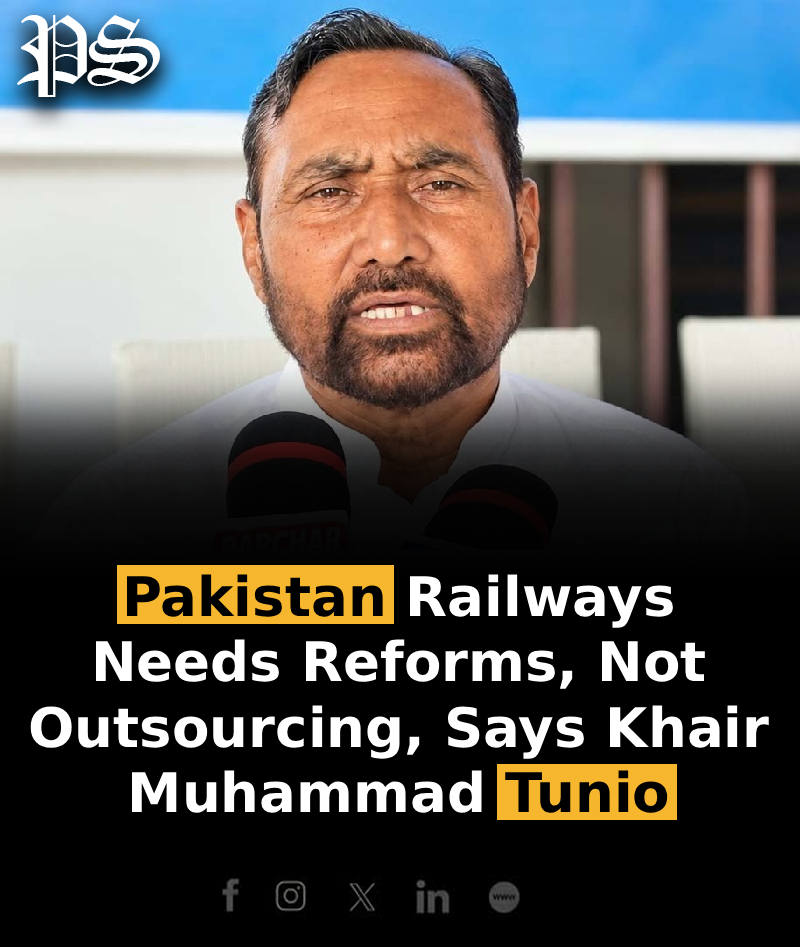
SUKKUR: Pakistan Railways must focus on improving its internal system rather than handing over national assets to contractors, while corruption must be eliminated and those responsible for mismanagement held accountable, said Khair Muhammad Tunio, Central Secretary General of the Pakistan Railways Prem Union CBA.
In a press statement, Tunio said the current situation was a matter of serious concern for the entire nation, particularly those responsible for running Pakistan Railways. He questioned why the country had been unable to strengthen and improve a vital national institution like Pakistan Railways.
He expressed concern that during the tenure of Federal Minister for Railways Muhammad Hanif Abbasi, instead of strengthening the railway system internally, improving its administrative and technical capabilities, and utilizing its own resources, various departments were being outsourced and handed over to contractors.
“The question is whether handing over national institutions to contractors is the solution to their problems, or whether their internal systems should be improved,” he said.
Tunio pointed out that Pakistan Railways has engineers, experienced officers, skilled employees, and an extensive administrative structure. Despite these resources, he questioned why the policies, ambitious claims, and reform initiatives of the Chairman Railways, CEO Railways, Secretary Railways, and other relevant officials had failed to deliver the desired results.
He said the situation required a serious and comprehensive review, adding that transferring national assets to private contractors was being presented as an achievement, whereas the real need was to enhance the institution’s technical expertise, administrative performance, and professional capabilities.
He stressed that the country must leave behind a safe, strong, and developed railway system for future generations rather than an institution burdened with persistent problems.
Highlighting the major challenges facing Pakistan Railways, Tunio identified corruption, poor planning, unnecessary political interference, appointments against merit, a severe shortage of technical staff, the non-availability of essential machinery and materials, a ban on permanent recruitment, and the failure to regularize temporary employees who had been serving for years.
He said that without addressing these fundamental issues, claims of institutional development and improvement could not become a reality.
Tunio questioned why the required resources, authority, and facilities were not being provided to the railway’s own engineers, officers, and experienced employees if they possessed the capability to operate and improve the institution. He also questioned who would identify the actual causes of the railway’s current condition and hold those responsible accountable.
He urged the Prime Minister of Pakistan, the Federal Minister for Railways, and other senior authorities to conduct an impartial review of the causes behind Pakistan Railways’ deteriorating condition and continuous financial losses.
He further demanded that those responsible for corruption and mismanagement be held accountable without discrimination, merit be ensured, technical staff shortages be addressed through recruitment, essential machinery and materials be provided, and long-serving TLA employees be regularized.
Tunio emphasized that the path to improving Pakistan Railways did not lie in handing over national assets to contractors but in introducing internal reforms, protecting workers’ rights, adopting modern technology, enhancing technical expertise, and establishing a transparent administrative system.
He said Pakistan Railways was not the property of any individual or particular group but a national asset belonging to the entire nation. Strengthening the institution, protecting employees’ rights, and securing its future for coming generations was a collective responsibility.
“Pakistan Railways does not need a contracting system; it needs effective reforms, merit, accountability, and the hard work of its employees,” he concluded.
PAK SOUCH MEDIA GROUP
Daily Pak Souch Newspaper Sukkur – Daily Pak Special Newspaper Karachi – Daily Pak Today Newspaper Karachi – Daily Pak Jazbo Newspaper Sukkur
Head Office : Ayub Gate Shaikh Muhalla Near Rabbania Masjid Sukkur
Karachi Office : Office No. 1901-B, 19th Floor Saima Trade Tower (B) Block I.I Chandigarh Road Near Jung Press, Shaheen Complex & National Museum of Pakistan Karachi Sindh Pakistan.
Contact : 03009319022
Website 1 : https://paksouch.com/
Website 2 : https://sindhi.paksouch.com/
Website 3 : https://pakjazbo.com/
Website 4 : https://urdu.pakjazbo.com/
About The Author