


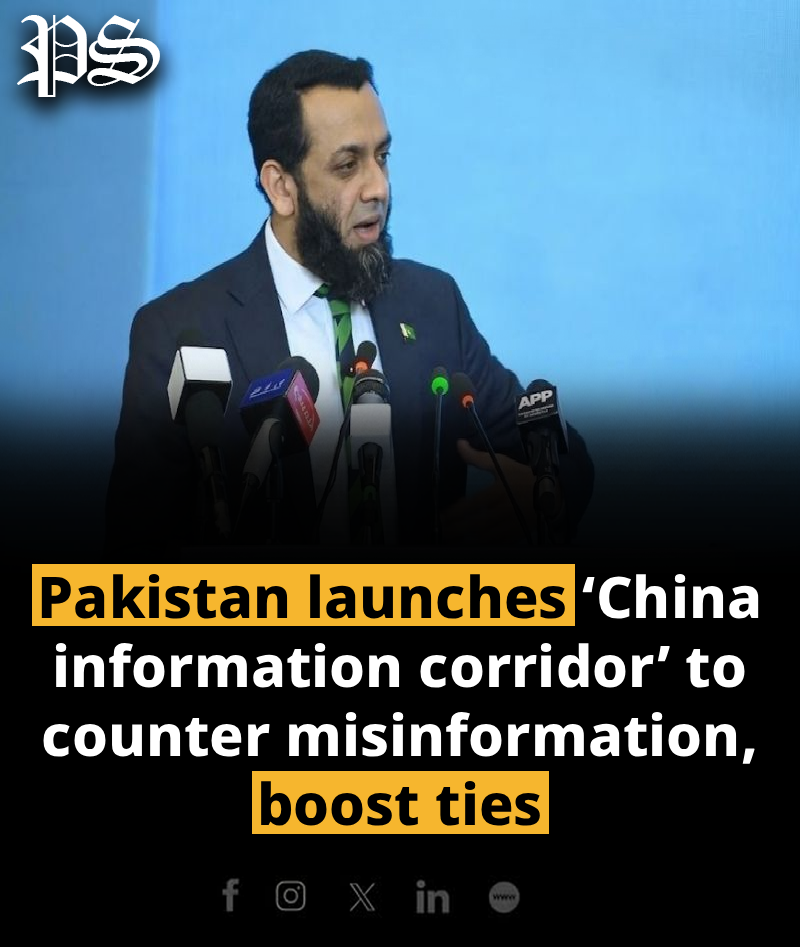
ISLAMABAD: Pakistan has launched a China-Pakistan Information Corridor (CPIC) to strengthen media cooperation, counter misinformation and deepen people-to-people ties.
Addressing a ceremony in Islamabad, Information Minister Attaullah Tarar described the initiative as a key component of the countries’ evolving partnership.
“The corridor will bring together media organisations, businesses, think tanks and cultural and youth initiatives to promote information exchange, fact-checking, trade and investment, Tarar said in a speech outlining the initiative.
He said the project would complement the China-Pakistan Economic Corridor (CPEC), which was launched in 2015, by focusing on public understanding and cooperation between the two countries.
“If CPEC is the body of our shared future, CPIC will be its voice,” Tarar said. “If CPEC connects our economies, CPIC will connect our understanding.”
The initiative comes as Pakistan and China seek to advance their partnership under the second phase of CPEC, with a focus on economic growth, innovation, green development and broader cooperation, he said.
Tarar said the information corridor would operate through four pillars: media, business and enterprise, think tanks, and culture, tourism and youth.
Under the media pillar, a news exchange working group comprising 18 Pakistani and Chinese media organisations has been established to share verified information on bilateral cooperation. A dedicated fact-checking mechanism will also track misleading narratives and respond with factual information, he said.
The business and enterprise pillar has opened its first regional office in Karachi and is developing a trade portal to track trade, investment and foreign direct investment. A podcast series will also highlight Chinese businesses operating in Pakistan and Pakistani entrepreneurs in China, Tarar said.
The think-tank pillar, led by the Pakistan-China Institute and involving research institutions from both countries, will promote joint dialogue, research and publications.
Meanwhile, work is under way on a tourism corridor linking China’s Xinjiang region with Pakistan’s Gilgit-Baltistan, while a Pakistan-China friendship rally and a youth ambassador programme are also planned. The first cohort of CPEC Youth Ambassadors has been nominated from 13 universities across Pakistan, Tarar said.
He said the initiative was intended to strengthen public understanding at a time when digital connectivity and control over a country’s narrative had become increasingly important.
“In the digital age connectivity is power and narrative is sovereignty,” he said, adding that a country unable to tell its own story in the digital space risked having others tell it on its behalf.
Tarar also highlighted cooperation in digital technology, including artificial intelligence, e-commerce and other emerging fields, and invited Chinese media organisations, universities, think tanks, businesses and young people to participate in the corridor.
He said Prime Minister Shehbaz Sharif had also pushed for cooperation in information technology education, including scholarships for Pakistani students to learn about emerging trends. An agreement with Alibaba Group, drafted using artificial intelligence and signed during the prime minister’s visit, was now being implemented, he added.
Tarar said more than 68 per cent of Pakistan’s population was under the age of 30, making youth development and digital skills central to the country’s economic future.
He described the Pakistan-China relationship as an enduring partnership rooted in shared history and cooperation, saying the information corridor would help carry that legacy to younger generations.
The first phase of CPEC focused on physical connectivity, including energy projects, motorways, Gwadar port and a fibre-optic link between Pakistan and China. The next phase, Tarar said, would seek to connect people and ideas as well as economies.
He invited Chinese partners to work with Pakistani institutions across all four pillars, saying the initiative aimed to promote understanding and trust through sustained information exchange.
PAK SOUCH MEDIA GROUP
Daily Pak Souch Newspaper Sukkur – Daily Pak Special Newspaper Karachi – Daily Pak Today Newspaper Karachi – Daily Pak Jazbo Newspaper Sukkur
Head Office : Ayub Gate Shaikh Muhalla Near Rabbania Masjid Sukkur
Karachi Office : Office No. 1901-B, 19th Floor Saima Trade Tower (B) Block I.I Chandigarh Road Near Jung Press, Shaheen Complex & National Museum of Pakistan Karachi Sindh Pakistan.
Contact : 03009319022
Website 1 : https://paksouch.com/
Website 2 : https://sindhi.paksouch.com/
Website 3 : https://pakjazbo.com/
Website 4 : https://urdu.pakjazbo.com/
About The Author