

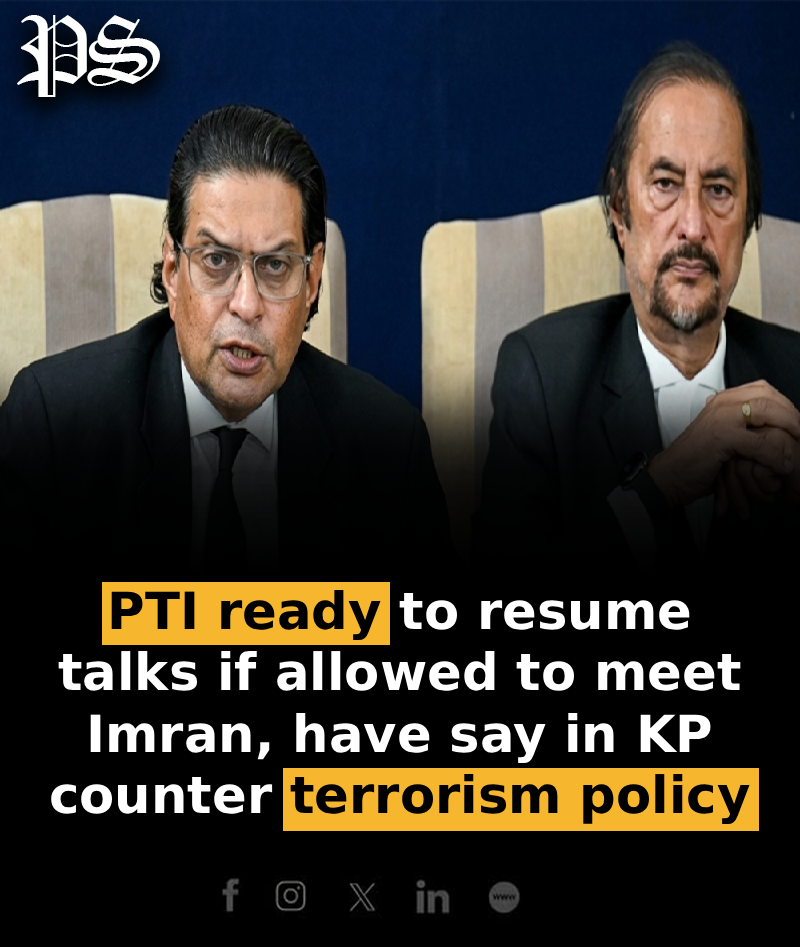
ISLAMABAD: Pakistan Tehreek-e-Insaf (PTI) Secretary-General Salman Akram Raja said Monday that government-opposition talks broke down over two key issues — access to incarcerated PTI founder Imran Khan, including meetings with his lawyers, family, party colleagues and personal doctors, and disagreement over how counterterrorism operations in Khyber Pakhtunkhwa should be conducted.
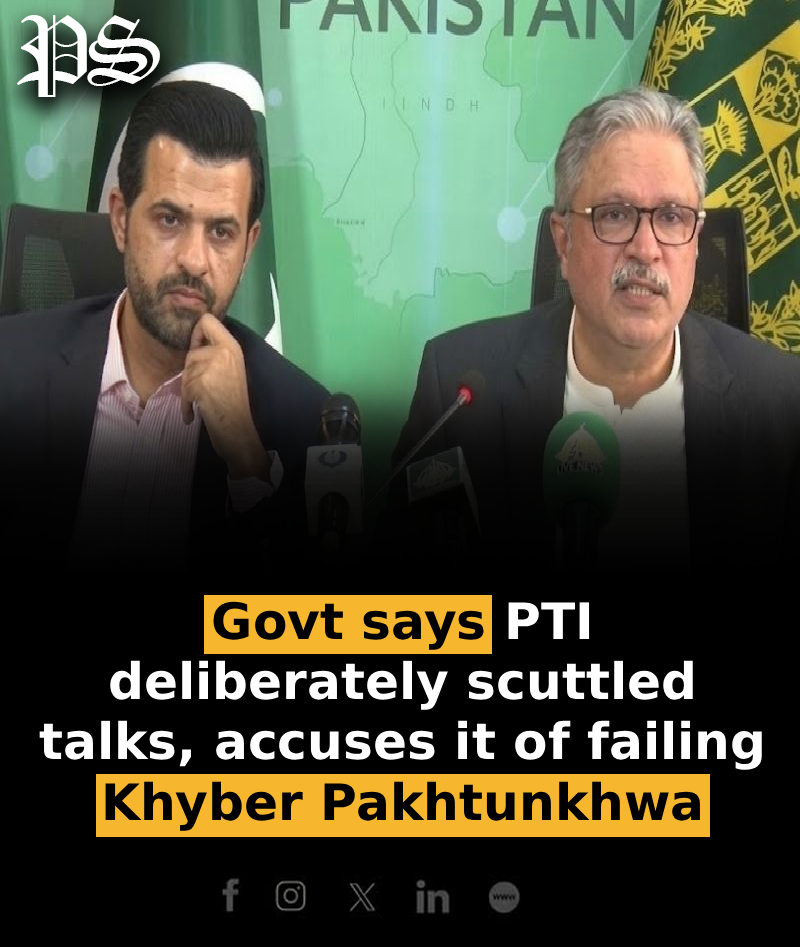
Speaking at a press conference in Islamabad alongside PTI leader Babar Awan and other party leaders, Raja said that the PTI had made it clear during negotiations that no matter could be finalised without Imran Khan’s consultation and party position being taken into account.
He said that the party had also demanded that Imran’s lawyers, family members and trusted political associates be allowed to meet him, arguing that such access was essential both for his legal cases and for political stability.
“These were all placed on the table, and it was made absolutely clear that there would be no success in the negotiating process until these key matters were settled,” Raja said.
The talks between the government and PTI-led opposition ended in deadlock after two rounds of negotiations at the National Assembly speaker’s chamber, with the two sides failing to bridge differences over counterterrorism measures in KP and access to Imran Khan. The talks had been aimed at averting the PTI’s long march on Islamabad.
Imran’s meetings with lawyers, family
Raja said that Imran Khan and his wife Bushra Bibi were facing more than 300 cases, and access to their legal teams was essential.
He said that lawyers needed to meet their clients to obtain instructions and guidance before representing them in court.
“A lawyer says in court what his client tells him to say,” Raja said, stressing that Imran’s legal team must therefore have access to him.
He said that Imran’s family had the first right to meet him, while lawyers handling his cases also had a right to see him.
But Raja said that the matter was not limited to legal consultations.
Imran Khan, he said, remained the head of the country’s largest political party and it was important for political stability that his senior colleagues and trusted associates be allowed to meet him.
He said that some of those party figures had been with Imran for 30 years and were among the people he trusted and relied upon.
Raja said that the PTI had therefore demanded meetings between Imran and his family members, lawyers and political colleagues, and had put the issue before the government negotiating team.
The opposition had also sought access to Imran’s personal doctors. Raja said this was not a political demand but a matter related to his medical care.
“If the founder of PTI is not given access to his personal physicians, then there is no point in talking,” he said.
The PTI had sought provisions relating to his meetings and medical treatment to be included in a proposed agreement, while the government did not agree to incorporate them in the manner demanded by the opposition.
PTI says two issues caused deadlock
Raja said that the PTI had entered the negotiations in good faith and with an open mind, viewing the first two meetings as the beginning of a process rather than expecting every issue to be resolved immediately.
He said that the party expected some matters to be settled during the initial meetings and others in subsequent rounds.
“We sat at the negotiating table with an open and sincere heart,” he said.
However, Raja said that it was now important to explain where the process had broken down and why the two sides eventually left without an agreement.
He said many issues had been discussed and considerable progress had been made on some matters, but two issues were particularly important and remained unresolved.
He said that the PTI delegation eventually decided at around 2:40am that continuing the discussion was no longer useful.
One of those issues was access to Imran Khan, particularly meetings with his personal doctors and other people close to him, he said adding that the other concerned the proposed strategy to counter terrorism in Khyber Pakhtunkhwa.
“If agreement can still be reached on these two matters, we are ready to sit down for the stability of Pakistan,” Raja said.
Dispute over KP counterterrorism strategy
Raja said that the negotiations involved lengthy discussions on militancy and terrorism in Khyber Pakhtunkhwa and how the problem should be tackled.
He said that the PTI delegation told the government that any future counterterrorism strategy in the province could not be imposed unilaterally.
Instead, he said, the federal and KP governments should jointly formulate the strategy, while political parties represented in the KP Assembly and tribal elders should also be consulted.
Raja referred to a peace jirga held at the KP Assembly, saying representatives of all major political parties, including the Pakistan Muslim League-Nawaz (PML-N), the Pakistan People’s Party (PPP) and the Awami National Party (ANP), had participated in it along with tribal elders.
He said that the federal government should listen to the participants of that jirga because they understood the ground realities in the province.
“These people want to tell you what the ground realities are and what strategy will be effective,” Raja said.
He argued that Islamabad could not effectively determine a strategy for KP while remaining detached from the people and political forces directly affected by militancy.
Raja said that the KP Assembly, political parties represented in it and tribal elders should all be involved in determining the future course of action.
“The future strategy should be based on consensus and consultation,” he said.
The PTI has previously said the principal dispute was the federal government’s insistence that the KP government endorse or take ownership of counterterrorism actions initiated by the Centre and its institutions. The PTI has maintained that such measures should be agreed upon by the federal and provincial governments and should have the support of political parties represented in the provincial assembly.
PTI rejects unilateral operations
Raja’s account is consistent with the PTI’s earlier public explanation of the talks’ failure.
In a statement issued after the negotiations, he had said that the PTI-Tehreek Tahafuz-i-Aain-i-Pakistan (TTAP) negotiating team had maintained that counterterrorism actions in KP must be based on an agreement between the federal and provincial governments.
He said that the strategy should also be framed after consultation with and the buy-in of political parties represented in the KP Assembly.
The PTI has stressed that its objection is not to action against terrorism itself but to the manner in which such action is planned and implemented.
Raja said that the government had also sought PTI’s support for operations being carried out in KP.
The PTI’s response, he said, was that its own position on restoring peace and security in the province should also be incorporated.
72-hour proposal and political differences
Raja also referred to a proposal discussed during the negotiations concerning measures to be taken in KP within 72 hours.
According to the PTI’s account, the government side sought support for actions in the merged tribal districts and adjoining areas, including a proposal involving emergency measures.
The party maintained that such a course could not be decided without consultation with the provincial government and other political stakeholders.
Reports on the negotiations indicated that the government and opposition had at one stage moved towards an understanding on a draft agreement, but differences over the counterterrorism provisions ultimately prevented the deal from being finalised.
The government, however, has presented a different account of the breakdown.
Interior Minister Mohsin Naqvi has said that an agreement had been prepared and blamed the KP government, particularly Chief Minister Sohail Afridi, for backing away from commitments concerning counterterrorism measures. Other government leaders have also accused the PTI of failing to provide the required support for federal efforts against militancy.
PTI seeks inclusive approach
Raja said that the PTI wanted future decisions on KP security to be based on consultation rather than unilateral action.
He said tribal elders and political parties in the province could provide the federal government with a better understanding of the situation on the ground and help devise a strategy that would have broader public acceptance.
He said that excluding these stakeholders would make it difficult to implement any counterterrorism policy effectively.
The PTI leader also criticised what he described as a growing narrative of “hatred and division”.
He said that one of the concerns raised during the negotiations was the tendency to bring people together around such divisive rhetoric.
Raja alleged that efforts were still being made to mobilise people on the basis of that narrative, warning that such politics would further deepen divisions.
Talks end as PTI march moves ahead
The press conference came a day after the government-opposition negotiations ended without an agreement and as the PTI’s long march on Islamabad moved ahead from Khyber Pakhtunkhwa.
The negotiations had been convened to avert the PTI’s October 4 march and were held over two days at the Parliament House under National Assembly Speaker Ayaz Sadiq.
The opposition delegation included PTI leaders Barrister Gohar Khan, Raja Nasir Abbas, Aamir Dogar, Asad Qaiser, Haleem Adil Sheikh and Salman Akram Raja. The government side included federal ministers and representatives of the PPP.
After the talks failed, PTI leaders said that there was no agreement on when negotiations would resume and announced that the march would proceed.
The march, led by KP Chief Minister Sohail Afridi, subsequently began moving towards Islamabad. Reuters reported on Monday that thousands of PTI supporters had set out for the capital following the collapse of the negotiations.
Raja said that the PTI remained willing to return to the negotiating table if agreement could be reached on those two matters.
“If these two matters are agreed upon even now, we are ready to sit for the stability of Pakistan,” he said.
Salman Akram said that the PTI would take to the streets for “love, respect, the law, the Constitution and peace” following the failure of negotiations with the government.
He said that Sohail Afridi had set out to lead the long march after the talks ended without an agreement.
“I had said on the day of the negotiations that my daughters and I would come out, carrying flowers, not Kalashnikovs,” Raja said.
“We are not armed people. Even today, we say that proximity should not be turned into distance.”
Raja said the two sides had been close to resolving their differences during the negotiations but that the situation had suddenly changed.
“We were close to resolving the issues that day, but suddenly that proximity was turned into distance,” he said answering a question.
“The government committee said it would not allow access to personal doctors and would not work on a consensus-based strategy. What else could we do?” Raja said.
He said that such “arrogance” was unacceptable.
Responding to criticism by Naqvi that Sohail Afridi was “non-serious” and “amateur”, Raja said: “If Sohail Afridi is being called non-serious and amateur, then remember that young people will eventually run the country.”
Babar Awan
Addressing the press conference, PTI leader and lawyer Babar Awan said that preventing Imran Khan from meeting his family members was a violation of prison rules.
He said that denying lawyers access to Imran Khan amounted to a violation of Article 10 of the Constitution.
Awan also raised the issue of Imran Khan’s proposed transfer to a hospital, saying the matter involved contempt of court.
He said that Imran Khan was transferred to PIMS instead of Shifa International Hospital for treatment, contrary to a Supreme Court decision, describing the move as an act of deception.
Babar Awan said the government claimed it (PTI) was not ready for negotiations while the sisters Imran Khan were arrested for supporting his release.
He said that the government claimed Imran Khan’s sisters were arrested because they posed a threat. “One of the founder’s sisters is a doctor. If she is considered a threat, I would be a much bigger threat,” Awan said.
He said that no state should allow anger to close the door to negotiations.
“Even during wars, the two sides hold negotiations. Is the hotline between Pakistan and India not kept open during war?” he asked.
“If they are consumed by anger, how will negotiations be possible?” Awan said.
He said it was Imran Khan’s decision to include Mahmood Khan Achakzai in the negotiations.
According to Awan, Achakzai had been of the view that if the government did not agree to a meeting with Imran Khan, the talks should be ended.
However, Awan said the negotiations did not end because of Achakzai’s opinion or any statement made by him.
“We were only against people being killed and their homes being taken away,” he said, adding that there was no coordination between the military operation and the strategy being pursued.
PAK SOUCH MEDIA GROUP
Daily Pak Souch Newspaper Sukkur – Daily Pak Special Newspaper Karachi – Daily Pak Today Newspaper Karachi – Daily Pak Jazbo Newspaper Sukkur
Head Office : Ayub Gate Shaikh Muhalla Near Rabbania Masjid Sukkur
Karachi Office : Office No. 1901-B, 19th Floor Saima Trade Tower (B) Block I.I Chandigarh Road Near Jung Press, Shaheen Complex & National Museum of Pakistan Karachi Sindh Pakistan.
Contact : 03009319022
Website 1 : https://paksouch.com/
Website 2 : https://sindhi.paksouch.com/
Website 3 : https://pakjazbo.com/
Website 4 : https://urdu.pakjazbo.com/
About The Author