

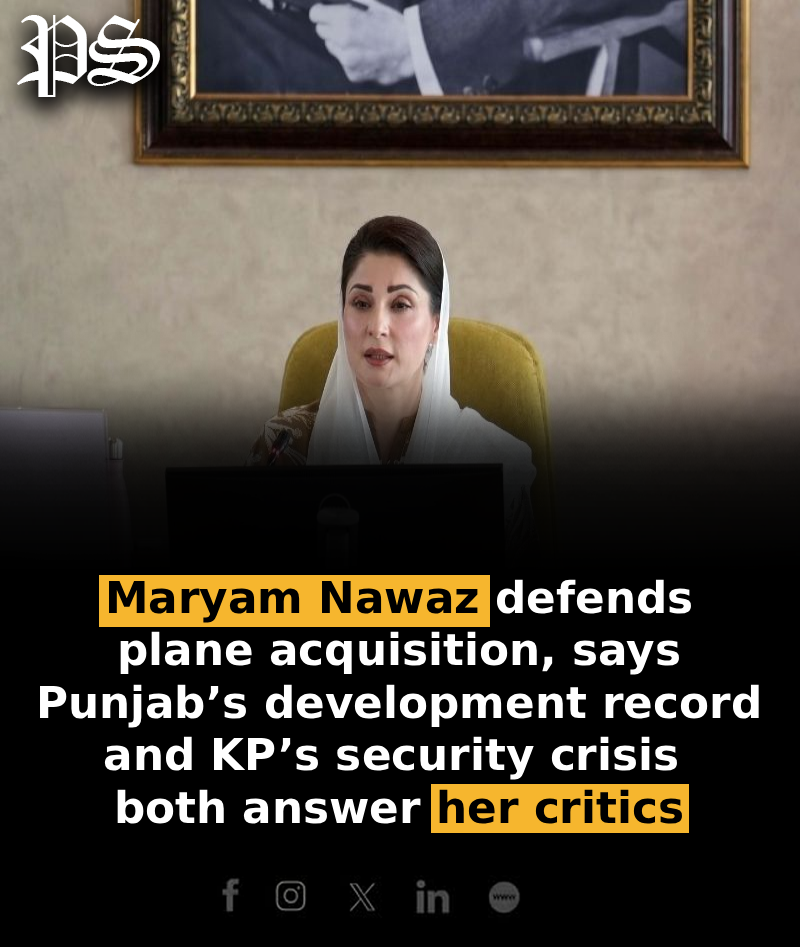
Chief Minister Punjab Maryam Nawaz Sharif defended her government’s acquisition of an aircraft amid sustained media criticism, arguing that the province’s development record speaks for itself, while separately warning that weak governance, not the performance of security forces, remains the real threat to defeating terrorism in Khyber Pakhtunkhwa (KP).
Addressing the criticism directly on Friday, CM Maryam said the aircraft attached to her office does not belong to her personally. “That is not my plane, it is Punjab’s plane. I will not take it to Raiwind with me, it will remain here,” she said, explaining that frequent travel across the province, including to remote districts such as Layyah, Bhakkar, Rajanpur and Dera Ghazi Khan, made air travel a practical necessity rather than a luxury.
She said she was aware that higher public visibility made her a bigger target for criticism and security threats, but said she was prepared to face it. “I am ready, I face those attacks, I know this is part of the whole package,” she said. She questioned why similar scrutiny was not applied elsewhere, alleging that other provincial governments had acquired more expensive aircraft and helicopters, citing a figure of around Rs16 billion for a helicopter purchased by another province, without facing comparable media attention, and separately questioned the source of funding for KP’s chief ministerial vehicle convoys, police escorts and ambulances.
She said no matter what her government accomplished, media coverage would reduce it to coverage of the aircraft. “You say I built 45,000 kilometres of road, they will say ‘plane,’” she said, arguing that criticism over the aircraft persisted because, in her view, opposing parties had no substantive governance record of their own. “They have no sanitation, no roads, no health, no education, no law and order — but Punjab has a plane,” she said.
Says governance failures, not security forces, are behind KP’s militancy crisis
Turning to the security situation in KP, CM Maryam said internal security, not the performance of the armed forces, was the real obstacle to defeating terrorism nationally. Addressing a leadership course attended by senior officials from the country’s scientific, nuclear and strategic institutions, she said external security was “taken care of” by Pakistan’s armed forces, pointing to the recent war with India as a source of national pride. The internal front, however, remained the country’s vulnerability, she said: “Unless governance improves… as long as the internal system keeps cracking, external security will remain under threat.”
She said terrorism should not be viewed through a provincial lens, “a terrorist is a terrorist, there is no classifying them”, while stressing goodwill toward Afghanistan as a Muslim neighbour, but said the state must draw a line when a neighbour uses its territory against Pakistan. She alleged that militants and “illegal occupants” targeted in operations in Punjab and parts of Sindh often flee into areas of weaker governance, including KP’s riverine “kacha” areas, to evade capture, contrasting this with what she described as Punjab’s comparatively controlled security situation under its counter-terrorism department (CTD).
CM Maryam also spoke of her own memories of KP, recalling childhood holidays in Kaghan and Naran, and expressed sorrow over the province’s current security situation, saying she felt deep grief over how security personnel and officers were being martyred in a province she once associated with its natural beauty. She also blamed a lack of policy continuity across governments, and said the 18th Amendment, while intended to devolve power to the provinces, had produced an unintended consequence of provinces operating with their own distinct political approach, as though each had become its own country.
Cites Punjab’s development record more broadly
CM Maryam pointed to a wide range of governance initiatives as evidence for her broader argument. On transport and infrastructure, she said Punjab had introduced fully electric, not hybrid, green buses in districts including Layyah, Bhakkar, Rajanpur, Chakwal, Pind Dadan Khan, Gujjar Khan, Chiniot and Toba Tek Singh, alongside province-wide electric charging infrastructure, and had built 40,000 to 45,000 kilometres of road over two and a half years. She said the province had also invested heavily in underground water storage and reservoirs to address ageing drainage systems, improving urban flood response so that areas once submerged for up to two weeks now cleared within roughly two hours.
She cited the “Maryam ki Dastak” doorstep document-delivery scheme, which she said had completed 4.3 million deliveries, and said the province’s Ramzan relief package of Rs10,000 was delivered directly to low-income households. “This is the governance I believe in,” she said. She also pointed to a province-wide socio-economic registry covering every household, a housing scheme under which roughly 130,000 homes had been completed and 100,000 more were under construction, the Suthra Punjab waste-management programme employing 200,000 people, decentralisation of water and sanitation authorities to every district, and third-year improvements in smog levels.
On education, she said Punjab operates around 50,000 schools serving millions of students, with a focus on missing classroom infrastructure, computer labs, and AI instruction introduced from grade one onward. She said the Honhaar Scholarship programme had funded the full education of hundreds of thousands of students from low-income households, and said recruitment across her government was strictly merit-based, with no exceptions for recommendations from assembly members or relatives. “Whoever comes recommended, I put a red cross against their name,” she said.
On women’s safety and representation, she said Punjab had appointed its first-ever women commissioners, deputy commissioners, police officers and departmental secretaries without gender-based quotas, and cited a virtual women’s police station initiative that she said had resolved several hundred thousand cases, including domestic violence reports, without requiring women to visit a police station in person. She also cited the province’s emergency flood response last year, saying camps, food, shelter and medical care were provided to five million displaced people.
PAK SOUCH MEDIA GROUP
Daily Pak Souch Newspaper Sukkur – Daily Pak Special Newspaper Karachi – Daily Pak Today Newspaper Karachi – Daily Pak Jazbo Newspaper Sukkur
Head Office : Ayub Gate Shaikh Muhalla Near Rabbania Masjid Sukkur
Karachi Office : Office No. 1901-B, 19th Floor Saima Trade Tower (B) Block I.I Chandigarh Road Near Jung Press, Shaheen Complex & National Museum of Pakistan Karachi Sindh Pakistan.
Contact : 03009319022
Website 1 : https://paksouch.com/
Website 2 : https://sindhi.paksouch.com/
Website 3 : https://pakjazbo.com/
Website 4 : https://urdu.pakjazbo.com/
About The Author