

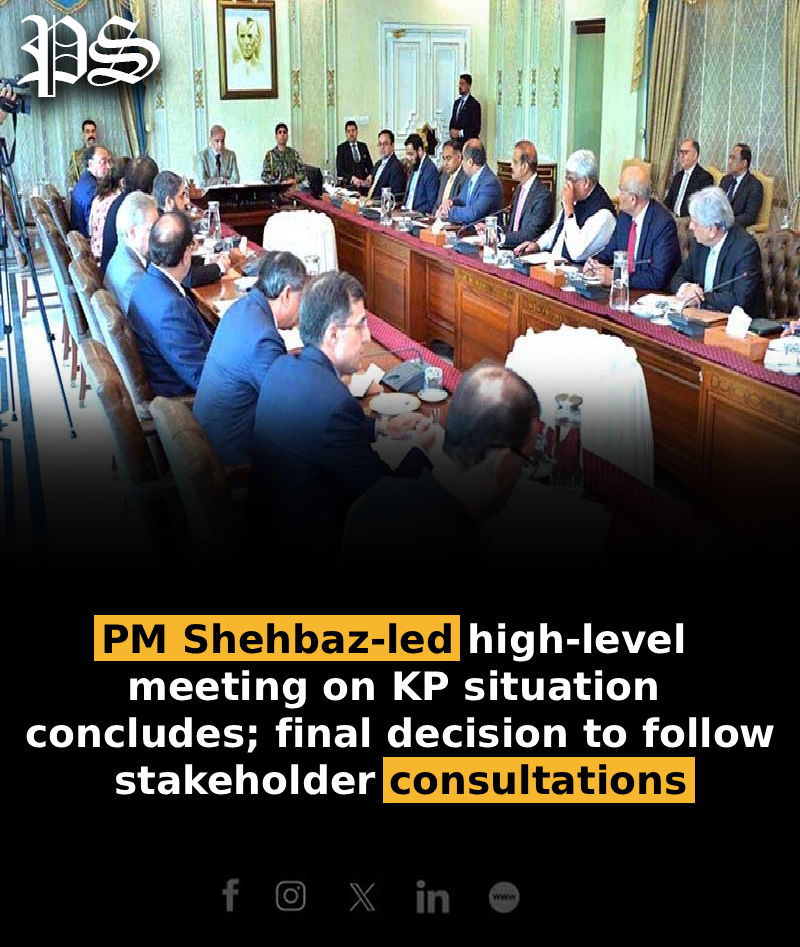
ISLAMABAD: A high-level meeting chaired by Prime Minister Shehbaz Sharif to review the situation in Khyber Pakhtunkhwa (KP) has concluded, according to sources.
Deputy Prime Minister and Foreign Minister Ishaq Dar, Interior Minister Mohsin Naqvi, Law Minister Azam Nazeer Tarar and Rana Sanaullah attended the meeting, during which participants discussed the province’s security situation as well as constitutional and legal options.
Tarar briefed the meeting on legal matters concerning KP, while the participants reviewed possible measures to address the situation in the province, sources said.
Constitutional and legal matters concerning KP are expected to remain a key part of the agenda, sources said. The ongoing consultations followed public speculation that the federal government could invoke emergency provisions or impose governor’s rule in KP.
According to sources, PM Shehbaz was briefed that the provincial government had failed to maintain law and order in the province. The premier expressed concern over the prevailing security situation and directed that all stakeholders be taken into confidence before any final decision is made regarding KP.
Federal consultations over KP situation
The federal government’s latest consultations on the situation in KP come amid growing tensions between Islamabad and the PTI-led provincial government over security, governance and the party’s planned October 4 march on the federal capital.
PM Shehbaz had earlier chaired a high-level meeting with senior ministers to review the situation in KP and consider possible constitutional and legal responses. Interior Minister Mohsin Naqvi briefed the prime minister on the law and order situation, while Law Minister Azam Nazeer Tarar provided input on constitutional and legal matters concerning the province, according to sources.
The meeting also covered backchannel contacts with PTI leaders and different legal options for dealing with the situation. Sources said the prime minister decided that relevant stakeholders would be taken into confidence before any decision was made and was expected to consult President Asif Ali Zardari as well.
Government denies immediate move on Governor’s Rule
Law Minister Azam Nazeer Tarar later said a high-level meeting at Parliament House was a routine consultation held ahead of the National Assembly session and was not linked to either measure.
“This meeting had nothing to do with governor’s rule or emergency,” Tarar told reporters, adding that such meetings were regularly held before parliamentary sessions and that coalition partner PPP was also consulted on legislative matters.
Tarar nevertheless maintained that extraordinary constitutional measures could be considered if circumstances warranted and the relevant constitutional requirements were met. He stressed that any such decision would be taken by the president or prime minister rather than by individual ministers.
Security situation fuels debate
The federal government’s concerns have largely centred on the deteriorating security situation in KP. Federal ministers have accused the provincial administration of failing to adequately address terrorism and questioned how resources allocated for counterterrorism have been utilised.
The criticism intensified following several deadly attacks. A September 18 attack near the old Police Lines in Kohat killed at least 21 people, including 15 police personnel, while more than 100 others were injured. On September 26, an explosives-laden vehicle targeted a checkpoint in Dera Ismail Khan’s Darazinda area, with a subsequent FIR putting the death toll at 14 and the number of injured at 35. Three traffic policemen were also killed in an attack on a police vehicle in Tank on September 28, according to police.
The federal government has also linked the security situation to tensions with Afghanistan, accusing the Afghan Taliban authorities of allowing militant groups to operate from their territory. Kabul has rejected the allegations.
PTI rejects federal allegations
The PTI-led KP government has rejected accusations that it has failed to tackle terrorism, arguing that the province’s police, citizens and political workers have themselves suffered significant casualties.
KP Chief Minister Sohail Afridi has called for a new counterterrorism strategy involving the provincial government, administration and police. He said his government had redirected Rs35 billion from development spending to the police and claimed that allocations for the force had been increased substantially.
The PTI has also maintained that its October 4 march on Islamabad will be peaceful. Party leaders have said their demands include access to jailed PTI founder Imran Khan and provision of medical treatment.
Difference between emergency and governor’s rule
The debate has also brought two separate constitutional mechanisms into focus: emergency under Article 232 and failure of constitutional machinery under Article 234, commonly referred to as Governor’s Rule.
Article 232 allows the president to proclaim an emergency where a grave situation involving war, external aggression or an internal disturbance beyond the provincial government’s ability to control threatens the security of Pakistan or a part of it. For an emergency based on internal disturbance, the Constitution requires a resolution from the relevant provincial assembly, subject to the provisions governing a presidential proclamation made without such a resolution.
Article 234 applies where the president, after receiving a report from the provincial governor, is satisfied that the provincial government cannot be carried on in accordance with the Constitution. It allows the president to assume certain provincial functions or direct the governor to exercise them on the president’s behalf. It can also allow the powers of the provincial assembly to be exercised by or under the authority of Parliament.
Both mechanisms contain parliamentary oversight and time limits. An Article 232 emergency normally requires parliamentary approval to continue beyond its initial period, while an Article 234 proclamation requires approval for continuation beyond two months and cannot remain in force indefinitely.
The constitutional distinction is therefore significant as the federal government weighs its options. While Article 232 is linked to an extraordinary security emergency, Article 234 concerns a breakdown in the constitutional functioning of a provincial government.
For now, the government has not announced any final decision regarding either measure, with consultations continuing among senior officials and political stakeholders.
PAK SOUCH MEDIA GROUP
Daily Pak Souch Newspaper Sukkur – Daily Pak Special Newspaper Karachi – Daily Pak Today Newspaper Karachi – Daily Pak Jazbo Newspaper Sukkur
Head Office : Ayub Gate Shaikh Muhalla Near Rabbania Masjid Sukkur
Karachi Office : Office No. 1901-B, 19th Floor Saima Trade Tower (B) Block I.I Chandigarh Road Near Jung Press, Shaheen Complex & National Museum of Pakistan Karachi Sindh Pakistan.
Contact : 03009319022
Website 1 : https://paksouch.com/
Website 2 : https://sindhi.paksouch.com/
Website 3 : https://pakjazbo.com/
Website 4 : https://urdu.pakjazbo.com/
About The Author