

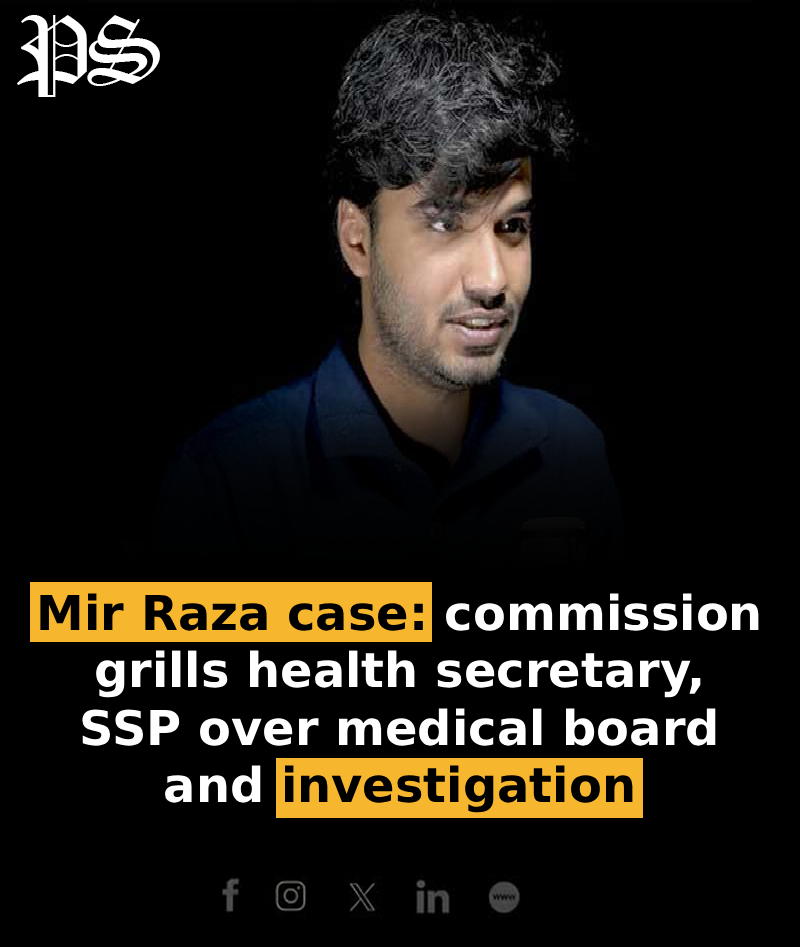
KARACHI: The judicial commission probing the murder of Mir Raza on Thursday grilled Sindh Health Secretary Tahir Sangi and SSP Samiullah Soomro over the replacement of a medical board and alleged shortcomings in the investigation into the death of young businessman.
The judicial commission head Justice Omar Sial questioned the officials over their decisions and conduct during the hearing.
The commission conducted its 11th hearing in Karachi, with Sangi appearing first as a witness.
At the outset, the commission asked the health secretary about his professional background and said his name had been mentioned by two witnesses, prompting the commission to summon him.
Sangi told the commission that he had worked in various departments in Punjab and Sindh.
The commission asked whether Dr Osama Sheikh worked under him, to which Sangi replied in the affirmative.
Justice Omar Sial remarked that Dr Osama had been repeatedly making people controversial and questioned why the health secretary had not sought an explanation from him.
“You should ask him what he has been doing. This behaviour is not appropriate,” the commission head remarked.
Health secretary questioned over medical board
The commission questioned Sangi about the legal basis under which a medical board is constituted.
When Sangi said medical boards were formed when ordered by a court, Justice Sial expressed displeasure and asked whether the health secretary was trying to shift responsibility onto the court.
“We can say that you do not know the law,” the commission head remarked.
Sangi then told the commission that he had received a letter stating that a judicial magistrate had directed that the medical board be changed.
Justice Sial asked him to produce the letter, which Sangi subsequently submitted to the commission.
According to Sangi, the letter stated that the board constituted by the police surgeon should include senior pathologists and forensic experts.
The commission pointed out that the letter also required the board to be constituted under the supervision of the police surgeon and asked whether Sangi had overlooked that point.
“You realise what you have done?” Justice Sial asked.
Sangi said he had been informed that the director general health and police surgeon dealt with the matter. He added that he had suggested including senior doctors so that there would be no question about only “preferred” people being included on the board.
The commission then asked whether Sangi was aware that a new medical board had subsequently been constituted overnight.
“I neither opposed it nor supported it,” Sangi replied.
Justice Sial pressed him for a direct answer and asked whether he knew about the formation of the new board.
“Yes, it was in my knowledge and I was on board,” Sangi said.
The commission head then remarked that this was why bureaucrats were summoned to the National Accountability Bureau (NAB) and other forums to answer questions.
Justice Sial questioned why doctors from Karachi had been removed from the board and doctors from Hyderabad included instead.
“Were you not surprised? Did you not ask any questions?” the commission asked.
The commission also pointed out that the law required doctors from nearby areas to be included in a medical board.
Sangi replied that he did not know any of the Hyderabad doctors who had been included in the new board.
Justice Sial questioned whether including doctors from Hyderabad made the case and the medical board itself suspicious.
The commission head then remarked that Special Secretary Health and Sangi were responsible for the change in the medical board and asked the health secretary to explain why it had been done and whether there had been any pressure on him.
Sangi said the matter was being discussed in the media and the family had also not been satisfied with the earlier board, prompting the authorities to replace it.
The commission asked him to explain why the board had been changed and whether he had been under pressure.
When asked whether he normally worked until 11pm, Sangi said this happened occasionally in important matters.
Justice Sial then questioned how the inclusion of a doctor with only two or three years of experience could ensure a credible report when another member was a senior doctor.
The commission repeatedly asked Sangi to provide an example of such a procedure having been followed previously.
Sangi eventually said he was sorry and asked that his statement be included in the record.
SSP questioned over investigation
The commission then recorded the statement of SSP Samiullah Soomro, who told the hearing that the basic responsibility of a sub-inspector investigation officer was to investigate criminal cases.
The commission asked who was involved in the investigation along with him. Soomro said Zubair Nazir Sheikh and others were working with him, while investigation officers Shabbir Laghari and Arshad Javed were also involved.
He confirmed that Usman Saduzai had been in Azad Jammu and Kashmir from Augusdt 1 to Aug 9.
The commission asked whether it was normal for several officers to be involved in such cases, and Soomro replied in the affirmative.
Family statements not recorded
Justice Sial questioned why statements from Mir Raza’s family had not been recorded.
Soomro said that on Monday he had asked Zubair Nazir Sheikh to contact Mir Raza’s father, but the father refused to meet them.
He said he subsequently met the family on August 3.
The commission pressed him on why the family’s statements had not been formally recorded.
When asked whether he had questioned the investigation team about the failure to record their statements, Soomro replied that he had not.
The commission then asked how he had concluded that the death was a suicide if the family’s statements had not been recorded.
Soomro said Mir Raza’s father had declined to provide details when he spoke to him.
Justice Sial also questioned why Soomro had spoken to the media and described the incident as suicide while the investigation was still at an early stage.
Soomro said he had repeatedly tried to avoid speaking to the media, but after the family did not cooperate, he eventually spoke to Dawn News.
The commission questioned whether he did not think the investigation was still in its initial stages when he made such statements.
Soomro replied that he had been asked questions and had said it “could be” suicide, rather than declaring that it was suicide.
He said statements of Haitham, Ahmed and Raziq were recorded on Aug 3 and the crime scene was also visited.
Commission questions limited CCTV collection
The commission then questioned Soomro about the collection of CCTV footage.
Justice Sial asked how many cameras were located on the routes leading towards Karachi University and whether the investigation team had identified all possible access points.
Soomro said CCTV footage had been obtained from the area where the body was found, including footage from outside a marriage hall, but he could not recall the exact name of the location.
The commission questioned why the investigation team had not collected footage from other relevant locations.
Justice Sial pointed out that there were around 52 cameras but the investigators had obtained footage from only one.
The commission asked why, as the head of the investigation, Soomro had not ensured that footage from other cameras was collected.
“You were the head. Why did you put the responsibility on someone else? This is your mistake. Accept it,” the commission remarked.
The commission directed Soomro to provide CCTV footage from around 30 cameras along with the relevant memos and seizure documents.
At one point, the commission warned the SSP against giving evasive answers.
“You are an SSP; you can even go home from here without a pension. Your career is at stake,” Justice Sial remarked.
Mir Raza’s mobile phone under scrutiny
The commission also questioned Soomro about CCTV footage showing Mir Raza throwing his mobile phone.
Justice Sial asked whether someone subsequently picked up the phone and why investigators had not pursued that lead.
Soomro said he had asked the investigation officer, who told him that he had not seen the footage.
The commission asked whether Soomro knew of a person named Sajjad who allegedly picked up the phone.
Soomro said he had interviewed a BRT employee but had not recorded his statement.
The commission asked whether the investigation officer had recorded Sajjad’s statement. Soomro said he was not aware of such a statement.
The commission further questioned claims that Sajjad had found the phone in a drain and that this information had subsequently been shared with the media.
Soomro said there were many rumours circulating in the media at the time.
Justice Sial questioned why the police had not issued a statement clarifying the facts if media reports were inaccurate.
The commission also asked whether Soomro had recorded the statement of Faisal Rahim. He replied that he had not and said he believed the person might have worked under the SSP East.
Mobile phone sent to CTD
Soomro told the commission that Mir Raza’s mobile phone had been sent to the Counter Terrorism Department (CTD).
Justice Sial asked whether he had evidence proving that the phone had actually been transferred to the CTD.
Soomro said the police had statements from the people who sent and received the phone.
The commission also questioned whether police officials had attempted to unlock the phone using a password.
Soomro said they had not done so and that the CTD had handled the matter.
The commission expressed strong displeasure over the handling of the phone and questioned Soomro about the apparent lack of control over the investigation.
Smartwatch and pistol cover
Justice Sial also questioned Soomro about a smartwatch reportedly mentioned by Adil Afzal.
Soomro said he had neither seen nor recovered the smartwatch.
The commission asked why no action had been taken against subordinate officers over what it described as negligence and carelessness.
Justice Sial sharply criticised the investigation and questioned why Soomro and investigation officer Shabbir Laghari had not ensured that relevant evidence was properly secured and examined.
The commission also asked about a pistol cover recovered on July 31.
Soomro confirmed that the cover had been recovered and said it had been found hanging at another location.
Justice Sial questioned why this had not prompted investigators to determine who had placed it there and who might have seen it.
The commission expressed serious reservations about the quality of the investigation.
Crime scene allegedly damaged
Soomro told the commission that on Aug 6 they received information about a fire at the location where the body had been found and investigated the incident.
Justice Sial referred to the destruction of crime scenes in previous high-profile cases and questioned how the Mir Raza crime scene had also been allowed to be damaged.
The commission head told Soomro that the investigation had effectively compromised the entire case and said the SSP himself appeared to be responsible for the failures.
When asked who ordered the location to be burned, Soomro said he did not know and had not issued any such order.
The commission pressed him to name the person who had ordered it, but Soomro said he did not know.
Justice Sial then questioned whether Soomro had realised how the investigation officers had been appointed and how the investigation was being conducted despite the facts and evidence available to them.
The commission noted that investigation officer Shabbir Laghari had stated that only 10 of 33 witnesses had been interviewed.
Justice Sial expressed concern over the consequences of such investigative practices, saying ordinary people could suffer if police investigations were conducted in this manner.
The commission head further remarked that the failures appeared deliberate and that Soomro seemed to be under pressure.
The hearing was subsequently adjourned for a 15-minute break.
PAK SOUCH MEDIA GROUP
Daily Pak Souch Newspaper Sukkur – Daily Pak Special Newspaper Karachi – Daily Pak Today Newspaper Karachi – Daily Pak Jazbo Newspaper Sukkur
Head Office : Ayub Gate Shaikh Muhalla Near Rabbania Masjid Sukkur
Karachi Office : Office No. 1901-B, 19th Floor Saima Trade Tower (B) Block I.I Chandigarh Road Near Jung Press, Shaheen Complex & National Museum of Pakistan Karachi Sindh Pakistan.
Contact : 03009319022
Website 1 : https://paksouch.com/
Website 2 : https://sindhi.paksouch.com/
Website 3 : https://pakjazbo.com/
Website 4 : https://urdu.pakjazbo.com/
About The Author